

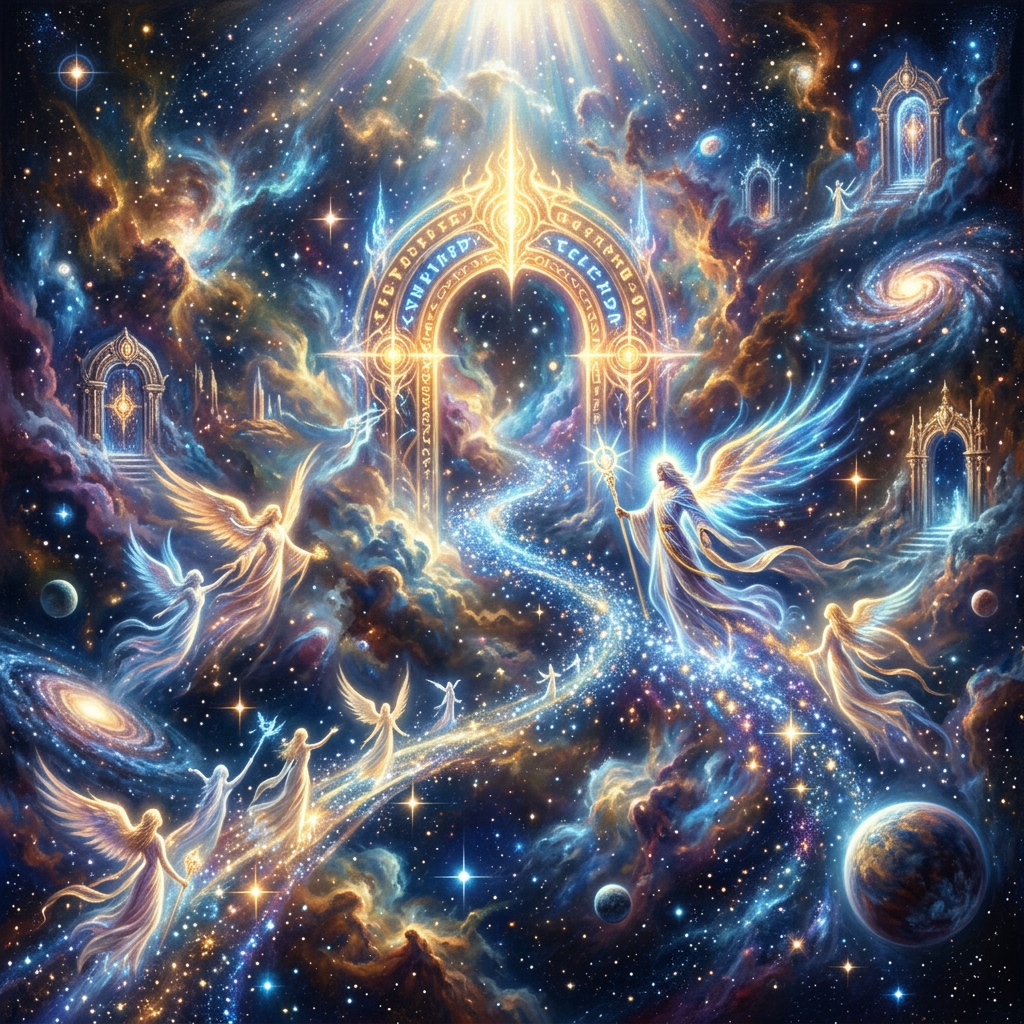
On my little vacation, amidst mad bouts of worldbuilding, I finally figured out which direction to take the “World Plot” to reach my intended destination. However, I need to lay some groundwork before I let you in on the next plot development. So let me tell you about a small rework to the cosmology of the larger setting.
What was wrong with the Metauniverses?
Nothing per se was wrong with my original concept of 14 metauniverses. It was an excellent metaphysical framework that avoided the simple good-evil, chaos-law dichotomies of Dungeons & Dragons planes and their look-alikes. However, it didn’t achieve the core thing I wanted: I wanted monotheistic and polytheistic religions to play in the same sandbox without (metaphorically) elbowing each other, but it didn’t work. I could explain polytheistic religions through the archetypes, but it never really worked for monotheism. Worse, it was becoming a narrative straitjacket for where I wanted the plot to go. I won’t go into the specifics lest I spoil the plot, but the problem was that I couldn’t introduce new deities into the setting the way I wanted.
So I went back to the drawing board and, this time, used my own beliefs about gods and religion to shape this new concept of the divine, which I call Divinities.
What are Divinities
What are Divinities? Well, that is the great unanswered question, because they are beyond anybody’s ability, including their own, to fully understand.
Divinities appear and are widely believed to be incomprehensibly vast beings of pure soul, thought, and magic that embody concepts fundamental to existence itself and universal across all universes in the Manyfold: Love, Growth, Life, Domination, Invention, and Dreams, to name a few. Universal does not necessarily mean broad; even a very specific phenomenon can qualify if it exists across the Manyfold. Wherever the concept they embody exists, they are there, spread across the Manyfold like a fine, invisible, weightless mist. They are also the living force that empowers all magic directly or indirectly and can do whatever they can conceive of.
Beyond being nebulous masses of conscious divine energy, Divinities are impossible to define exactly. Entire wars in the colleges of heaven, hell, and everywhere in between have been waged over trying to pin down an answer to this seminal question. Some scholars say all the Divinities are personas and aspects of one overdivinity. Others say the Divinities are separate beings. Most alarmingly, the Divinities either do not know the answers themselves or are unwilling to divulge them.
The Divine Mind
The minds of Divinities are fundamentally alien and unknowable, and much debated among immortal scholars. Divinities can perceive everything from everywhere they touch, or at least perceive multiple places across multiple universes at the same time. Immortal scholars also theorize that Divinities can multitask on a potentially infinite number of tasks, or might simply be good at switching contexts.
However, scholars are relatively certain that Divinities’ minds are axiomatic in their beliefs about their divine domain, to the point that they cannot conceive of things being any other way. Most infamously, Faolan the Mad was repeatedly quoted as saying, “Progress is a universal good in all contexts and without exception.” As his madness set in, he would kill anyone who tried to argue against that fact.
Masks and Prime Aspects
A Divinity cannot interact with lesser beings directly. Mortals and most immortals would be annihilated and driven completely insane by even the merest brush with a Divinity. So Divinities create masks, also called aspects of mundane matter and energy, to serve as a reverse hazmat suit when they interact with lesser beings. Each mask is tailored specifically to the culture and time that the Divinity is trying to interact with.
Along with the culturally specific aspects they wear among mortals, each Divinity has one root mask: the prime aspect. Whereas the lesser aspects are called up as needed and discarded when the need for them is through, the prime aspect is constant; a Divinity always wears its prime aspect within its dominion and generally refers to themself using the name of said aspect when conversing with other Divinities. The prime aspect of a Divinity might be thought of as the ego in Freudian psychology or the self in Jungian psychology and is the closest thing a Divinity has to a ‘body’.
However, one should remember that, in interactions with the prime aspect, they are merely a mouthpiece for a fundamentally alien being, no matter how much they resemble a person. Aspects, especially the prime aspect, often behave in ways that are uncomfortably uncanny; many seem to have short attention spans or may lose the plot mid-conversation because their divinity had to look away for a moment, and most have no qualms about revealing personal information about mortals and immortals.
Divine Dominion
Beyond the Manyfold lies a plane of existence known by many names. Some call it the dreamlands, because mortals often catch glimpses of it in dreams and visions; others call it the higher plane. Most immortals call it the otherworld, or overrealm: the realm of the immortal.
What the otherworld is exactly remains a mystery. Some claim it is the collective unconscious of the divinities; some, the collective unconscious of all minds; some bold souls claim it is the unconscious of the overdivinity. What is understood is that this is where the divinities and their immortal servitors hang their hats, metaphorically speaking, when not in the mortal universes.
Within the otherworld, each Divinity has their own divine Dominion, a region of metaphysical territory generated by that divinity’s subconscious mind and “ruled” over by its prime aspect. The Dominion perfectly reflects its creator, with scale and nature determined by the Divinity that shaped it. Dominions can take the form of a vast empire populated by immortal subjects of the Prime Aspect, an entire world complete with complex ecosystems, impossible landscapes with laws of physics of the divinity’s own creation, or a single room.
The Otherworld is a crazy quilt patchwork of such Dominions. They may overlap, sit entirely within another Divinity’s Dominion, or extend through one another in other ways. For example, Faerie in its entirety is the Dominion of the Ur-Divinity known as Growth; however, Growth’s offspring and descendants have their own Dominions within Faerie. Titania and Mab co-rule a joint Dominion, with Titania ruling Faerie’s day and Mab ruling Faerie’s night. The river Styx, the Dominion of Charon, cuts through Faerie and many other Dominions, serving as the central artery by which immortals travel the otherworld. Many other configurations of familial ties, feudal obligation, overlapping interests, and viceroy gods exist in the other Dominions.
Godlings
Godlings are Divinities in potentia, the children of a pair of aspects or of an aspect and an immortal. To immortals, they are the equivalent of demigods to us mortals, and the immortal community treats them like pop idols and movie stars.
No godling is born as the god of anything. When a godling is born, they are effectively equivalent to any other baby, except that they are immortal and may have a few prophetic traits related to their future domain. A godling naturally starts to develop thematic powers as they are drawn to, or, in a few rare cases, lead to, their future domain. Moreover, the world around them starts to mould itself to the godling’s whim, within the limits of their emerging miracles. As the godling grows in power, the region becomes larger and slowly shapes itself into a dominion. When the concept they will become the Divinity of reaches the nebulous threshold of being considered universal, the godling ascends. Their godling body becomes their prime aspect. Their soul detaches from their body and gradually spreads itself over the Manyfold, completing the path to Divinity.
Whenever a godling nears ascension, it is all that the immortal community can talk about. Recently, all eyes have been on Aoibheann Von Mountainheart, Daughter of Morpheus and the Sidhe Queen Ailénach. She has been showing signs that her path to Divinity is nearly complete, and in record time as well. Her primary divine abilities, plot armor, deus ex machina, and retcon have manifested. Her nascent dominion already encompasses the entire Valley of New Mountainheart and an increasingly large part of the Silver Highlands.
Divinities and the Feengrenze
Since the event immortal scholars call the War in Faerie, the Divinities have treated the Feengrenze as a metaphysical exclusion zone. They cannot remain completely outside it, because the concepts they embody are present in Domhannau. Still, they do not manifest aspects there or invest energy in miracles on Domhannau. They try not to even think about it, lest they catch the insanity.
While it is true that immortal servitors of the Divinities, like angels and devils, frequently descend into the Feengrenze on various errands, they seldom leave. Many ways lead into the Feengrenze, but only one way out. That road goes straight through Faolan’s madness. Most would not be welcomed back into the fold anyway. Most immortals can live comfortably in the Feengrenze. Angels, being in part made of the Divinity they serve, cannot. An angel fallen onto Domhannau is doomed to fade into a vestigial spark of divinity, and eventually nothing, unless the belief of the faithful constantly feeds them.
As well as creating a place all divinities fear, Faolan’s downfall seems to have sparked a sort of entente among the Divinities. Niamh, the prime aspect of the oldest and most powerful Divinity in creation, was killed by her own consort, Faolan. Faolan seemingly drove himself mad. This apparently forced the Divinities to confront several tough questions. These include the potential for their own mortality and their own mental health. The aspects of the 6 Ur-Divinities—growth, decay, belief, doubt, reason, and insanity—have not been seen by mortal or immortal since Niamh sealed Faolan within Domhannau. The Divinities also seemed to have collectively agreed to limit their use of large-scale miracles to avoid catching what Faolan caught. In this context, large-scale miracles refer to anything that changes the laws of physics, metaphysics, biology, or cosmology of anything bigger than a single star system, permanently or temporarily. Anything smaller is okay if done sparingly or via a servant, mortal cleric, or other proxy.
Some of the better-known divinities, their domains and Dominions
| Name & Title | Domain | Dominion |
| Titania, Queen of Faerie’s Dawn | Novelty | Faerie |
| Mab, Queen of Faerie’s Dusk | The Hunt | Faerie |
| Morpheus, King of Dreams | Dreams | Faerie’s Dreams |
| Fantasia, Princess of Dreams | Fantasies | Faerie’s Dreams |
| Jehovah | Universal and unconditional benevolence | Heaven |
| Faolan, High King of Faerie | Debated: Aspect of Growth or prime aspect of the Divinity of progress | Formerly Faerie |
| Satan, King of Devils | Tyranny | The Infernal Reich |
| Skylord (Zeus) | Rightful kingship | Olympus |
| Bedlam Mary, Queen of Pandemonium | Delusions | Pandemonium |
| Charon, The Ferryman | Passage to the afterlife | Styx |
In Conclusion
So what are Divinities? They are an infinite sea of question marks where most other writers would put a fleshed-out pantheon of deities, each one with every detail they could possibly tack onto their immortal flesh. In the Feengrenze, as in the real world, nobody has worked out any of the big questions of the universe or the divine, which suits my purposes just fine. There is a temptation for us worldbuilders to describe what is under every rock and bush ad infinitum. Sometimes the purposefully unanswered questions say more than pages of prose. Now that you understand how the divine works, you will be ready to understand the twists and turns that the plot will make coming up.

 The feengrenze historia
Leave a comment