

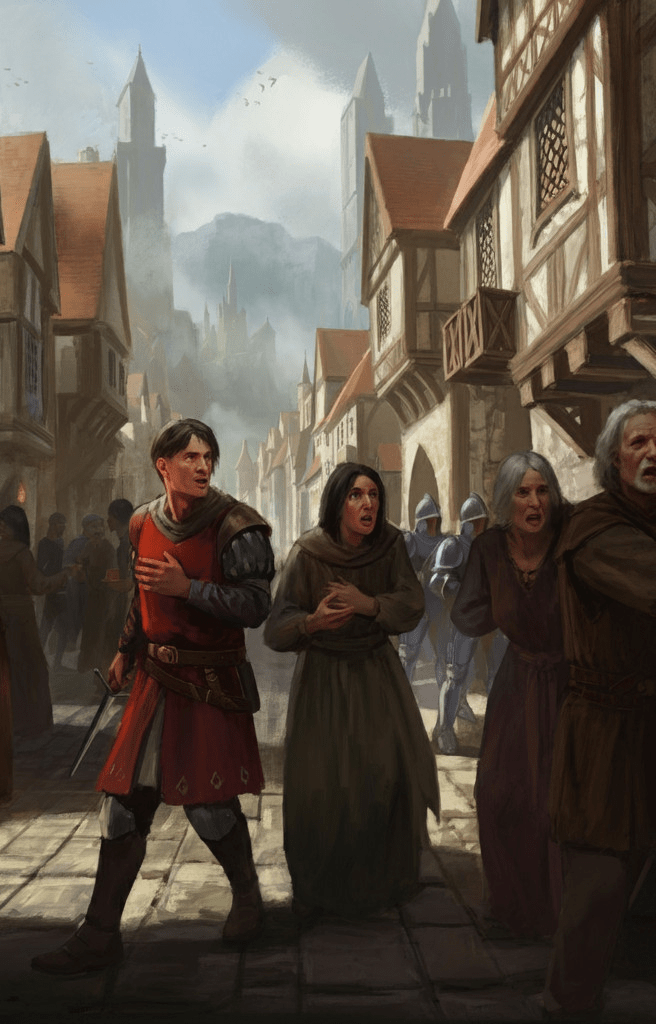
Sliberberg under occupation, generated with Google Imagen3
Designed for an adventuring party of 4 to 6 1st-level characters, this nonlinear player-driven DUNGEONS & DRAGONS adventure is set in Sliberberg, the largest city in the part of the Feyrealm known as the Feengrenze. This world sits on the border between the Feyrealm and the Material Plane, where both planes war for control over the world. By the end of the adventure, the players should be at the 8th level or higher.
Adventure Synopsis
Several months before the adventure begins, a coup led by the New Mountainheart’s High Marshal, Duke Murtagh Ó Ceallaigh, overthrew New Mountainheart’s perpetually depressed archfey ruler, King Fredrick Von Mountainheart. After securing his rule, the newly self-crowned King Murtagh started to invade the myriad small kingdoms surrounding the kingdom of New Mountainheart and transformed the capital city of Sliberberg into a police state with each of his 5 top commanders in charge a different ward of the city.
Escape from Ironhold
Chapter 1 starts in Ironhold, a massive gulag in an iron mine beneath the Sliber Berg. Each player has been accused of a crime against the state by the Murtagh or his 5 top commanders. As punishment, they were thrown into Ironhold and forced to mine for iron. While spending a few days in the deprivation of an isolation cell called the pit, a chance to escape presents itself. A Fairy and member of the Silver Moon Coven named Líadan slips into the pit and gives the players vague instructions about searching an abandoned and partially collapsed tunnel if they want to escape. The day afterward, the players are released from the pit and sent back to work in the mine. When the players slip away from the guards and search the shaft, they find a bag of holdings containing their starting gear, additional supplies, a crude map of the mine, and a map of the city with directions to a safe house. The players can either fight or sneak out of the mine; however, either strategy results in the same outcome; just as they leave the gates of Ironhold, they find their way blocked by a hobgoblin Royal Army officer and a handful of soldiers.
When they break into the city and go to the safe house, they find Líadan waiting there, who tells them their benefactor will be along in the morning. When the morning arrives, Tansy Fleetfoot, the local matron of the Coven of the Silver Moon, arrives with breakfast and terrible news. The hobgoblin officer they killed was Murtagh’s eldest and favorite son, Prince Eamon. Eamon was the only thing moderating Murtagh’s darker impulses, and with his death, Murtagh has finally become a full-fledged tyrant. Murtagh has put the city under martial law, established checkpoints at every city gate, and issued warrants for the player’s arrest; on top of that, he has ordered Admiral Kraggath and High Marshal Cathán to patrol the harbor and the countryside, respectively. Even if they were to somehow escape the city, it is doubtful Murtagh would ever stop his pursuit, and with New Mountainheart expanding rapidly, it is unlikely that the player would ever find a true safe haven. Their only choice is to dismantle Murtagh’s regime piece by piece.
Forming the Resistance
The players must form a resistance to stand any chance against Murtagh and his 5 top commanders. Chapter 2 provides the rules for stealthily moving through the city, dealing with alarms, commander awareness, and creating and using resistance.
Chapter 3 describes the various factions left in the city. This motley group of the last remaining public institutions, private citizens groups, rebels within the system, and criminal organizations can provide the players with additional resources to help take the fight to the regime.
Taking the Fight to the Regime
Chapter 4 describes various sidequests the players can undertake. Each has the potential to reward the players with vital resources and contacts or significantly hamper the regime’s efforts to stop the resistance.
Chapters 5-9 are dossiers on the 5 commanders operating in the city and their zones of operation. Having built a resistance, the players can tackle each commander in any order they like. Each chapter has information about the commander’s character, weaknesses, and routines that can be drip-fed to the players to allow them to develop plans to ambush the commander. The chapter also details the commander’s lair and other facilities that they frequent.
Chapter 10 details the final assault on Castle Sliberberg. With each of Murtagh’s top commanders dead and the Royal Army in a state of disorder, the time is right to deal with Murtagh himself. The players must devise a strategy to infiltrate Castle Sliberberg and fight Murtagh. It will be a challenging fight; he knows the players are coming and will do anything to prevent himself from being deposed.
Chapter 11 provides instructions for creating a satisfying ending to the adventure. With a nonlinear adventure like this, with dozens of NPCs and nine factions, it is almost impossible to make a one-size-fits-all ending to the narrative. Thus, it will be up to you, the dungeon master, to craft an impactful ending to your version of the Liberation of Sliberberg.
Adventure Background
In a forgotten corner of the multiverse at the very edge of the Feyrealm, there is a world betwixt and between. A nowhere world that hangs between the Material Plane and the Feyrealm like a rope used in a tug-of-war, the battleground of a never-ending war between mundanity and whimsy called the Feengrenze. Upon the surface of the Feengrenze, the Material Plane and the Feyrealm fight for control of the world, their struggle manifesting as swirling ball-shaped storms that tumble over the surface like a pair of siblings engaged in a never-ending wrestling match. These so-called whimwhirls leave carnage in their wake, time is tied into knots, space shatters, geography oozes like slime, climate unravels, and detritus of civilizations drawn into the maelstrom from other places beyond this tiny world is thrown far and wide across the landscape.
One would think that life and civilization would be impossible in such a world, but life is incredibly tenacious, and where there is a will, there is a way. For eons, people have been unwillingly marooned in this world by the whirlwhims and have built little kingdoms in places left relatively untouched by the chaos. In mountain valleys, hidden nooks in hills, and underground caves, little nations of dwarfs, elves, humans, goblinoids, and fey folk have emerged. These fragile little realms, often little more than a few villages, huddled around the walls of a mountain valley ruled by a scheming prince or minor archfey, beyond which lay the unpredictable wilderness known by all as the wilds. Of these little points of light, a few stand out as being greater than the rest. Nestled where the Silver Highlands meet the sea is the one such nation, New Mountainheart, home to the largest city in the Feengrenze, Sliberberg.
Murtagh and the Plot against King Fredrick
High Marshall Murtagh Ó Ceallaigh, the hobgoblin duke of Craggy Hills of the kingdom of New Mountainheart, never particularly liked his liege lord King Fredrick von Mountainheart. Born at a time when Fredrick had long since returned from his most recent fruitless expedition to locate his missing wife Aoibheann, he spent his entire career as Duke and High Marshall watching Fredrick sinking farther and farther into a depressed malaise of near constant pining and moping and forcing his advisors to rule in his stead. Forced to shoulder an ever-increasing amount of the work of running the kingdom, he started believing that he could do it better and, in secret, began to plan his coup.
About a year and a half ago, Murtagh was visited by archfey Fionnuala the Fair, the ruler of Loch Slanach and arguably the most powerful archfey in the Feengrenze. She sought to expand her domain and saw an opportunity in the ambitious duke and his scheme to overthrow King Fredrick. She offered him a deal; if Murtagh swore an eightfold vow of everlasting fealty to her and became her vassal, she would grant him the money and magical power needed to overthrow Fredrick and make New Mountainheart his own. He accepted, and over a year, he greatly expanded the Royal Army with mercenaries loyal to him.
The Fall of Sliberberg and the Rise of the Murtagh Regime
Murtagh launched his coup at the height of the Ostara festivities. While the city folk celebrated the return of spring, his mercenary troops swarmed out of the old castle and batteries on Carrey Head. They quickly overwhelmed the city watch and garrison and seized critical city structures. Fredrick has not been seen since that day.
However, things took a dark turn once Murtagh had claimed the throne. Fionnuala wasted no time in giving orders to her new vassal. To Murtagh’s horror, she ordered him to expand his realm by conquering five dozen nearby chiefdoms and petty kingdoms and gave him until the end of the year to do so. Instead of implementing his reforms, he has been forced to rule with an iron fist to meet his liege’s timetable. The strain of keeping up with Fionnuala’s demands and ruling the kingdom has steadily eroded his sanity, turning into what he wished to avoid, becoming a mad tyrant. Meanwhile, Sliberberg has been turned into a police state where Murtagh’s 5 top Lieutenants unleash petty cruelty in the name of their usurper king.
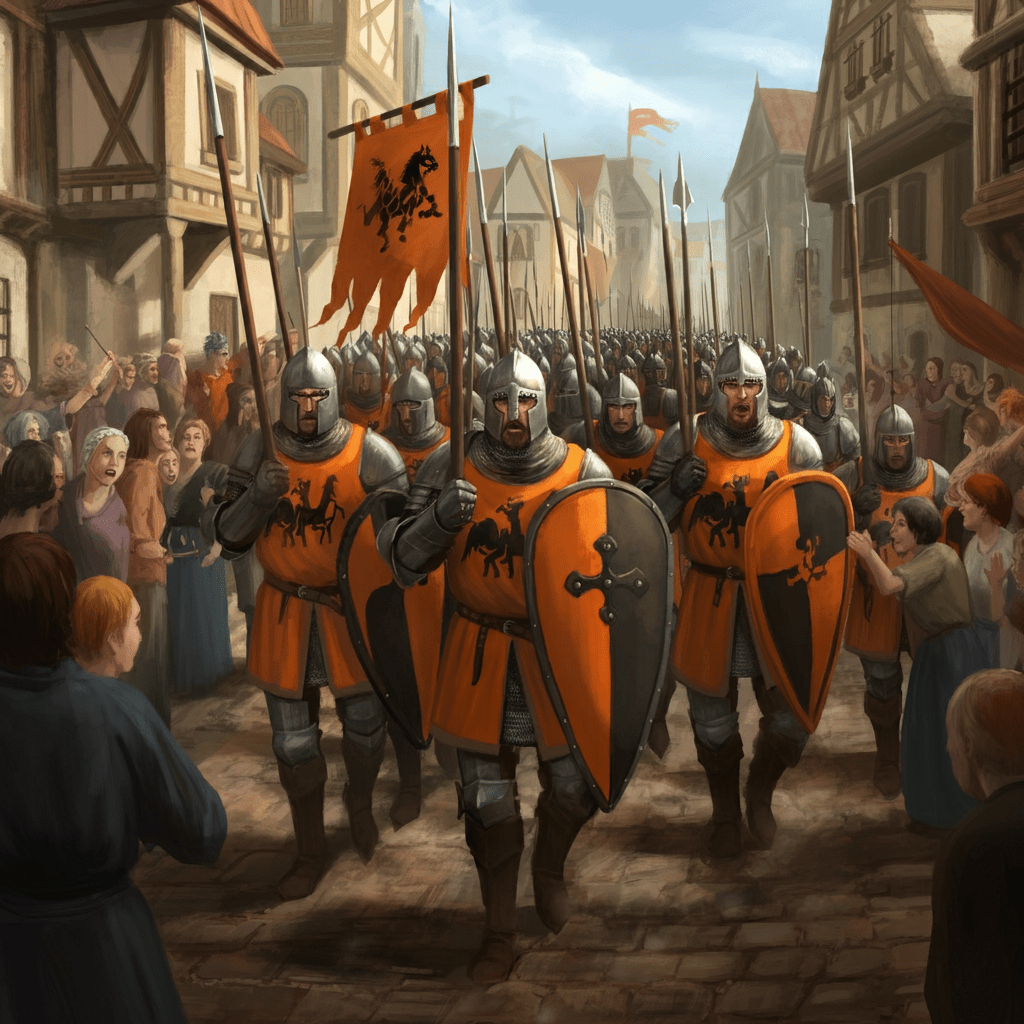
The regime’s soldiers making their way down the street, generated with Google Imagen3
Running the Adventure
The Liberation of Sliberberg is unlike most published adventures for DND. Once the players escape Ironhold, they are free to do whatever they want. They have a set of goals in the form of the 5 top commanders of Murtagh forces, but it is up to the players to determine how they achieve that goal, how long it takes to achieve their goals, and in what order. Moreover, the adventure encourages players to break the balance of the encounters and gives them the tools to do so through resistance and ample access to magic items. This understandably puts a lot of strain on the dungeon master, who will need to be able to improvise encounters and rebalance existing ones on the fly. Still, it also puts a lot of strain on the players because it will be up to them to figure out what to do, where to go, and how to deal with the challenging combat encounters the Murtagh’s forces consistently throws their way. This is not a recommended campaign for beginner Dungeon Masters or inexperienced players. However, if you, the dungeon master, have the experience to improvise whole sessions on the fly, and your players are quick-witted in combat or can roleplay their way out of a difficult battle, then maybe this campaign is for you.
What You Will Need
To run this adventure, you will need the 2024 Player’s Handbook, the 2024 Dungeon Master’s Guide, the 2014 Monster Manual, and Monsters of the Multiverse. Most of this adventure’s monster and NPC Stat blocks come from the 2014 Monster Manual. When an NPC or creature’s name appears bold, the stat block can be found in the Monster Manual or the Monsters of the Multiverse. NPCs and monsters found in the book’s appendix will instruct you to look up the stat block in the appendixes. Spells and equipment are described in the Player’s Handbook. Magic items are described in the Dungeon Master’s Guide unless the text specifies the item’s description is in Appendix C.
Dangerous Encounters
The players are underdog rebels in a city occupied by a brutal dictatorship actively searching for them. To reflect this, the encounters involving soldiers of the regime will be consistently moderate or difficult for an average party of 4 adventurers with dozens of enemy soldiers. Many of these encounters expect the players to either be backed up by a band of resistance fighters, use clever tactics or the environment to their advantage, or avoid contact if necessary. Be sure to communicate this to your players during your session zero. They cannot go charging headlong into every fight they encounter, and clever use of equipment, magic items, and the environment will be rewarded.
Deus Ex Machina
Even with the best-laid plans of both players and Dungeon Master, sometimes the dice are uncooperative, and the players get in over their heads. When a group of second-level players is tangling with multiple knights out on the streets or trapped in a location that is quickly being flooded with enemy soldiers due to the players setting off an alarm, do not be afraid to whip out a Deus Ex Machina. While it might be offputting to some players and Dungeon Masters to contrive a convenient escape from a situation, the adventure and the setting have been designed to give both players and Dungeon Masters ways to escape from hopeless situations.
On the player side, the player’s resistance is, by its very nature, a kind of Deus Ex Machina waiting to happen; if the players have spellcasters among their number or sending stones, a squad of reinforcements is just a sending away. There are also several magic items in Appendix C, such as reset bombs, the ring of the hearth, and the timepiece of returning, that allow the players to get out of sticky situations at the expense of resources the resistance desperately needs.
For Dungeon Master, you have even more options to naturally give the players a way out of a bad situation. The city is famous for the seemingly random magical phenomenon that happens daily; people turn into animals for several minutes while walking down the street, and gravity can randomly change direction, to name a few. It is an easy suspension of disbelief for a few enemies to transform into weasels mid-combat, or the players stumble upon Gearrthóg Street while fleeing a combat encounter. The players also have allies that can help them if they are over their heads. For example, if the players are friends with the drolls and have gotten themselves in a fight they cannot win, have a random pack of drolls stumble onto the scene and join the fight. If the players get into a fight in Slibermond and have done some favors for the Coláiste Draoidheil, some of the students from the college will start throwing magic missiles at Murtagh’s troops.
If the unthinkable does happen and the players experience a TPK, do not fret; contrive a means for the players to survive. Perhaps one of the allies among the factions or their resistance fighters dragged them off to be healed, and now the players are in that faction’s debt. Another possibility is that they will awake with one hit point in a holding cell in a watchhouse or in a dank cell in the City Jail. Murtagh has decreed that the players are to be captured alive so that he can have the pleasure of torturing them personally. It will be up to the players and their resistance to orchestrate their escape. Above all, ensure that the story continues after the player’s defeat.
Recommended Optional Rules
This adventure features multiple instances where the players are up against large groups of soldiers or the players and their resistance fighters attack an isolated group of Murtagh’s soldiers. In either case, it is suggested that you should use the Mob Rules described on page 82 of the 2024 Dungeon Masters Guide to keep combat moving at a brisk pace. Also, it is recommended that you use the optional morale rules on page 273 of the 2014 Dungeon Master’s guide to even out the player’s chances in the many challenging combat encounters featured in this adventure. You may also consider using the Reactive Tactics on page 117 of the 2024 Dungeon Masters Guide and the Prepared Defenders on page 118 of the same book if you choose to use the morale rules in your game to make the possibility of fleeing enemies more impactful to the story. Finally, be ready to roll on the individual treasure table on page 120, and the gemstone /art objects tables on pages 214 and 215 of the 2024 dungeon masters guide to create the loot on the bodies of defeated enemies in sidequests and random encounters.

A meeting of Resistace Fighters
Timers
This campaign makes extensive use of time-sensitive events and time pressure. Guard patrols move in predictable patterns, sidequests may hinge on players achieving a goal in time, Events may happen on regular schedules, and the villains’ plans might unfurl over days and weeks. To represent the time pressure on the players, this campaign makes extensive use of timers.
What is a Timer?
Roll a die before the players when an encounter, side quest, or situation calls for a timer. Under most circumstances, this will be a d4, but if need be, it can be a d6 or d8. Every time a round of combat, a turn of exploration, or some other discrete unit of time passes, tick the die down by one. When the die reaches zero, something will happen, which is usually not good for the players.
This book depicts timers in the following syntax: Timer D4: When the timer reaches zero, A guard patrol will arrive.
Exploration Turns
Several units of time are used throughout the campaign rounds in combat, turns in explorations, in-game minutes, days and hours, and game sessions. Of these, 4 units of time turns were explicitly created for this campaign. An exploration turn refers to the time a player takes to do one thing, make one skill check, rummage through one chest, etc. For the sake of simplicity, assume a turn takes about 2 minutes of in game time..
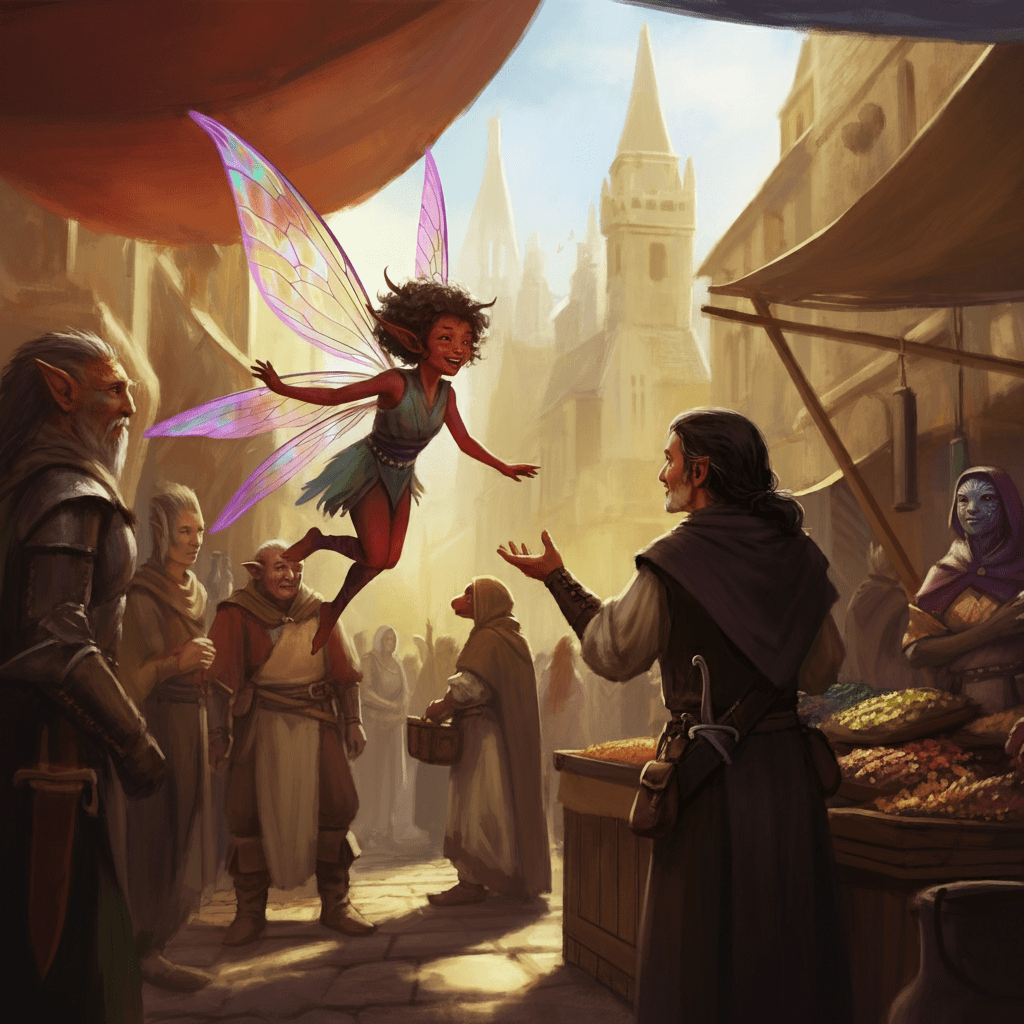
The fey loves to haggle, generated with Google Imagen3.
Roleplaying the Feyfolk
While not the campaign’s focus, you can elevate the player’s experience by roleplaying the fey folk of the city to act like the fey folk of myth and legend of our world. Although the fey folk of the kingdom generally try to make an effort to see things from the mortal perspective when dealing with mortals, they are still alien beings with alien views. This makes it tricky to roleplay feyfolk convincingly, but here are a few insights into the mindset of the fey.
Fey takes promises, oaths, and contracts seriously.
Of all the taboos among the feyfolk, breaking oaths and promises or renigging on a contract are the most unthinkable. Feyfolk always honors their debts and promises to the letter. The feyfolk intrinsically know that failing to do so will generally invite severe repercussions from either the injured party or the Feyrealm itself. When a fey breaks an oath or promise, show them panicking and worrying about what the other party in the pledge will do. If the players break a promise to fey, have them be visibly angry and demand some form of recompense or a new promise to be made to them.
The fey folk are literal-minded
The fey takes language at face value, interpreting words literally. When they ask for someone to lend them a hand, they will take your hand with a promise to return it later. Tell a fey to drop by any time, and they will likely show up at your door in the middle of the night. When coupled with their obsession with fulfilling their promises, obligations, and debts, they choose their words very carefully in speech. When roleplaying, the feyfolk have them misinterpret figures of speech and colloquialisms. When they make an oath or a promise, they use concrete language and overly formal legalize, especially when it turns the promise into a long, complicated word salad.
The Feyfolk cannot tell outright lies.
The fey cannot knowingly tell an outright falsehood through word or deed. When roleplaying a lying fey, have them lie by omission or weaving half-truths. If you’re feeling especially devious, have the lying character weave a complicated maze of words that technically tells the truth but leave the players utterly confused about what you said.
The feyfolk values beauty and intuition.
Morality and beauty are often intertwined in the mindset of the fey. However, the definition of beauty may differ between each fey, with the various fey courts valuing diffrent things all fey consider what is beautiful to them virtuous and what is ugly morally suspect. When roleplaying the feyfolk have them treat players who they consider beautiful as being righteous, regardless of what they actually do. Have feyfolk be taken aback when the players suggest a course of action that would reduce the “beauty” in the world or insist that doing something immoral that would make the world more beautiful is morally justifiable. When faced with a decision, go with your gut instinct as to how the character will react.
The fey folk are governed by their emotions.
The fey experience emotions on a much more visceral level than mortals. They tend to dance about when happy and sulk moodily when sad. However, this means the fey folk are easily insulted by seemingly innocuous things. If the offender does not apologize or provide compensation, a feud can form between the fey folk and the offender. When roleplaying, the fey exaggerate their emotions. Describe them jumping for joy when happy, going into a raw fury when angry, or sulking when sad.
Feyfolk society revolves around the numbers 8 and 3
In the Feengrenze, there are eight major festivals of the year; when they make oaths, fey often invoke the names of 8 powerful archfey, and there are eight schools of magic. Furthermore, they frequently repeat the same thing 3 times for emphasis, they will often request three favors for a service done, and they tend to gather in groups of three or not at all. Try to find ways to naturally integrate the numbers 3 and 8 into the behavior or speech of the fey folk.
The feyfolk are obsessed with Reciprocity.
The society of the fey operates on a complex system of quid pro quo. To the fey, any action, service, or gift must be balanced by something of equal value. However, something of equal value is much more subjective to the fey; things that hold personal significance, personal favors, and objects of beauty are things the fey generally consider more valuable to the fey than gold and silver. A handmade trinket or a heartfelt performance of a song the player wrote would be viewed as a much more valuable gift than a purse filled with coins. When roleplaying the fey, have them insist on paying the players back for any service provided or gift given to them. When a feyfolk gives a gift or service to the players, have them insist on playing them back later.
Unique Fey
Four unique fey species call the Feengrenze their home: the pooka, the Knockenvolk, the Selkies, and the Clockfolk. These races are rarely seen outside the Feengrenze, and they all have at least a token presence in the city.
The pooka
The pooka are a race descended from the survivors of the drowning of Mountainheart. The powerful whimwhirl unleashed into the mortal realm transformed the survivors into new species. They are short, mild-mannered people who resemble small mammals like mice, ferrets, and rabbits. Pooka are known for their supernatural abilities in forestry, farming, and animal husbandry. The pooka are only found within New Mountainheart in the Duchy of Sliberberg and revere King Fredrick as the first of their kind.
The Knockenvolk
Sometimes, when a person is caught in a whimwhirl, the storm will flay all the flesh from their bones and the wits from their mind. The resulting creatures are known as Knockenvolk. Knockenvolk are a disturbingly common sight in the towns of the Feengrenze; generally, most Knockenvolk have no flesh on their scoured white bones except for their eyes, which remain just as dynamic as before the transformation. Members of the species generally have screwy, eccentric personalities and work as alchemists, curio shop owners, and in specialty trades like organ making and bookbinding.
Selkies
The selkies are a spirited and nomadic race of seal people who travel up and down the coasts. Selkies have webbed feet and hands that almost look like seal flippers, rubbery grey, brown, or black skin, seal-like faces, and large black eyes. They generally migrate as family units up and down the coasts of the Feengrenze, working seasonal jobs as pearl divers, fishermen, or shellfish harvesters.
Clockfolk
The clock folk are a conservative and generally insular species from the city-state of Mainspring. They are living automata made of tin, brass, bronze, and porcelain in the shape of men and women. Each clock folk has a key in its back, and someone or something must wind this key daily to keep a clockfolk’s heart spring wound. It is rare, but not unknown, to see clock folk away from Mainspring.
Life in Sliberberg
Sliberberg and the Feengrenze are not your typical fantasy settings. They are filled with unique phenomena and inhabitants that defy the laws of reality. Dark fairytale shenanigans are a daily occurrence. Here are some tips to help you bring this wonderfully strange world to life in your storytelling.
The Strange is Normal
Sliberberg is a weird city. There is a parallel society of rats and mice living in the walls and gutters; temporary magical transformations and brief suspensions of the laws of reality happen daily without rhyme or reason. Awakened animals are considered part of the city’s population and work alongside fey and mortals. A whole economy is built around selling things that cannot be held, written down, or embodied in any other way, like dreams, thoughts, and youth. The city’s people take their city’s strangeness in stride, considering part of the kingdom’s natural charm. You can use Appendix A’s tables or create your strange phenomenon.
Every Noble is a Schemer.
Murtagh is by no means an outlier in this world. The nobility of New Mountaiheart and the wider Feengrenze consider themselves big fish in small ponds. They are constantly scheming against each other, seeking prestige, wealth, and power. This so-called great game is an ever-present concern of the noble classes. With the recent regime change in the kingdom, nobles of all ranks are trying to curry favor with Murtagh and his top commanders
The Regime is Omnipresent
The Murtagh Regime has left an indelible mark on the city. Even when the regime soldiers are not in sight, the influence of Murtagh and his top commanders is palpable. The city is transforming, becoming more militarized at the expense of its once whimsical charm. As the players navigate the city, they will encounter boarded-up shops with whimsical designs closed on the order of a regime commander, destroyed gardens and other bits of scenery, and a general sense of unease among the citizens.
Character Creation
Along with the typical aspects of character creation, there are a few other points for the players to consider. First, the Feengrenze is a crossroad of trade between the Feyrealm and various worlds of the Material Plane. New Mountainheart is an island of relative normalcy in a world of dramatic twists in both space and time and, as such, is a crossroads of trade within a crossroads of trade. The players can initially be from Eberron, Krynn, Faerûn, or any Dungeons and Dragons setting if they so desire. If they are not natives of Feengrenze, then ask them why they are in Sliberberg. Are they immigrants? Did they just stop here on their way to somewhere else?
Also, before the campaign begins, the players are accused of crimes against the kingdom, arrested by Cairbre’s city watch, and sentenced without trial to years of hard labor. If Crimes against the Kingdom sounds vague, it is meant to be ambiguous; it is a convenient label for Murtagh and his cronies to apply to political rivals, dissidents, rebels, and other people who irk them for one reason or another. Work with your players to establish what the “crime” was. Who was the one who accused them of the crime? Did they have accomplices? Did your friends and family get caught up in your arrest? Or are they innocent victims in the wrong place at the wrong time or framed? If this is the case, who got you thrown into Ironhold? Do you want revenge on him or her?Finally, the players should create at least one connection to the city of Sliberberg or the kingdom of New Mountainheart. By having each player have a friend, lover, family member, or any other personal connection living in the kingdom of New Mountainheart, you gain a source of narrative tension and a potent potential plot hook to dangle in front of the players. By killing his son while escaping Ironhold, the players have made their conflict with Murtagh personal for Murtagh. By having loved ones in harm’s way, you, the Dungeon master, can make it personal for the players, or at least their player characters, too, and Murtagh is the sort of ruler who will not shy away from using the player’s loved ones as means to hurt the players.


Leave a Reply