

This is the first adventure in a series I call All For Mountianheart. These adventures will focus on opportunities for players to further the overarching goals of the second act of the Märchenweltgrenze chronicles. The adventures will focus on expanding the realm and increasing the Mountainheart’s military strength per Fionnuala’s orders. Expect political maneuvering, epic battles, and morally dubious decisions that may even rival the second half of Fallout New Vegas in this adventure and those beyond it.
We start the series with a duchy in a rather large pickle. The empire the duchy was part of has been conquered by another empire and now that empire’s army marches on the duchy with the intent to force it to bend the knee or raze it to the ground. The duke is desperately seeking another nation to help protect his hide and his duchy (in that order).
But things are not that simple in Marconis. The duke is weighing offers by 4 other nations for various alliances, vassalage, and tributary arrangements. There is also another player lurking in the shadows waiting for his opportunity. The players will soon find themselves between two bad options, a sleazy, corrupt, and elitest duke and a vengeful and genocidal populist prince.
Background:
At the far end of the Feysea from Sliberberg, lies the Dukedom of Marconis—a once thriving trading hub now caught in the crosshairs of political upheaval. The Sultanate of Qaldira has seized the capital of Imperium Lysandros. The Sultanate now seeks to force the far-flung territories of the once-proud empire to bend the knee.
Founded five centuries ago when the Fey Sea first formed, Marconis flourished as a vital trading post between the Imperium Lysandros and the diverse realms of Märchenweltgrenze. The discovery of portals to the Feyrealm within the sea transformed Marconis into a hub for magical commerce, dealing in rare artifacts and luxury goods.
Now, Marconis faces a dire predicament. The Sultanate of Qaldira is sending its Janissary army into the hinterlands of the former Imperium Lysandros. Marconis, once hidden away in a remote corner of the Märchenweltgrenze, is thrust into the forefront of political turmoil as the Sultanate seeks to bring the distant territories under its control.
As the advancing Janissary army draws near, Duke Erasmus Varianos seeks a new ally and protector for himself and Marconis. The players find themselves embroiled in a web of diplomatic intrigue, with rival diplomats from a neighboring state and a few powerful Fey Soverigns presenting conflicting proposals.
Unbeknownst to all, a mysterious saboteur operates in the shadows, aiming to derail the delicate negotiations. Their escalating acts of sabotage culminate in an assassination attempt, forcing the players to intervene and untangle the conspiracies within Marconis.
At the heart of the turmoil is Aleksei Lysandrov, the last heir to the Imperium Lysandros, hiding amidst the squalor of the lower town of Marconis. Driven by a thirst for vengeance against the Qaldira Sultanate, the heir manipulates events to discredit Duke Erasmus, intending to take control of Marconis for their purposes.
The players, caught between a sleazy but politically savvy Duke and a vengeful heir with questionable motives, must navigate moral dilemmas, political intricacies, and the looming threat of war. As the clock ticks down to the arrival of the Janissary army, alliances are formed, secrets unveiled, and choices made that will shape the destiny of Marconis.
Adventure Begin:
The news from the far side of the Feysea has reached King Fredrick’s ears—the once-sleepy Dukedom of Marconis, nestled at the convergence of the material world and the Feysea, now faces imminent peril. The Sultanate of Qaldira, having conquered the capital of the Imperium Lysandros after a multi-year-long siege, is extending its reach to the former empire’s hinterlands, seeking to bring the distant territories under its control.
Duke Erasmus Varianos, the beleaguered ruler of Marconis, has sent word to King Fredrick, desperate for assistance in the face of the advancing Qaldira Janissary army. Seeing an opportunity to expand his realm, King Fredrick has a proposition for the players—to travel across the Fey Sea and negotiate the integration of Marconis into Mountainheart.
King Fredrick, through you, aims to annex Marconis as one of his vassals, extending full privileges of nobility to Duke Erasmus. The potential benefits are manifold—expanded territory, increased resources for building an army, and a strategic stronghold against the advancing Qaldira forces.
Arrival in Marconis
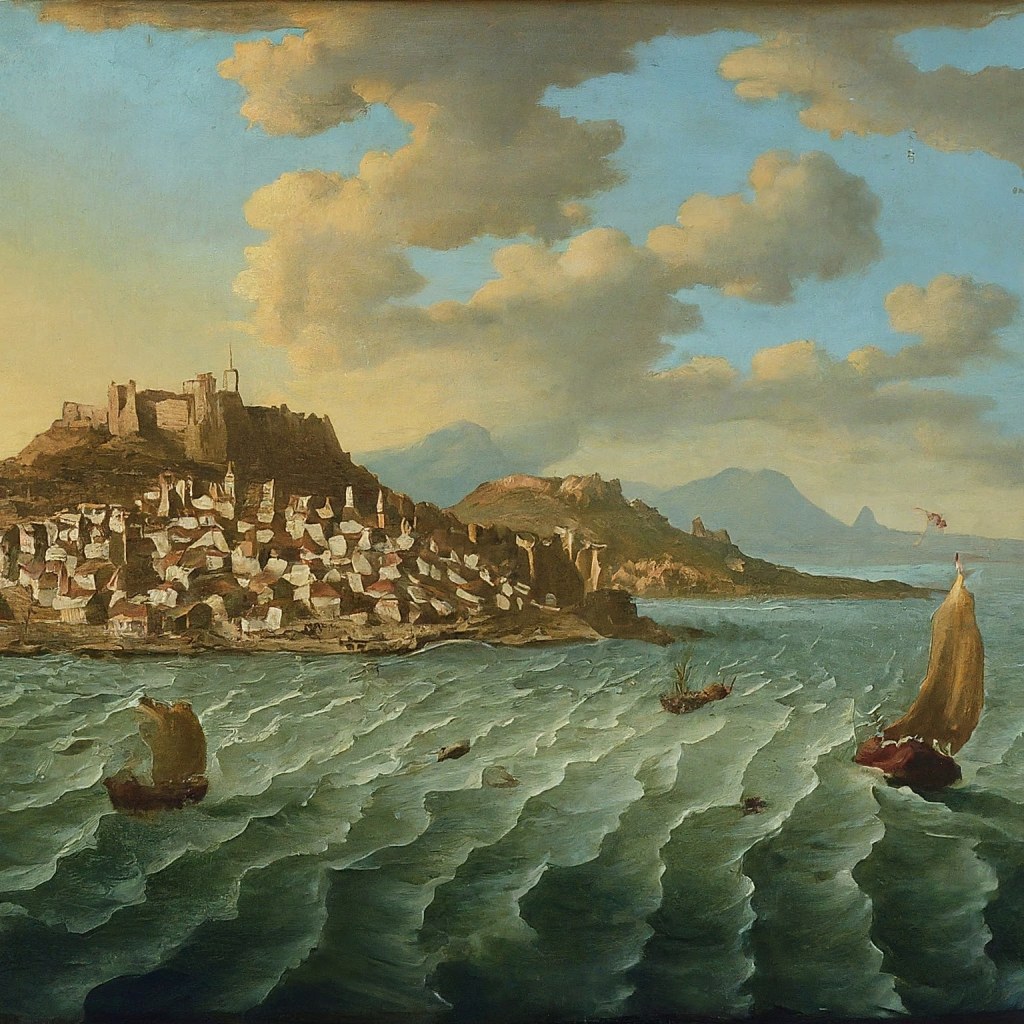
As your ship glides gracefully into the Fey Sea port of Marconis, the air is alive with the ethereal glow of the magical waters. The town emerges before you, a captivating blend of Byzantine-inspired architecture and the whimsical touch of the Feyrealm. Towers adorned with intricate mosaics and domed roofs reminiscent of the Balkans reach toward the sky, casting shadows on cobbled streets below.
At the docks, Marconian guards dressed in regal attire welcome you with polite nods. Alongside your ship, three other vessels bob gently in the Fey Sea’s embrace. Each ship boasts a distinct and fantastical fey design—a ship carved from a colossal seashell, another adorned with floating, luminescent petals, and the third resembling a tree with branches that seem to sway to an unseen breeze.
As you step onto the dock, the atmosphere is filled with the scent of sea salt and the distant whispers of the Feyrealm. Your presence has not gone unnoticed; curious fey creatures with colorful wings flit about, observing the newcomers with inquisitive eyes.
Awaiting you is an ornate carriage, pulled by fey creatures resembling elegant unicorns with coats that shimmer like stardust. The carriage itself is a work of art, adorned with golden filigree and crafted from wood that seems to pulse with a subtle life force.
Your journey through Marconis begins. The carriage takes you through the bustling lower town, where the energy is palpable. Market stalls overflow with exotic goods from the Feyrealm, and locals dressed in vibrant clothing weave through narrow streets, their voices a harmonious symphony of various languages.
At last, the carriage arrives at the Duke’s palace—a majestic structure perched atop the ridge, overlooking both the lower and upper towns. Guards clad in gilded armor stand at attention as the carriage comes to a halt. Duke Erasmus Varianos awaits inside, ready to usher you into the intricate dance of political intrigue that awaits in Marconis. The fate of the duchy lies in the delicate negotiations that are about to unfold.
The Duke’s Audience Chamber

As the ornate double doors swing open, you find yourselves in a lavishly decorated audience chamber. Gilded tapestries depicting scenes of feywild beauty hang from the walls, and a grand throne, adorned with gold and velvet, sits atop a raised dais. The scent of lilac lingers in the air, intermingled with the unmistakable aroma of the sweets the Duke is devouring.
Seated on the throne is Duke Erasmus Varianos—a rotund figure with a balding head and a layer of excess girth that stretches the seams of his extravagant robes. He welcomes you with a broad, practiced smile, revealing stained teeth. His beady eyes scan you, sizing up the potential benefits you might bring.
Duke Erasmus Varianos: (spoken with a greasy charm) Ah, esteemed guests! Welcome to Marconis, the jewel of the Southern Feysea! I am Duke Erasmus Varianos, your humble host. (He rises from his throne with a slight wobble, extending his hand for a limp handshake.)
Notes on Roleplaying Duke Erasmus:
- Appearance: Duke Erasmus is overweight, balding, and dressed in extravagant yet slightly disheveled attire. His rosy cheeks and stained teeth hint at a lavish lifestyle.
- Demeanor: Despite the grandeur of his surroundings, Duke Erasmus exudes an air of nervous energy. He is quick to size up others and seems ever-watchful for opportunities that could benefit him.
- Speech Pattern: The Duke’s voice is oily and smooth, with a tendency to lower to a whisper when discussing matters of personal interest. He often interrupts himself with indulgent bites of sweets.
- Motivations: Duke Erasmus is primarily interested in self-preservation. His loyalty lies with whoever can offer the best protection against the impending threat. He is willing to make deals, but his alliances are ultimately self-serving.
- Aroma: The lingering scent of lilac, coupled with the sugary sweetness of the confections he consumes, adds a peculiar layer to the encounter, reinforcing the Duke’s decadent and somewhat repugnant nature.
The Deceptive Guest Suite.
As you enter the guest suite, a wave of opulence washes over you. Rich tapestries depicting scenes of feywild enchantment adorn the walls, and a plush carpet underfoot muffles the sound of footsteps. Two elegantly draped beds promise a night of luxurious repose, each adorned with silky sheets and plump pillows.

The guest suite is a masterful display of comfort and extravagance. Lavender-scented candles flicker on ornate tables, casting a warm and soothing glow across the room. It seems every detail has been meticulously arranged to ensure a tranquil stay in these plush accommodations.
Investigation of the Guest Suite:
- Sabotaged Bed: Your initial examination of the beds reveals nothing amiss. However, the true danger remains hidden until a weight equivalent to a person is placed upon one bed. Two legs on one side break away in a carefully orchestrated manner, causing the bed to collapse with a startling crash. A DC 15 Investigation check unveils saw marks on the legs, cunningly concealed beneath the veneer of luxury.
- Peephole: As you explore the room, a discerning eye catches a subtle irregularity—a tiny peephole discreetly placed in the wall, hidden amidst the mesmerizing tapestries. It seems someone might be keeping a watchful eye on the guests in this seemingly private space.
- Jug with a Hole: While inspecting the washbasin area, a DC 10 Investigation check reveals a tiny hole in the bottom of the jug. It’s strategically designed to spill its contents, potentially leading to an unexpected and unwelcome surprise.
- Sabotaged Floorboard: A cursory look at the floor gives no indication of anything unusual. However, a DC 13 Investigation check uncovers a sabotaged floorboard near the beds. It’s weakened in such a way that it could break underfoot, potentially causing injury to an unsuspecting guest.
The Banquet at Marconis
The banquet hall is a grand display of opulence, with tables adorned in rich fabrics and exotic flowers. The scent of lavish dishes wafts through the air, and the chandeliers overhead cast a warm and inviting glow. Duke Erasmus Varianos stands at the head of the hall, welcoming the diplomatic envoys with a gracious smile.
As you enter the banquet hall, the atmosphere is alive with chatter and the clinking of fine crystal. The tables are laden with delicacies from the Feywild and the Märchenweltgrenze, creating a feast fit for royalty. Duke Erasmus, resplendent in his regal attire, beckons you to join the festivities.
Roleplay Notes:
- Ambassador Katerina Drakov:
- Demeanor: Katerina exudes an air of regal authority, her eyes sharp and calculating. She represents the Principality of Volhynsk and is straightforward in her goal—annexation as a vassal to the prince. She engages in polite yet firm discussions, pressing the practical advantages of alliance with her principality.
- Lady Isolde of the Silver Veil:
- Demeanor: Isolde is an ethereal figure, dressed in silver and adorned with feywild flowers. She represents the archfey court seeking a marital alliance. Her speech is graceful, and she subtly weaves enchanting suggestions into her words. Isolde emphasizes the potential for cultural exchange and magical prosperity.
- Lord Eirik Shadowsong:
- Demeanor: Eirik stands mysterious and aloof, representing the Twilight Court. His eyes gleam with otherworldly knowledge, and his words are cryptic. Eirik seeks to turn the duchy into a tributary state, emphasizing the benefits of aligning with the court’s enigmatic power.
- Lady Seraphina Moonshadow:
- Demeanor: Seraphina, a less powerful archfey, is diplomatic but pragmatic. She represents mutual defense, highlighting the importance of solidarity against external threats. Her tone is measured, and she subtly hints at potential consequences if the duchy stands alone.
- Duke Erasmus Varianos:
- Demeanor: The Duke is the host, exuding charm and a facade of affability. He navigates the diplomatic discussions with practiced ease, always ensuring the banquet remains a pleasant affair. However, his eyes betray a nervous energy as he tries to balance the competing interests of the diplomats.
Banquet Roleplay Dynamics:
- The diplomats engage in polite but firm discussions, trading jabs and veiled threats.
- Duke Erasmus tries to maintain a semblance of control and diplomacy, ensuring the atmosphere remains convivial.
- The players can participate in discussions, gather information, and navigate the intricate web of political discourse.
- Tensions rise as each envoy presses their case, and the crescendo builds naturally.
Phantom Sabotage: As the roleplay reaches its peak, a dramatic incident occurs. The chandeliers overhead, seemingly secure, suddenly shudder. A section breaks loose, crashing down, narrowly missing Duke Erasmus. The room falls into chaos, and accusations fly. The sabotage is meant to make the Duke appear negligent or even culpable, adding a layer of complexity to the diplomatic dance.
Unveiling Shadows of Sabotage
As the dawn breaks, the grandeur of Marconis seems overshadowed by a sinister undercurrent. The once lavish atmosphere is replaced with a tense aura, as rumors of the night’s events circulate through the duchy.
The morning light reveals a Marconis vastly different from the one you knew. Whispers of the night’s disturbances echo through the corridors, casting a pall over the once-vibrant town. As you make your way to the common area, you realize that the diplomatic entourages have fallen victim to more ominous forms of sabotage.
Examples of Sabotage:
- Katerina Drakov:
- Description: Katerina, having retired for the night, wakes up to find herself pinned to the bed with daggers. Her nightdress is adorned with notes containing threatening messages, implicating her in the night’s chaos.
- Lord Eirik Shadowsong:
- Description: Eirik’s suite is filled with cold iron caltrops, scattered across the floor. Cold iron, deadly to the fey, is strategically placed to cause discomfort and potential harm to any who tread upon it.
- Lady Isolde of the Silver Veil:
- Description: Isolde awakens to find every surface of her suite and luggage painted with hurtful and derogatory messages written in blood. The messages, accusing her of betrayal and treachery, mar the once beautiful surroundings.
- Lady Seraphina Moonshadow:
- Description: Seraphina discovers her entire body covered in dark runes that have been burned into her skin. The runes pulsate with an otherworldly energy, suggesting a malicious enchantment.
Creating Custom Sabotage: Consider the dynamics of your campaign and the characters involved to create custom sabotage scenarios. Tailor them to heighten tension, challenge the players, and add layers to the narrative.
Negotiations with Duke Erasmus Varianos

The grand chamber is adorned with the trappings of diplomacy, and the air is thick with the tension of political maneuvering. Duke Erasmus Varianos, surrounded by advisors and courtiers, awaits the arguments and entreaties of the various diplomatic parties.
As you enter the negotiation chamber, the Duke regards you with a measured gaze. The atmosphere is charged with the weight of decisions that could reshape the destiny of Marconis. The chamber is filled with murmurs as the other diplomatic envoys, each with their agenda, prepare to plead their case.
Duke’s Initial Disposition:
- The Duke is outwardly composed, though an undercurrent of anxiety flickers in his eyes.
- His primary concerns are the security and prosperity of Marconis, as well as the preservation of his own position of power.
Negotiation Mechanics:
- Each diplomatic party, including the players, has a chance to present arguments.
- The DM assigns a baseline mood value for the Duke towards each party.
- Players can use any skill to present their arguments, with the DM assigning DCs based on the complexity of the argument.
- Successful skill checks improve the Duke’s mood towards the party, while failed checks may worsen it.
- The DM tracks the Duke’s mood between the parties and decides the threshold for the Duke’s final decision.
Example Skill Checks:
- Persuasion (Charisma): Use charm and eloquence to sweeten the deal, promising the Duke both military support and the retention of his position.
- History (Intelligence): Remind the Duke of historical alliances and the benefits of aligning with Mountainheart.
- Insight (Wisdom): Read the Duke’s emotions and tailor arguments to assuage his fears and concerns.
- Deception (Charisma): Plant seeds of doubt in the Duke’s mind regarding other diplomatic proposals.
- Intimidation (Strength): Display the might and prowess of Mountainheart, emphasizing the consequences of refusing the alliance.
Duke’s Response:
- The Duke responds more favorably to honeyed words, genuine concern for Marconis, and concrete promises of support.
- Depending on the Duke’s mood, he may express reservations, seek clarifications, or be more open to specific proposals.
- The Duke may reveal hidden motives or fears if the players successfully use Insight or uncover secrets through investigation.
Tracking Duke’s Mood:
- Start with a baseline mood for each diplomatic party.
- Adjust the mood based on successful or failed skill checks.
- Consider the overall narrative and roleplay to determine the Duke’s final decision.
Possible Outcomes:
- The Duke aligns with Mountainheart due to the players’ convincing arguments.
- The Duke leans toward another diplomatic party, leading to potential complications and consequences.
- The Duke remains indecisive, leaving the situation in a precarious state with ongoing political intrigue.
Poison Gas Sabotage
The negotiations, fraught with delicate diplomacy, take a sinister turn as an eerie popping sound fills the chamber. Suddenly, a poisonous green gas billows forth, swirling ominously and snaking its way through the room. Panic ensues as the realization sets in—the negotiation chamber has been sabotaged.
Poison Gas Mechanics:
- The poisonous gas begins to spread, filling the room over the course of 20 minutes.
- Players and NPCs must make Constitution saving throws (DC determined by the DM) to resist the effects of the gas.
- Those who fail the saving throw may suffer from nausea, dizziness, or other adverse effects.
- The gas itself is a deliberate act of sabotage, adding an element of mystery to the situation.
Barred Door Mechanics:
- The door leading out of the chamber has been barricaded from the outside.
- Players must decide whether to attempt to break down the door or find an alternative means of escape.
- The barricade and door collectively have about 200 hit points.
Roleplay Aftermath:
- Breaking down the door leads to a chaotic scene as gas spills into the corridor, affecting those outside the chamber.
- The diplomatic parties, once in tense negotiations, now turn on each other amidst the chaos.
- The Duke, previously the target of persuasion, now finds himself caught in the crossfire of accusations and distrust.
Possible Outcomes:
- Successful Escape: The players successfully break down the door, escaping the poisoned chamber and potentially saving others in the process.
- Complications: The gas affects some individuals more severely than others, leading to complications and mistrust.
- Blame Game: The diplomatic parties turn on each other, accusing rivals of the sabotage, adding layers of intrigue to the political landscape.
Roleplay Dynamics:
- Players can use their skills to navigate the chaotic aftermath, assess the situation, and gather information.
- The Duke, once an authority figure, now seeks the players’ aid in unraveling the conspiracy.
- Players may need to make quick decisions about whom to trust and how to diffuse escalating tensions.
DM Tips for Roleplaying Chaos:
- Keep track of time as the gas continues to spread, adding urgency to the situation.
- Describe the effects of the gas on NPCs, using their reactions to heighten tension.
- Use the chaos to reveal hidden motives or alliances among the diplomatic parties.
- Allow players to use their skills creatively to navigate the evolving political landscape
The Saboteur’s Reveal and Chase
As the players prepare for the night banquet, another sinister twist awaits them. The suite, seemingly a haven, reveals itself as a treacherous trap, setting the stage for a dramatic confrontation with the elusive saboteur.
As you make your way to the night banquet, anticipation hangs in the air. However, a sudden scream pierces through the bustling sounds of Marconis. Rushing to investigate, you find Lady Seraphina Moonshadow under attack, her retainers incapacitated, and a shadowy figure looming over her with a raised saber.
Chase Mechanics:
- Initiating the Chase: The saboteur notices the players and flees, initiating a high-stakes chase through the town.
- Skill Checks: Along the chase, the saboteur weaves through obstacles, requiring players to make skill checks (Dexterity, Athletics, or Acrobatics) to navigate the hurdles.
- Obstacle Examples: Narrow alleys, crowded marketplaces, and rooftop jumps. Players may need to make checks to avoid losing ground or stumbling.
- Chase Progress: The chase unfolds through the town, with the saboteur displaying uncanny agility and speed. Players must keep pace and successfully navigate the obstacles to close the gap.
The shadowy figure darts through the narrow alleys like a wraith, blending into the darkness and moving with unnatural speed. The clatter of footsteps and the occasional glance back reveal a fleeting glimpse of elven features, but the face remains obscured in the dim light.
Zipline Climax:
- Lower City Descent: The chase reaches a climax as the saboteur approaches the edge of the upper city.
- Zipline Maneuver: The saboteur swiftly navigates a zipline, descending to the lower city below.
- Cutting the Zipline: In a daring move, the saboteur cuts the zipline behind him, leaving the players stranded on the upper level.
Chase Resolution:
- Town Exploration: Players may explore the upper city to gather information about the saboteur and uncover potential motives.
- Player Decisions: The chase outcome impacts the players’ standing in Marconis and their relationship with Lady Seraphina Moonshadow.
- Revelations: Lady Seraphina may reveal information about the saboteur’s identity, tying back to the overarching political intrigue.
DM Tips for the Chase:
- Dynamic Descriptions: Emphasize the fluidity and speed of the chase, using vivid descriptions to immerse players in the pursuit.
- Obstacle Creativity: Introduce varied and creative obstacles to keep the chase engaging.
- Player Choices: Allow players to make decisions during the chase, such as choosing alternative routes or leveraging abilities.
Searching the Lower City for the Saboteur
The players find themselves in the bustling and in some places squalid lower town a stark contrast to the upper town’s opulence. Here, amidst the crowded streets and humble dwellings, they must skillfully navigate the environment to pick up the trail of the elusive saboteur.
Skill Checks:
- Investigation (Intelligence): The players search for any distinctive markings, footprints, or clues left by the saboteur in the lower city’s dusty streets and alleys.
- Stealth (Dexterity): Maneuvering through the lower city’s tight spaces, the players attempt to move discreetly and gather information without drawing undue attention.
- Perception (Wisdom): Keeping a keen eye out for any unusual activity, the players scan the lower city for signs of the saboteur or witnesses who might have seen something.
- Streetwise (Intelligence): Drawing upon their knowledge of urban life, the players tap into the local gossip network to gather information about recent unusual incidents or sightings.
- Survival (Wisdom): Following the trail of the saboteur, the players use survival skills to track their quarry through the lower city’s diverse terrain.
- Persuasion (Charisma): Engaging with the locals, the players attempt to extract information by subtly questioning the residents about any unusual figures or incidents.
Challenges in the Lower City:
- Crowded Market Square: The bustling market square poses a challenge to Stealth and Investigation as players navigate through the lively crowd without losing the trail.
- Narrow Alleyways: Players encounter narrow alleyways where precise maneuvering (Dexterity) is required to avoid obstacles and stay on the trail.
- Hidden Corners: The saboteur may have taken refuge in hidden corners or abandoned buildings, requiring Perception to spot potential hiding spots.
- Diverse Districts: The lower city consists of various districts, each with its own challenges. Streetwise may be crucial for understanding local dynamics in different areas.
- Obstructed Pathways: Environmental obstacles such as crates, barrels, and makeshift barricades may impede progress, requiring creative solutions and checks.
- Social Interactions: Engaging with the lower city’s residents demands a delicate touch. Persuasion checks may be necessary to gain trust and coax information from wary individuals.
Outcome:
- Success: The players successfully trace the saboteur’s path, gaining valuable information about their whereabouts and motives.
- Partial Success: The players find some clues but may miss certain details. The trail becomes clearer, but challenges persist.
- Failure: The players struggle to pick up the saboteur’s trail, facing dead ends and misinformation. The saboteur’s identity remains elusive.
Meeting Aleksei Lysandrov

As you follow the elusive trail through the lower city, you find yourself surrounded by an eerie assembly of shadowy figures. Suddenly, clapping echoes through the dimly lit space, and a young man in princely attire emerges from the shadows. His eyes gleam with a mix of amusement and calculation as he strides forward, offering a congratulatory smile.
“Ah, bravo! It seems Mountainheart’s champions have exceeded my expectations. I am Aleksei Lysandrov, the last prince of the Imperium Lysandros. Now, let us talk of the future, for you have stumbled upon a pivotal moment in the fate of Marconis.”
Roleplaying Aleksei Lysandrov: Aleksei Lysandrov, an enigmatic and ambitious figure, presents himself as a charismatic and cunning negotiator. His words carry the weight of a young leader seeking to carve his destiny. Here’s a guide to roleplaying Aleksei:
- Charismatic Demeanor: Aleksei exudes charm, combining the grace of royalty with the confidence of a born leader. He moves with purpose, his gestures measured and deliberate.
- Sharp Intellect: Aleksei’s mind is a strategic playground. He employs clever arguments and sharp reasoning to sway opinions, and his quick wit is evident in every exchange.
- Contempt for Qaldira: The disdain in Aleksei’s voice is palpable when discussing the Sultanate of Qaldira. He openly advocates for extreme measures, revealing a deep-seated hatred for the Qaldiran forces.
- Wealth Gap Accusations: Aleksei places blame on the Duke and his predecessors for the stark wealth gap between the upper and lower halves of Marconis. He asserts that the ruling elite has perpetuated a system of oppression.
- Negotiation Skills: Aleksei is a skilled negotiator, capable of exploiting divisions among the fey representatives. He reveals that negotiations with Lady Isolde and Lady Seraphina Moonshadow are already underway.
- Long-Term Vision: Aleksei presents a vision of an independent nation, free from the shadow of the Sultanate and governed by principles he believes will bring prosperity to all Marconis residents.
Negotiation Points:
- Support for Independence: Aleksei seeks the players’ support in his bid to form an independent nation, free from the influence of both the Sultanate and Mountainheart.
- Anti-Qaldiran Alliance: Aleksei proposes a collaboration against the Sultanate, emphasizing his dedication to dismantling Qaldira’s presence in the Märchenweltgrenze.
- Wealth Redistribution: He advocates for a restructured society that addresses the wealth disparity, promising a more equitable distribution of resources.
- Feyrealm Alliances: Aleksei hints at negotiations with powerful fey entities, presenting alliances that could tip the balance in his favor.
DM Tips:
- Dynamic Dialogue: Engage the players in a dynamic conversation, allowing them to question Aleksei’s motives and present their own arguments.
- Vocal Delivery: Convey Aleksei’s charisma through a confident and articulate vocal delivery, emphasizing key points during negotiations.
- Confrontation Potential: Introduce moments of tension, especially if players challenge Aleksei’s controversial views or question the morality of his proposed alliances.
The Corrupt Duke vs. The Genocidal Prince
The players find themselves at the crossroads of a morally challenging decision, caught between supporting the corrupt Duke Erasmus or aligning with the genocidal populist Prince Aleksei Lysandrov. Each choice carries significant consequences, shaping the destiny of Marconis and the Märchenweltgrenze. Here’s a guide to presenting this crucial decision to the players:
Presenting the Dilemma:
Read Aloud Text: As the echoes of Aleksei Lysandrov’s proposal linger in the air, the weight of a monumental decision settles upon your shoulders. Two paths lay before you, each fraught with peril and ethical complexity. On one side stands Duke Erasmus, a corrupt politician whose interests align with his own pockets. On the other, Aleksei Lysandrov is a charismatic prince whose vision involves extreme measures against the Qaldiran forces, and the potential for a radical societal shift.
Consequences of Supporting Duke Erasmus:
- Duchy Remains Under Mountainheart: Choosing Duke Erasmus means aligning with Mountainheart and maintaining the status quo. The Duke’s corruption may persist, but Mountainheart provides a semblance of stability and protection against the advancing Qaldiran forces.
- Mountainheart’s Support: The players gain the support of Mountainheart, potentially leading to reinforcements in the upcoming battle against the Qaldiran Janissaries. King Fredrick views Marconis as a valuable strategic asset.
- Ongoing Corruption: Duke Erasmus continues his corrupt practices, perpetuating the wealth gap and maintaining the oppressive system within Marconis.
Consequences of Supporting Prince Aleksei Lysandrov:
- Independence and Genocidal Tendencies: Choosing Aleksei aligns with the prince’s vision of an independent Marconis, free from the Sultanate’s influence. However, this independence comes at the cost of extreme measures, potentially involving genocide against the Qaldiran population.
- Fey Realm Alliances: Supporting Aleksei may lead to powerful alliances with fey entities, changing the balance of power in the Märchenweltgrenze. These alliances, however, could have unpredictable consequences.
- Societal Restructuring: Aleksei promises a restructuring of Marconis society, aiming to address the wealth gap and create a more equitable system. However, the extent of these reforms and their impact remains uncertain.
Player Agency and Morality:
- Confronting Morally Ambiguous Choices: Emphasize the moral ambiguity of the decision, forcing players to grapple with the lesser of two evils.
- Player Discussions: Encourage players to discuss their characters’ perspectives and beliefs, fostering in-character debates that reflect the challenging nature of the decision.
The Calm Before the Storm
With the weight of an impending decision hanging heavy in the air, the players find themselves in a moment of respite—a calm before the storm that will shape the destiny of Marconis. This interlude allows the players to reflect on their choices, observe the actions of other key figures, and witness the potential unraveling of alliances. Here’s how to frame this crucial interlude:
The town of Marconis takes on an eerie calm as the sun sets, casting long shadows across the landscape. The air is thick with tension, and a palpable anticipation of the imminent storm lingers. Tomorrow afternoon holds the promise of resolution, but the choices made in the coming hours will echo through the Märchenweltgrenze.
Observing Key Figures:
- Katerina Drakov’s Decision: The players witness Katerina Drakov preparing to depart. She is resolute in her plan to inform her prince and recommends a forceful military takeover after the Janissaries invade.
- Eirik Shadowsong’s Wavering Resolve: Eirik Shadowsong, once committed to the talks, is now visibly uncertain. The fey diplomat contemplates returning to the feyrealm, expressing doubt about the feasibility of diplomatic resolutions.
- Fey Diplomats’ Elusive Behavior: The other two fey diplomats maintain distance, avoiding direct contact with the players and the duke. Their motivations and loyalties remain shrouded in mystery.
- Duke Erasmus’s Desperation: The duke, facing the imminent collapse of his duchy, approaches the players with desperation in his eyes. He pleads for them to consider incorporating Marconis into Mountainheart, offering loyalty in exchange for protection.
Player Agency and Choices:
- Decision Reflection: Encourage players to reflect on the choices before them, considering the potential consequences of supporting Duke Erasmus, Prince Aleksei Lysandrov, or opting for alternative paths.
- In-Character Discussions: Allow players to engage in in-character discussions, exchanging insights, concerns, and perspectives. The interlude becomes a platform for roleplaying meaningful interactions between the characters.
- Individual Investigations: Provide opportunities for players to investigate the motivations and actions of key figures, potentially uncovering hidden agendas or alliances.
DM Tips:
- Emotional Atmosphere: Convey the emotional atmosphere of the interlude, emphasizing the gravity of the impending decision and the impact it will have on Marconis and the surrounding regions.
- NPC Reactions: Describe how NPCs react to the players’ presence, offering subtle cues about their loyalties and intentions.
- Foreshadowing: Introduce subtle hints and foreshadowing elements that hint at the potential outcomes of the impending decision.
Taking a Side
As the afternoon sun casts long shadows across the palace courtyard, tension reaches its peak. The players find themselves in the heart of a clash between two opposing forces—an angry mob led by Prince Aleksei Lysandrov and his shadow agents, and a group of soldiers guarding Duke Erasmus. The fate of Marconis hangs in the balance, and the players must choose a side in this tumultuous encounter.
The air crackles with animosity as Prince Aleksei Lysandrov leads an enraged mob through the winding streets of the upper town. At the forefront, shadow agents move with eerie precision, their silhouettes blending seamlessly with the encroaching shadows. On the opposite side, Duke Erasmus stands surrounded by loyal soldiers, prepared to defend the duchy at any cost. The courtyard is a battleground, and the clash of crowds is imminent.
Combat Scenario:
- Prince Aleksei’s Forces:
- Aleksei Lysandrov (Noble Stat Block)
- 6 Shadow Agents (Upgraded Spy Stat Block – CR 2)
- Angry Mob (Count as a difficult terrain with potential crowd control effects)
- Duke Erasmus’s Forces:
- Duke Erasmus (Noble Stat Block)
- 4 Veterans (Soldier Stat Block – CR 3)
- Loyal Soldiers (Act as a defensive line)
- Player’s Decision:
- The players must choose to align with either Prince Aleksei or Duke Erasmus. This choice determines the allies they’ll have in the upcoming battle.
- Environmental Hazards:
- Crowd Dynamics: The angry mob can hinder movement and impose disadvantage on certain actions, reflecting the chaos of the crowd. Players may need to navigate carefully to avoid getting swept up.
- Terrain Variation:
- Defensive Barricades: Various structures and barricades offer cover and strategic vantage points. Players can utilize the environment for tactical advantage.
- Dynamic Combat Progression:
- The clash evolves dynamically as the mob and soldiers collide. The players must adapt to changing circumstances, making strategic decisions as the battle unfolds.
Victory Conditions:
- Prince Aleksei’s Victory:
- If Prince Aleksei Lysandrov survives and Duke Erasmus is defeated, the mob gains control of the palace, and Aleksei establishes his vision for an independent Marconis.
- Duke Erasmus’s Victory:
- If Duke Erasmus survives and Prince Aleksei is defeated, the soldiers regain control, and Marconis remains under Mountainheart’s influence, with potential repercussions.
DM Tips:
- Morally Ambiguous Consequences: Emphasize the morally ambiguous consequences of the players’ choice, showcasing the potential impact on Marconis and its residents.
- Environmental Storytelling: Describe the chaos and fervor of the crowd, setting the tone for a tense and unpredictable encounter.
- Player Agency: Allow players to explore creative solutions, engage in diplomacy mid-battle, or attempt to diffuse the situation in unexpected ways.
Preparing for the Janissary Onslaught
As the looming threat of the Janissary onslaught draws near, the players must rally the town’s resources and strategically fortify key locations. Each fortification project offers unique benefits during the impending battle. However, the conflicting goals of the surviving ruler—either Duke Erasmus or Prince Aleksei Lysandrov—add an extra layer of complexity. The players have limited time, and the success of each project relies on skill checks and efficient use of the available hours. Here are the ten fortification projects:
- Fortify the Heights (Duke’s Priority):
- Time: 18 hours
- Skill Check: Athletics or Survival (DC 15)
- Benefits: Rain of arrows every round in a 30-foot sphere around the biggest enemy clumps.
- Reinforce the Lower Town (Prince’s Priority):
- Time: 18 hours
- Skill Check: Athletics (DC 15)
- Benefits: Provides cover and obstructions for players, creating advantageous positions.
- Mobilize Local Militia:
- Time: 16 hours
- Skill Check: Persuasion or Intimidation (DC 14)
- Benefits: Add 20 local militia members armed with ranged weapons to assist during the defense.
- Construct Barricades (Strategic Locations):
- Time: 10 hours
- Skill Check: Athletics (DC 14)
- Benefits: Creates obstacles for enemies, slowing their advance and providing partial cover for defenders.
- Set Up Traps in Alleyways:
- Time: 10 hours
- Skill Check: Stealth or Survival (DC 16)
- Benefits: Deals damage and hinders enemy movement when triggered during the defense.
- Stockpile Healing Potions:
- Time: 16 hours
- Skill Check: Medicine (DC 16)
- Benefits: Provides a stash of healing potions for the defenders to use during the battle.
- Enchant Defensive Runes (Magic Users Required):
- Time: 12 hours
- Skill Check: Arcana (DC 18)
- Benefits: Places defensive runes that grant temporary hit points to defenders and weaken enemy attacks.
- Deploy Scout Teams to Gather Intelligence:
- Time: 10 hours
- Skill Check: Perception or Investigation (DC 14)
- Benefits: Provides early warnings and insight into enemy tactics, granting advantage on initiative rolls.
- Create Flaming Barricades:
- Time: 10 hours
- Skill Check: Survival (DC 15)
- Benefits: Ignites barricades that deal fire damage to enemies attempting to pass through.
- Establish Signal System (Communication Enhancement):
- Time: 4 hours
- Skill Check: Stealth (DC 16)
- Benefits: Enables efficient communication between different defensive positions, improving coordination.
Time Management:
- Each project takes a specific number of hours to complete.
- The players have a total of 72 hours (3 days) to allocate to these projects.
Complications:
- Duke Erasmus pushes for the fortification of the heights, while Prince Aleksei Lysandrov insists on fortifying the lower town.
- Conflicting goals may lead to tension among the townsfolk, affecting the success of certain projects.
Player Agency:
- Allow players to choose the order of projects based on their priorities.
- Encourage creative solutions and improvisation during skill checks.
DM Tips:
- Convey the urgency of time, emphasizing the impending Janissary threat.
- Use the success or failure of each project to shape the battlefield dynamically during the Janissary onslaught.
Janissary Onslaught

As the sun dips below the horizon, a sea of Janissaries begins their relentless assault on Marconis. The players, stationed on a 60-foot section of the town wall, must face multiple waves of Janissaries, each accompanied by a siege engine. The air is thick with tension as the fate of the town hangs in the balance.
Wave 1: Vanguard Assault
- 10 Janissaries (Bandit Stat Block)
- 2 Janissary Archers (Scout Stat Block)
- Siege Engine: Battering Ram
Description: The initial wave is a vanguard assault, aiming to breach the town gates with a battering ram.
Wave 2: Elemental Onslaught
- 8 Janissaries (Bandit Stat Block)
- 4 Janissary Mages (Mage Stat Block)
- Siege Engine: Fire Ballista
Description: A wave of Janissaries accompanied by powerful mage reinforcements, bringing destructive magical firepower.
Wave 3: Elite Guard and Siege Tower
- 6 Janissaries (Bandit Stat Block)
- 4 Elite Janissaries (Veteran Stat Block)
- Siege Engine: Siege Tower
Description: The elite guard marches forward, supported by a towering siege tower aiming to breach the town walls.
Wave 4: Archer’s Precision Strike
- 5 Janissaries (Bandit Stat Block)
- 5 Janissary Archers (Scout Stat Block)
- Siege Engine: Ballista
Description: A wave of skilled archers providing covering fire for a deadly ballista, targeting specific defenders on the wall.
Wave 5: Final Onslaught – Janissary General
- Janissary General (Knight Stat Block)
- 6 Janissaries (Bandit Stat Block)
- 3 Janissary Mages (Mage Stat Block)
- Siege Engine: Catapult
Description: The final wave is led by the formidable Janissary General, a skilled and powerful commander aiming to crush the defenders and open the gates for the main Janissary force.
Special Rules:
- Siege Engines: Each siege engine has its own health pool and attacks. Players can target and disable siege engines to mitigate their impact.
- Waves: The waves arrive at regular intervals, allowing players to strategize and recover between assaults.
- Terrain Hazards: The town wall and its features can be used strategically by both defenders and attackers. Creative use of the environment may yield advantages.
- Janissary General: The Janissary General is a formidable foe, utilizing tactics and inspiring nearby Janissaries. Defeating the general may demoralize the remaining forces.
- Victory Conditions: Defend the town wall until the Janissary forces retreat or are defeated. The Janissary General’s defeat can also sway the morale of the remaining forces.
Conclusion: The Fate of Marconis
After the Janissary Onslaught, the players claim the treasure of the Janissary leader, which includes a Banner of Resilience and various luxury items worth a total of 10,000 gold pieces.
1. Duke Survives, Prince Killed:
The lower city lies in ruins, a testament to the brutality of the Janissary onslaught. The upper city, however, remains unscathed, a stark divide mirrored in the socioeconomic status of its residents. Duke Erasmus, grateful for the players’ assistance, fulfills his promise and bends the knee to King Frederick of Mountainheart. Marconis, now under the umbrella of Mountainheart, continues its existence. However, uncertainties linger about the longevity of Duke Erasmus’s rule. The corrupt politician remains in control, raising questions about how long King Frederick will tolerate his openly elitist and corrupt governance.
After the dust settles, the players enjoy the spoils of their victory, having successfully integrated Marconis into Mountainheart. King Frederick honored his promise, granting them additional titles of nobility or personal gifts. Marconis, now a part of the larger kingdom, plays its role in the ever-evolving political landscape.
2. Prince Survives, Duke Killed:
The lower city witnesses a grim spectacle as Prince Aleksei Lysandrov impales Janissary prisoners outside the walls. His ruthless rule begins, and Marconis is proclaimed the capital of the new Imperium Lysandros. The prince initiates societal rearrangement and wealth redistribution, fulfilling his promise with an iron fist. Disturbing rumors of atrocities committed in the borderlands by the new nation’s military circulate, leaving a stain on the once-proud city.
Prince Aleksei grants them a boon—a favor they can call in at any time to him or the 3 fey courts allied to him. The fate of Marconis is now irrevocably tied to the leadership and decisions of the new Imperium Lysandros.
3. Neither Survives:
With both the duke and the prince meeting their end during the Taking a Side encounter, the players assume control of Marconis on behalf of Mountainheart. They govern the city until King Frederick appoints a new duke to lead. Marconis becomes just another duchy within the growing kingdom of Mountainheart. The city’s future is shaped by the policies and decisions made by the new rulers appointed by King Frederick.
King Frederick, appreciating their service, grants them further titles of nobility or personal gifts. The fate of Marconis is now entwined with the larger kingdom, and the players’ influence echoes through the city’s ongoing history.
Appendexs
New magic items
Banner of Resilience
As the Janissary onslaught reaches its climax, the players uncover a rare and powerful magical artifact among the possessions of the Janissary Commander. This artifact, known as the Banner of Resilience, bears ancient enchantments that grant incredible benefits to those who carry it into battle.
Description: The Banner of Resilience is a majestic flag, crafted from an otherworldly material that seems to shimmer with an ethereal glow. Adorned with intricate symbols and sigils, the banner exudes an aura of strength and resilience.
Abilities: When planted into the ground, the Banner of Resilience bestows its magical effects to all allies within a certain radius. The bearer gains the ability to command the banner, choosing when to activate its powers.
- Aura of Fortitude:
- When the Banner of Resilience is planted, all allies within a 30-foot radius gain advantage on Constitution saving throws.
- Inspiring Presence:
- Allies within the banner’s radius gain temporary hit points equal to the caster’s level at the start of their turn while the banner is planted.
- Warding Shield:
- The banner provides a +2 bonus to AC for all allies within its radius.
- Rallying Call:
- Once per long rest, the bearer can use a bonus action to rally all allies within the banner’s radius, granting them advantage on attack rolls for one minute.
Activation: To activate the Banner of Resilience, the bearer must spend a bonus action to plant it firmly into the ground. The effects last for one minute or until the banner is removed.
Limitations: The banner requires attunement, and only characters of good alignment can fully unlock its potential. Additionally, the Banner of Resilience can only be planted once per long rest.
Stat blocks
Shadow Agent (CR 2)
Medium humanoid (any race), any alignment
Armor Class 12 (leather armor)
Hit Points 27 (6d8)
Speed 30 ft.
STR 11 (+0)
DEX 16 (+3)
CON 10 (+0)
INT 12 (+1)
WIS 14 (+2)
CHA 10 (+0)
Skills Stealth +6, Acrobatics +5, Deception +2
Damage Resistances Necrotic
Senses Darkvision 60 ft., Passive Perception 12
Languages Common, Thieves’ Cant
Challenge 2 (450 XP)
Shadow Stealth. While in dim light or darkness, the shadow agent can take the Hide action as a bonus action.
Evasion. If the shadow agent is subjected to an effect that allows it to make a Dexterity saving throw to take only half damage, the agent instead takes no damage on a successful save.
Actions
Multiattack. The shadow agent makes two shortsword attacks.
Shortsword. Melee Weapon Attack: +5 to hit, reach 5 ft., one target. Hit: 6 (1d6 + 3) piercing damage.
Shadow Strike. Ranged Weapon Attack: +5 to hit, range 20/60 ft., one target. Hit: 7 (1d8 + 3) necrotic damage. If the target is in dim light or darkness, the target must succeed on a DC 12 Constitution saving throw or have its hit point maximum reduced by an amount equal to the necrotic damage taken. This reduction lasts until the target finishes a long rest. If a target’s hit point maximum is reduced to 0, it dies.
Shadow Step. The shadow agent magically teleports up to 60 feet to an unoccupied space it can see that is in dim light or darkness.
Reactions
Uncanny Dodge. When an attacker the shadow agent can see hits it with an attack, the agent can use its reaction to halve
 The feengrenze historia