

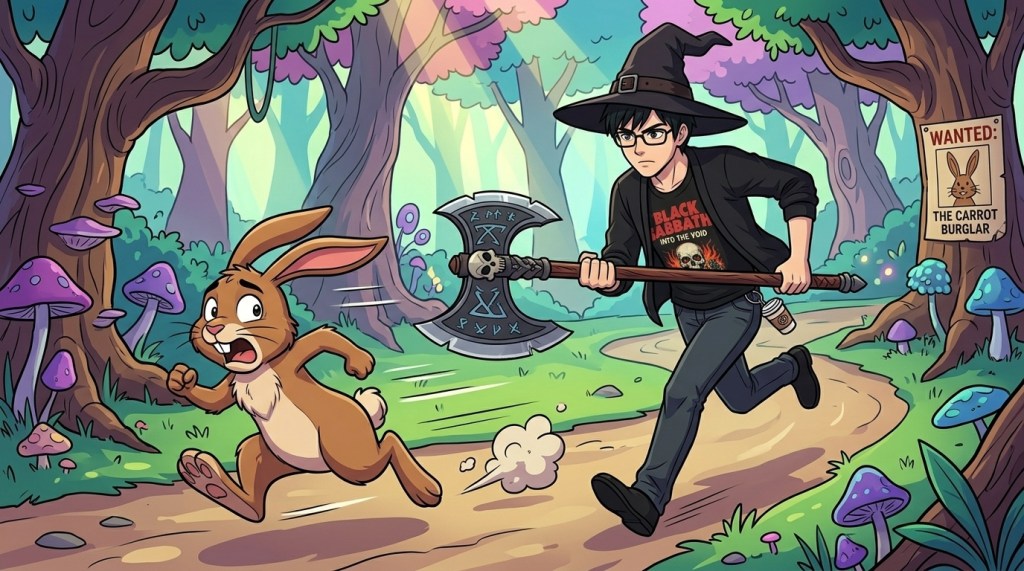
This is the first in what will likely be a long series of posts I call Hairs That Need Splitting. From time to time, I come across questions in my journey that I cannot answer, so I put one to you, the reader: Is it time to jump systems? In this case, the question is whether Worlds Without Number is the better fit for the Feengrenze.
Is it time to jump systems?
It is no secret that I am fascinated by the Old School Renaissance; I have been trying to work lessons from the OSR into my adventures for some time now. However, I have been firmly in the D&D 5e camp up until now. But when I started working on The Enchanter’s Retreat, things were looking bad for Dungeons and Dragons, and I began to wonder whether D&D was still the best system for emulating adventuring in the Feengrenze. At the same time, I revisited some OSR systems and now think that Worlds Without Number is a better fit for the Feengrenze.
What’s wrong with Dungeons and Dragons
Breaking Loose from the Design Straight Jacket
I have been deviating from D&D’s “lore” for some time now when it comes to creatures and lore. One might argue, from the state of my design docs, that the last eight months have been something of a massacre, with me cutting and reworking ideas and lore to better fit the world. In the last month, I have killed another sacred cow of Dungeons and Dragons lore by getting rid of the concept of dragon colors determining their alignment and breath weapon element.
Each cut was necessary to achieve the tone I want, but it has made me wonder whether I would be better off with a system with less lore baggage.
The magic question
That is all before I began experiencing mechanical friction from the system itself. Over the winter, I designed a framework for how magic works in the Feengrenze and the manyfold in general that reinforced the themes of farce, stagnation, and the melancholy of loss. I have already started to include bits and pieces in my writing. But I also tried to integrate an early version of the system into D&D rules, and ended up redesigning each magic-using class’s spellcasting feature. It went over as badly as you think, and sent me back to the drawing board.
The magic rules are not the only mechanical sticking point. There are other attempts to graft rules onto elements in my world (wyrd magic being the big one), and they never seemed to work right.
Why do you like Worlds Without Number?
There is no built-in lore.
Worlds Without Number comes with an example setting called Latter Earth and an example starting region called the Gyre. Unlike D&D, however, the setting is largely separate from the rules themselves. The monsters, classes, and mechanics do not assume a particular cosmology or history, and most of the setting-specific flavor can be removed with little more than a change of names.
That freedom is appealing because I have spent much of the last year tearing out and rebuilding D&D’s assumptions to fit the Feengrenze. Dragons no longer follow the traditional color-coded alignment system. Fey are not quite what D&D expects them to be. My cosmology bears little resemblance to the Great Wheel. Worlds Without Number asks far fewer questions about how the world is “supposed” to work.
That leaves me free to create my own wacky lore for monsters, magic, and everything else, without players bringing as many built-in expectations to the table.
It’s a Lighter system
There is no getting around the fact that Dungeons and Dragons is a crunchy system with lots of options and abilities, which can make homebrewing rules a chore. Worlds Without Number occupies a middle ground between crunchy modern systems and lightweight OSR systems while keeping things familiar for D&D heads like me.
A lighter system makes it easier to create and modify rules to fit my needs and to add new content without worrying about power scaling. One thing I noticed while reading the rules is how modular they feel. Many subsystems can be added, removed, or replaced without affecting the rest of the game, making it easier to tailor the rules to a particular campaign.
Another thing about a lighter system is that I can write a whole lot less to get the same bang as multiple pages of text in D&D. A class in Worlds Without Number is one page of mostly flavorful text. A race is a feat that can be explained in three to four sentences. A monster can often be described in a few statistics and a special ability or two, rather than requiring an entire page of mechanics.
It’s part of an ecosystem, and it’s cross-compatible with other ecosystems too.
Kevin Crawford is a game design machine who has been putting out a new book almost every year for over two decades. Many of those game systems and supplements are cross-compatible, and many are even based upon the same rule system; items and monsters from one can work perfectly fine in another. I plan to do just that in several future articles on this blog, which will allow me to mess with other genres that D&D has historically struggled with, like horror, domain play, or sci-fi.
Moreover, its lightweight and modular design allows easy porting from other systems. When designing the Enchanter’s Retreat, I used the Monster Overhaul by Skerples for the monsters, which more than compensated for the thin bestiary in Worlds Without Number. That experience convinced me that the system’s lightweight, modular design makes it remarkably easy to borrow material from elsewhere. There are also plenty of supplements from other RPGs with interesting ideas that fill gaps the Without Number series currently doesn’t address.
It Supports Heroic Fantasy without things getting ridiculous.
Heroic fantasy is the one thing keeping the Feengrenze from being a typical dark fantasy setting. Sure, the world is a farce where nothing changes on its own, but change is possible, and change for the better is possible if heroes step up to make the change. So heroic fantasy is non-negotiable for me.
Modern D&D and Pathfinder try to accommodate both heroic fantasy and superheroic fantasy within the same progression. In my experience, that can make high-level play difficult to manage because the game’s assumptions change dramatically as characters grow in power.
What appeals to me is that Worlds Without Number treats heroic fantasy and superheroic fantasy as separate modes of play. If I want capable heroes who can change the world, I can use the Heroic rules. If I want demigods who can level kingdoms, there are separate rules for that. The system does not assume every campaign must eventually become a battle between flying superheroes.
Why I might stay with 5th edition DND
It’s a Familiar System
D&D has been with me for almost my entire life as a tabletop gamer. I’ve spent years learning its quirks, publishing material for it, and building the Feengrenze around it. Walking away from that investment isn’t a decision I’d make lightly.
Large Supportive Community:
Dungeons & Dragons has a huge community, with many third-party publishers and community members producing great third-party content for D&D 5e over the years. I have collected a few standouts from Hit Point Press, Kobold Press, and the Dungeon Masters Guild over the year. I would love to use them. A larger community means more people to play my adventures, more feedback from other designers, and a much larger pool of third-party material to draw inspiration from.
It’s crunchy but also flexible.
While I think Worlds Without Number gives me better tools for shaping the game to the Feengrenze, D&D has repeatedly shown that it can support settings far beyond traditional heroic fantasy. Publishers have adapted it to gothic horror, cosmic horror, sword-and-planet adventures, modern fantasy, and even science fiction. If it can power a space opera, then it can certainly handle a strange fairy-tale world.
Larger Audience
Let’s be honest: publishing for D&D means publishing for the largest tabletop RPG audience in the world. Even if another system fits the Feengrenze better, choosing it means accepting a much smaller potential readership.
So what do you think?
So I put the question to you: should I stick with D&D, Jump to Worlds Without Number, or keep looking for a new system? The poll will open later today. Follow the links below and like the one you prefer. I will announce the victor in a few weeks’ time.


Leave a Reply