

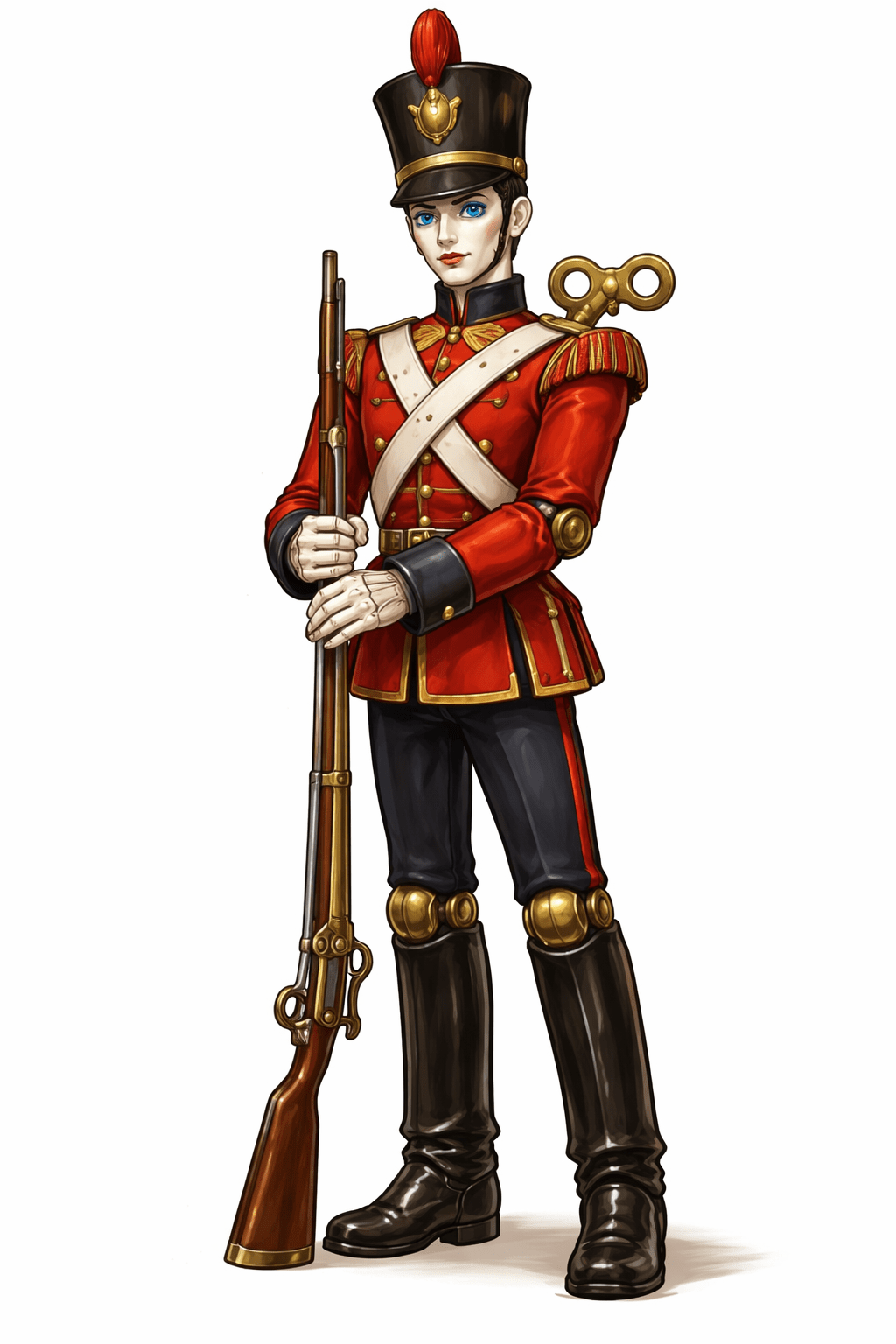
Of all the species I have created, the clockfolk are getting the most significant change in lore, with only Knochenvolk coming close to the level of new details getting added. This might have something to do with an upcoming adventure, but that’s neither here nor there. But to start this piece, I will let Doctor Elssler explain the current state of knowledge regarding the clockfolk
An excerpt from the Journal Scholars Review
A treatise on the Clockfolk and their society, as gathered via examination and interview with an individual of the species
By Doctor Matthias Elssle, Professor of Supernatural Biology, Coláiste Draoidheil
Of all the species of our world, the clockfolk have baffled us the most. This is mainly due to the lack of contact with these mysterious constructs; they seldom leave their city-state of Mainspring, and those who do are soldiers single-mindedly pursuing a cause they dare not explain, accompanied by whatever hirelings they can acquire. In other words, the clockfolk are not inclined to sit down and answer basic questions of their “biology” and culture.
It is with great honor that announced that the Coláiste Draoidheil has acquired an “inert” subject of said species for “examination” and interrogation. However, the revelations we uncovered raise more questions than answers, and many are quite terrifying to behold.
Physiology
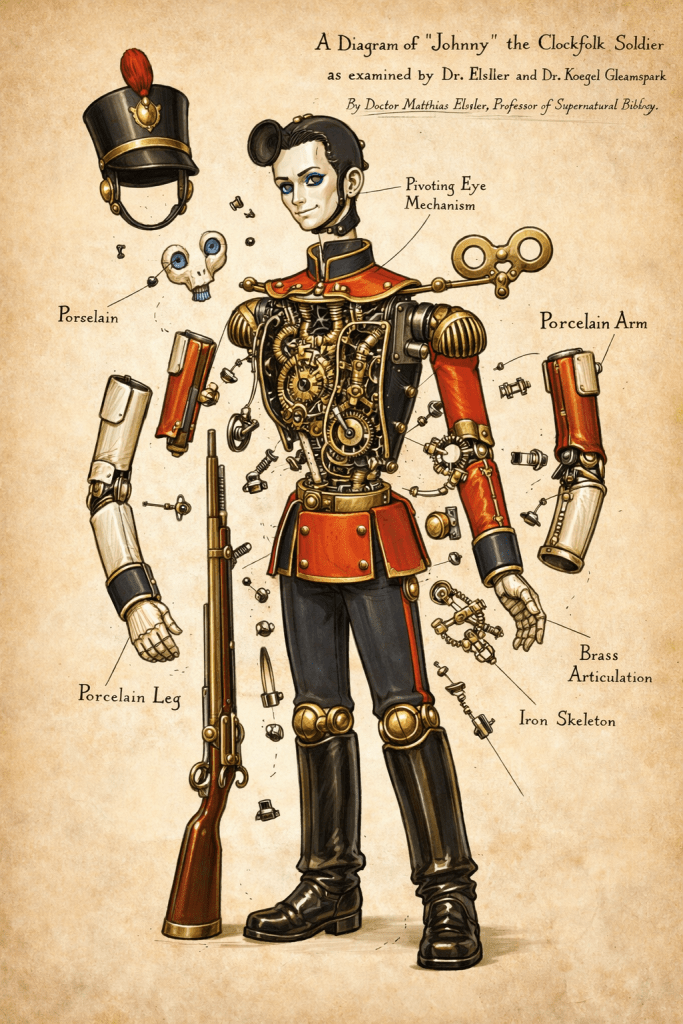
I had the great honor of being present when Doctor Koegel Gleamspark of the artifice department did a full cavity examination of the subject, while it was inert. I can personally attest to the accuracy of the information I am relating.
The subject appeared to be a young male, approximately 20 years old. He was about 6ft 1 inches from the top of his head to the bottom of his feet, with an overall blocky build like one of the tin soldiers sold at Gleamspark Toys. He also had a large key protruding from his back like a wind-up toy or clock.
The subject’s skin appeared to be made of porcelain, according to Dr. Koege, and was attached to the body with screws. Interestingly, we discovered that not only were the subject’s clothes, which consisted of a red jacket, black pants, and a shako, also made of metal, but were attached to the subject’s body in the same way as his skin.
Beneath the skin of the arm, we discovered that the subject’s skeleton was a hollow framework made of what appeared to be iron. Within this framework, cables connected to every major articulating joint snaked into the torso. Upon opening the torso, we discovered a massive mass of clockwork occupying almost the entire torso cavity.
It was at this point that we decided to end our examinations into the subject’s guts. Doctor Koegel, an expert in his field, believed that, when faced with a machine so complex, he would be unlikely to reassemble it to the point where the subject would reactivate, and we still wanted to ask the fellow questions. He did allow me time to examine the subject’s body more thoroughly. I observed the following:
- The subject’s limbs were as flexible as my own, despite their blocky, hinged structure.
- The subject’s eyes could pivot along 4 degrees of freedom
- The subject’s mouth was a hinged gate leading into an empty cavity, like a ventriloquist’s dummy or the jaw of a nutcracker doll
- His ears, while sculpted, had no ear canal
- Finally, the subject’s black hair was a single piece of metal attached to his head with screws.
Waking our ”Living” Subject
The remaining observations in this article were obtained after we finished closing the subject up, strapped him to a chair, and gave his key a good winding. Upon winding the subject’s key 30 times, he promptly opened his eyes and expressed confusion about his circumstances. We wasted no time in questioning him.
According to him, his name is Private Johnny of Her Majesty’s First Rifle Company of the Second Wyrdback Expedition; no last name was given. After we explained where he was and what was happening, and after promises to let him go and put him on a ship back home if he cooperated, he agreed to answer our questions.
Mentaility
We confirmed, through extensive questioning about his life and Mainspring’s culture, that he is about as smart as the average man or woman of our fair kingdom. He responded promptly and intelligently to questions asked about his life. He was able to read and understand, with some difficulty, a page of a book written in Lyonesse English, which was similar to his native Mainspringian English but featured unusual spelling. He was able to perform basic arithmetic, though he had to count on his fingers for sums larger than 100 and was completely unable to grasp basic algebra. He also “laughed” at a joke Doctor Koegel cracked, although his laugh sounded very strange, like a flute hiccuping.
However, we also noticed a disturbing trend in our questioning. Johnny would repeatedly answer questions, specifically ones about abandoning the military, finding a wife, or seeing the world as a tourist, with a simple I cannot or I am unable to. While this may seem benign, I must reiterate that he answered any question about being anything outside his occupation with the exact phrase, “I cannot.” Not “I do not want to,” or “I am unable due to X,” a simple flat statement of inability.
When asked why he could not even consider the most basic deviations from his role in society, he revealed that his entire race lacks free will. According to Johnny, the clockfolk are “born” to fulfill a specific societal role; he was literally born a footsoldier about 160 years ago. The complex mechanisms we observed during our dissection were his; in a sense, Johnny’s mind and his societal role were built into the gears by his creator, Aedan the Toymaker. He explained that he and everyone else in his species were required to obey role-specific rules that amounted to a set of if-then statements dictating everything he did, including the conversation we were having. And the most terrifying part of it, he and his entire species were intimately aware of this limitation and wanted free will more than anything.
Reproduction
According to Johnny, the clockfolk have completely lost any ability to reproduce. Aedan was the only one who knew how to build new clockfolk, and he died over a hundred years ago. This line of inquiry naturally led to questions regarding the presence of women and children. Johnny affirmed that yes, women and children exist within Mainspring. Women tend to be less heavily built than men, with thinner, frailer bodies built for homemaking that reminded Doctor Koegel of the porcelain dolls his cousins make for Gleamspark toys.
However, the one question I regret asking almost immediately concerned the children and how they stayed sane through what was apparently over a hundred years of childhood. Johnny’s answer was gut-wrenching and straightforward. They do not remember any of it. Apparently, specific roles in Mainspring society are designed to forget things once an internal timer ticks down. Aedan made all the children in Mainspring purpose-built to be a certain age forever, and Aedan achieved this by having them reset to their factory default on their birthdays.
When he saw the terrified expressions on our faces, he explained that families were built as a single unit and that, although the children were reset on their birthdays, they retained their personalities and memories of their parents, so it was not so bad. When asked if the parents reset, he said no, which, in my view as a father, is even more terrifying.
Magic
Johnny confirmed that there are no magic users among the clockfolk. Aedan specifically designed the race to lack aptitude for magic to better ensure their submission. However, he did mention that certain members of his species have a keen interest in magic for reasons he did not know. He suspects that it has something to do with Queen Charlotte.
Society and origin
The last thing we questioned Johnny about before sending him to the docks was Mainspring, and the answers we received were unsatisfyingly banal after the gut-wrenching revelations earlier, but no less disturbing.
The clockfolk were created to be the personal playthings and subject of Aedan the toymaker, a former subject in the court of Titania. He created them to emulate citizens of a human nation on a world called Earth, a nation called “Great Britain,” in minute detail. Their city-state of Mainspring was designed by Aedan using elements of architecture and urban layout he copied from British cities, specifically those he found pleasing. As such, Mainspring is a maze of streets arranged along the slope of a large caldera with no consideration given to the needs of the citizens.
The clockfolk themselves are meant to be a perfect emulation of the citizens of Britain, down to the presence of purpose-designed drunkards, thieves, and other less desirable social roles. Aedan had embedded the norms and values of Great Britain during the reign of Queen Victoria into their gears. Such a discussion of British culture is beyond the scope of this article; however, I am aware that several books have been written on the subject by our departments of speculative sociology and xenoanthropology.
As for Aedan, Johnny described him as “a cruel king, a fat, ugly pig of a Sidhe,” who treated his clockwork subjects like toys to be broken, knowing full well they could not fight back. As testament to his cruelty, he made a contract with a grieving British woman, exchanging her unborn daughter ( to be delivered to Aedan on her 18th birthday) in exchange for returning the woman’s dead military officer husband to life.
Upon receiving the 18-year-old Charlotte Evermore, Aedan tore most of the girl’s insides and replaced them with the same sort of clockwork we found in Johnny’s torso. Charlotte was rendered as meek and hapless as any other clockfolk, and Aedan treated her like a cruel child treats his favorite plaything. According to his she endured this for 20 years before she somehow managed to slip cold iron into his wine and meal.
Johnny expressed almost divine reverence for his queen, despite Aedan’s death having little effect, and Queen Charlotte seemingly being unable to rule due to the rules Aedan imposed on her via the clockwork heart in her chest.
The Clockfolk in play
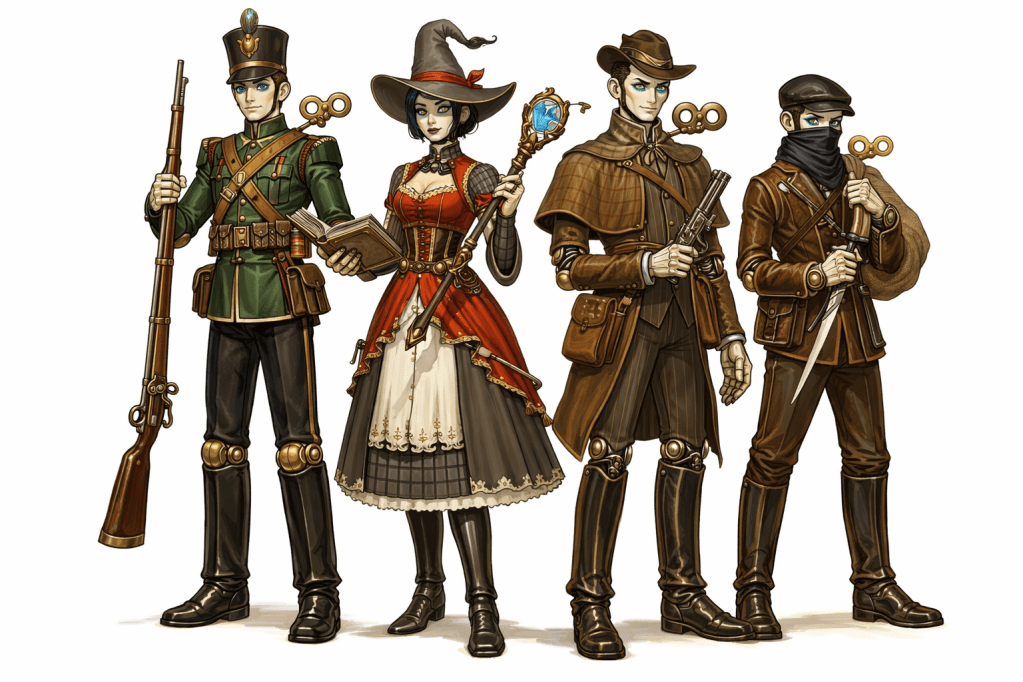
Clockfolk are almost by definition not adventurers; they are robots purpose-built to serve a role in a city constructed as a playset for a would-be tyrant.
However, that does not mean there are no clockfolk adventurers. Queen Charlotte seeks anything that might set herself and her people free from the limits Aedan placed upon them, and you were among the few sent out to find it. You travel the world in search of an expert in clockwork among the mortalfolk, a sympathetic patron, or even a scroll bearing the legendary wish spell, said to bring a person’s greatest desire to pass.
Playing a clockfolk is about confronting hardcoded limitations — and, more importantly, enduring the strain of a world that constantly demands things you were never meant to do. There are many aspects of the adventuring life you cannot even conceive of, because they lie outside the function you were built to fulfill. Your programming is not absolute, but it is relentless; you possess just enough freedom to desire more of it, and just enough flexibility to sometimes find a workaround when faced with the impossible.
Creature Type: Construct.
Size: Medium or small
Speed: Your walking speed is 30 feet.
Clockwork Body: Your body, being made of metal, porceline and clockwork, is surprisingly resilient. You have a base unarmored AC of 12. When you reach zero hitpoints instead of making death saves, you become inert. While inert, you are unconscious and cannot make any actions until you are repaired. A character proficient with tinker tools can make an intelligence check (10+ your constitution bonus) to spend a long rest repairing you.
Heart Spring: You do not need to consume food or water or breathe. Instead, you have a key or t-handle sprouting from your back, attached to your heart spring. This spring must be wound at least once every day. You cannot wind the spring yourself; another creature must take at least 1 minute to wind your key. If your heart spring winds down, you become inert until a creature winds your key.
Purpose Built: You were built to fulfill a specific role in society; you are exceptionally good at this role, but cannot deviate from it at all. Establish a role you serve in clockfolk society. Your role should be broad enough to plausibly support an adventuring life, but narrow enough to meaningfully restrict your behavior. Any time you make a skill check or do something related to your role, at the GM’s discretion, you can add your proficiency bonus to the result. However, if you try to do something that is expressly not allowed by your role in society, again, at the GM’s discretion, you will be unable to make the skill check and must answer that you cannot.


Leave a Reply