

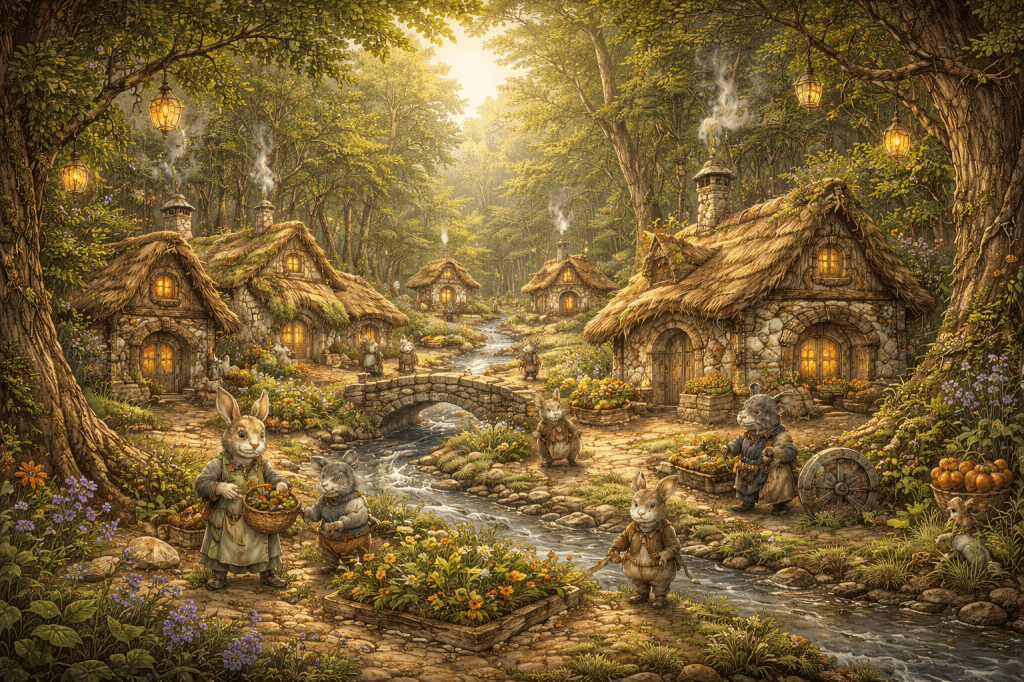
The trend of old, original species lore becoming irrelevant, moot, or incorrect continues, with the pooka now due for a revision and expansion. I think the original vibe I had for the species works, but I want to expand the paltry two paragraphs of lore from my first species’ article into something more substantial. But first, we start with an excerpt from the inter-universal academic journal Scholars Review.
The Pooka: A primer for the Ignorant and Uninformed
By Matthias Elssler, professor of supernatural biology, Coláiste Draoidheil
It baffles me by the sheer number of misconceptions about my species held by both the fey and the mortalfolk. As the only fey species that never were full fey to begin with, it seems that confusion was going to arise naturally. Well, as a mole body pooka myself, I would like to set the record straight with the latest biological and sociological research on the subject.
Etymology
The origin of the term pooka to describe native inhabitants of New Mountainheart is lost to history, but it was almost certainly the native fey folk who first applied the label.
The noun pooka is fey in origin, and my research seems to indicate it is a catch-all term for any creature that was transformed in part or in full into a beast against their will by curses or other forms of magic. It would make natural sense, given the origin of my people in this world, that the fey living near the Valley of New Mountainheart would initially mistake the transformed humans for bearers of a curse and use the term pooka to describe them, and the name eventually stuck for use by all.
The pooka of the Feengrenze have also been known by various names in different languages. The original Feengrenze pooka used the words Kreaturenmenschen and Kreaturenvolk, literally ‘critter people’ and ‘critterfolk,’ to describe themselves before the loanword pooka became the norm. Some of the more conservative pooka families still use the now archaic terms to describe their species. Many of the neighboring mortal kingdoms still use some variant of the term critter folk/people in their native tongue alongside the more commonly used word pooka when referring to the species, often because Pooka still retains some meaning as a diagnosis of people suffering from fey curses and spells.
Origin
It is debatable whether or not pooka existed in the Feengrenze before May 2nd, 1523 AD. It is certainly possible that someone was cursed to be a beast person. However, the first recorded sightings of the pooka of New Mountainheart were by feyfolk living along the former Bay of Broken Teeth. Said pooka, including my ancestors, were dragging themselves out of the surf onto the shingle beaches along what would become the coast of New Mountainheart. They claimed that they were originally humans whose kingdom was swept away in a great flood. The fey who witnessed our emergence from the ocean dubbed us pooka before doing little to nothing to help us in our time of need.
Physiology
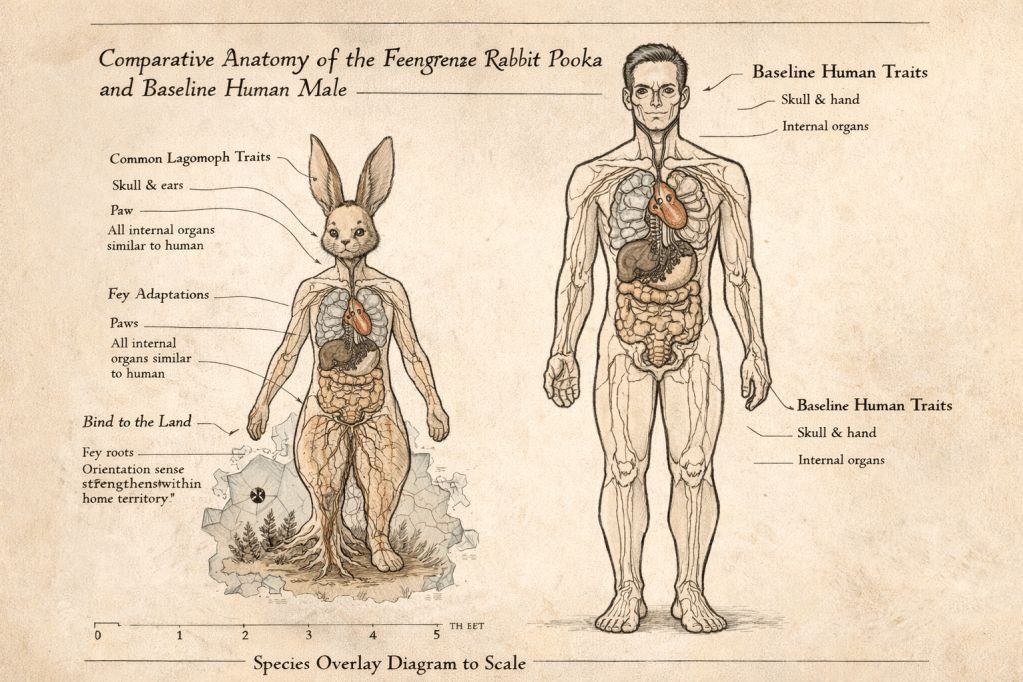
At first glance, one might mistake the Feengrenze pooka for anthropomorphized animals straight out of the whimsical tales of Beatrix Potter or The Wind in the Willows. However, our bodies are closer to those of humanoids than to those of beasts in most respects.
The average size of a fully grown pooka is between 4 feet and 5 feet. The bodies of my species are proportioned between those of a dwarf and a human. On the inside, our organs are almost identical to those of a human, and our skeletons are mostly identical to those of humans, except for the skull, feet, and hand bones.
The primary divergence between their human ancestors and modern pooka is the presence of animalistic features. All pookas appear like and have features of one of the meeker species of terrestrial mammals, with mice, rabbits, and squirrels considered the most common. There has never been a reported case of a pooka having the features of a predatory animal aside from the royal family of New Mountainheart, the Von Mountainhearts, who are wolf pooka. This is generally treated as a special case by my colleagues because A. Fredrick von Mountainheart was turned into a high fey at the time of his transformation 500 years ago, B. the von Mountainheart coat of arms prominently features a wolf, and C. the princesses were magically given their current bodies by her majesty when she returned from her 500 year absence with the princesses in tow.
All pookas are covered from head to toe with the fur of the animal they most closely resemble, and if the animal question has a tail, a pooka resembling that creature will have a tail too. All pookas have paws in place of hands and feet, with the appearance of the paws dependent on the species of animal they most closely resemble.
However, it is their heads that exhibit the animal resemblance of a pooka most prominently. Every pooka has the head of the animal they most closely resembles, and all that entails. For example, a pooka that resembles a rabbit would have pronounced front teeth, a rabbit’s nose, large ears, and the facial structure of a rabbit. I, for one, resemble a mole and have a long snout with whiskers and tiny ears. The only non-animal-like feature of their heads is their eyes, which are distinctly human-like (I have blue eyes). Also, most pooka will have human-like hair on their heads, in all the colors and lengths humans have (mine’s grey and has been thinning for a while).
Reproduction
As for reproductive ability, the pooka retain most of the characteristics of their human forebearers. Pooka have the same 9-month gestation period as baseline humans, and most pooka pregnancies end with the mother giving birth to one child. Pooka children undergo the same developmental stages as humans and begin puberty at approximately the same age. However, it should be noted that pooka are completely incapable of interbreeding with humans or any other species, regardless of similarities in reproductive characteristics.
Pooka genetics are still poorly understood. The mechanism that determines which species the child will resemble in particular is a mystery to my fellow scholars. Historically, most New Mountainheartain Pooka midwives insist that the father determines the child’s species; however, there is no evidence to support this claim. Most of my own children resemble my rabbit pooka wife, Sibiline. In most cases, the child will resemble one or both of its parents, with a 50-50 chance of either.
However, in rare cases, a pooka child might be born resembling neither of its parents, and the old midwives’ tale says that is a sure sign of an affair, regardless of whether there was an affair at all. In even rarer cases, one or more of a pair of twin siblings might be of a completely different species than their parents.
Mentality
The members of my species are humble to the point of meekness. They display extreme deference to those in authority, bordering on the pathological. Overall, they tend towards a conservative mindset that favors the interests of the group, whether the family unit or the community, over the individual.
It is almost impossible to tell whether this generally submissive nature is innate, as reflected in their animal-like appearance, or a cultural byproduct. There are certainly grounds for both arguments and camps, although the cultural argument is currently dominant among the Feengrenze’s scholars, myself included.
Genealogical studies of the pooka residents of our kingdom reveal that 4 in 5 members of the kingdom’s pooka population descended from the serfs of Old Mountainheart. Serfdom has not officially existed in the kingdom at any point since New Mountainheart’s official founding, but it seems that most of the country’s pooka have not been informed of this fact, and few among the gentry have felt compelled to correct the misunderstanding. Most pooka still treat the New Mountainheartain gentry as though they were their masters. Combined with generational trauma from the destruction of Old Mountainheart and the rebuilding of their realm from nothing on a strange shore, the proponents of this theory argue is why the pooka are so timid.
The naturist argument is based on their biology. They argue that the pooka have inherited certain character traits from the animals they appear as, traits that drive them to humbly defer to authority and to stick with the crowd. They point out that all the species that pooka resemble are smaller than a housecat, tend to be sociable with each other, and above all else, very skittish. They point out that it’s a common wise tale (that has not been proven) about pooka having personalities that mirror the traits of the animals they resemble. For example, a mouse pooka would have a mousy personality, or a rabbit pooka would be flighty and skittish. I should emphasise, however, that this is currently a fringe belief among my colleagues, and most of the proponents are not pooka.
Society
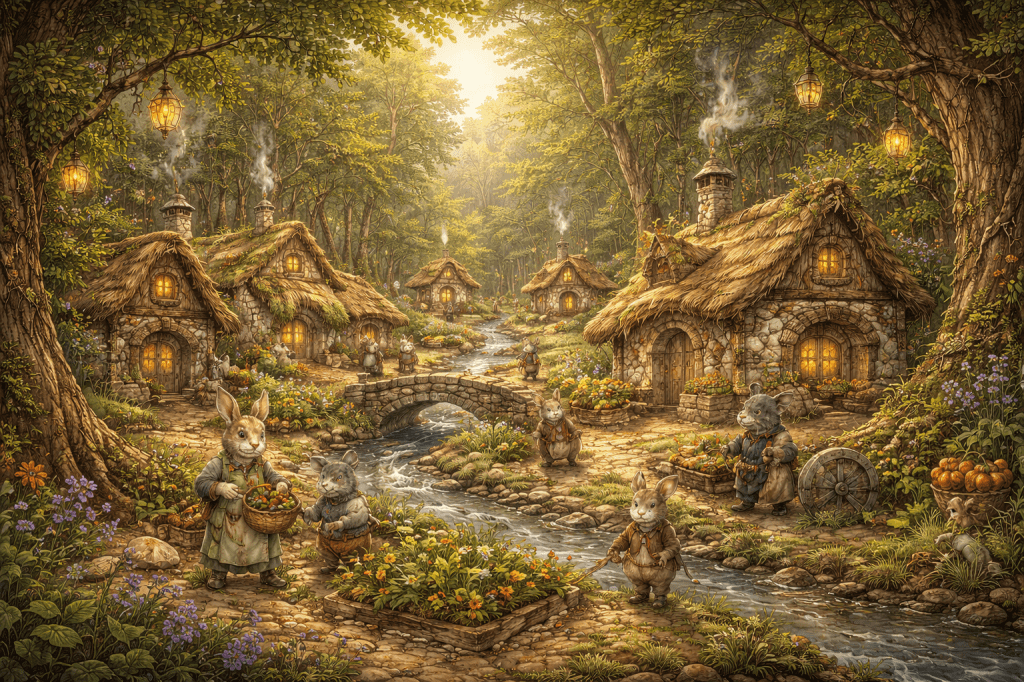
I shall not tarry long on this subject, for I am not an expert, and any discussion of the society of the pooka quickly becomes a discussion of the society of New Mountainheart’s countryside, for I estimate that six out of every seven pooka live within our fair kingdom’s forested glens.
We Pooka, as previously mentioned, are a staunchly conservative and socially cautious people, mostly descended from the serfs of the old world. As such, we remain largely agrarian in character, most often found in the countryside. We tend to settle in small, close-knit hamlets of seven or eight families, each largely self-sufficient and bound together by kinship, obligation, and shared memory. In the case of New Mountainheart, these hamlets are often nestled deep within the fairy forests where we harvest Faerie fruit, forage, and Hidebark tree bark.
Within these communities, leadership is rarely formalized. Day-to-day matters are governed by tradition, precedent, and quiet consensus, and disputes are typically resolved by appeal to what has “always been done.” When authority is invoked, it is most often deferred to an outsider of noble birth, even when that noble has little direct involvement in the life of the hamlet. To be fair, the small size of these settlements and the self-policing of the residents means that such authority is seldom exercised in practice, and many hamlets pass years—sometimes decades—without any direct intervention from the gentry at all.
In pooka settlements, tradition, precedent, and the perceived good of the group function as law. Written charters are rare, formal councils rarer still. Custom is remembered rather than recorded, and change, when it comes, is usually accepted only after it has already become unavoidable. This has made pooka communities remarkably stable, resilient in the face of hardship, and slow to fracture under pressure.
It should be noted that this social conservatism is not enforced through punishment or decree, but through quiet expectation. A pooka who chafes against custom is not exiled, nor censured, but gently ignored until they learn to behave properly once more, or else takes upon themselves to leave the settlement for adventure or employment elsewhere. Ambition is regarded with suspicion, innovation with discomfort, and those who seek prominence beyond the bounds of the hamlet are often encouraged—kindly, and repeatedly—to reconsider. In this way, pooka society maintains harmony not by forbidding change, but by ensuring that change rarely finds fertile ground.
I also have to note a recent development in pooka culture within our kingdom. Large numbers of pookas have been converting from Catholicism to the newly formed sect of Fey Paganism, which asserts that Queen Aoibheann is the lady reborn. I personally do not know what to make of these reports.
Magic
All fey have magic, our lands are surcharged with Faerie magic, and our ancestors were doused in the wyrd upon their arrival in this world. Likewise, pooka have always shown some supernatural ability. I do admit that I am no expert on the use of magic, so for the sake of this section, I was forced to rely on notes from Junior Professor Felice Ungers, whom I told is a former pupil of Miss Tansy and a lay sister of the Silver Moon Sisterhood.
According to Miss Ungers’ notes, we pookas have a near mystical connection to the Valley of New Mountainheart and to the land. Pooka peasants living out in the valley are reportedly able to navigate the glens around their homes, blindfolded, by the mere feel of the ground under their feet, and can instantly tell you where in the valley they are if you were to take them to a completely random spot. Also, pooka peasants are well known for their ability to handle animals and plants, as if they have developed a rudimentary sixth sense for them.
I cannot attest to the accuracy of any of these claims, nor have I witnessed anything that was clearly innate spellcraft among my people. Nevertheless, I have known several of my uncles and aunts back in Hushwillow to be able to do things with animals that seem quite out of the ordinary in the context of my more recent observations. As a youth, I have seen them coax life back into dying pumpkins and then grow them to enormous sizes, soothe even the most crazed sheep or goat, and generally seem more at home with our awakened animal and plant neighbors than my own kinfolk
The pooka in play.
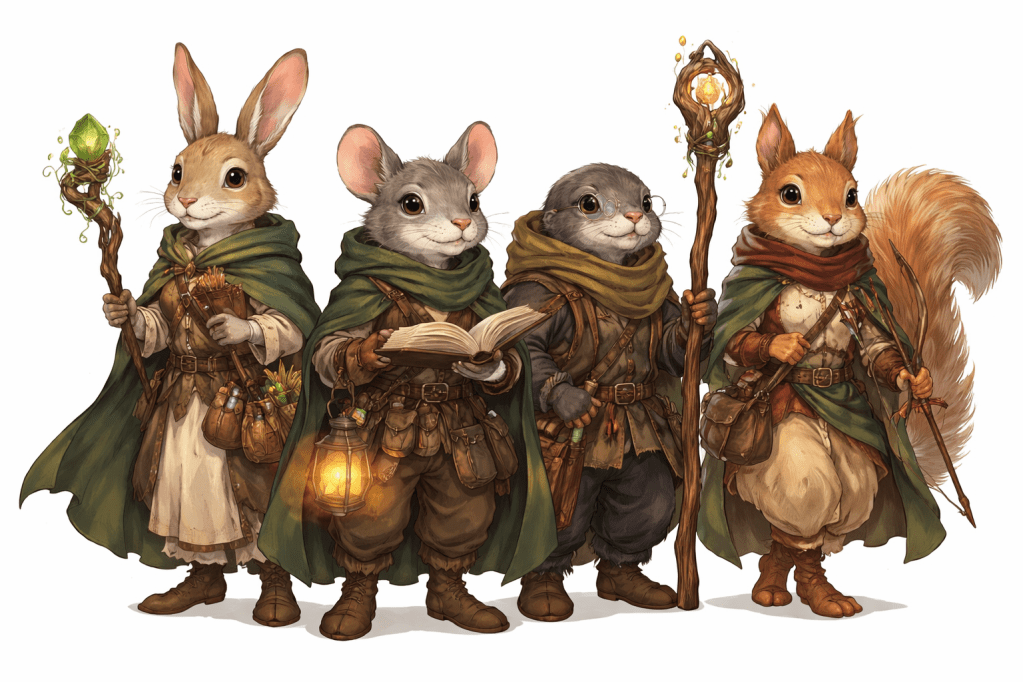
As a pooka, you are defined by your hometown and whether you embraced it or rejected it. Most pooka are content to quietly ignore the world beyond their fields and pastures when the sheriff or the taxman is not around. Any looming threat will eventually be dealt with by the gentry or some roaming adventurers, and they need not pay it any mind. Player characters are, by definition, the ones for whom this arrangement no longer sufficed for one reason or another
When playing a pooka, think about what your home was like and why you left. Were you a misfit that could never do right in the eyes of your elders until eventually you decided to leave? Or were you chosen by the community to deal with a problem they just could not ignore? Can you go back home, or is there even a home to go back to?
Pooka
Creature Type: Fey
Size: Small or medium
Speed: 30 ft.
Life Span: Pookas typically live for about 100 years.
Natural Agrarian: You possess a unique connection to the land, making you exceptionally skilled in cultivating plants and understanding animals. You gain proficiency in either the Nature or Animal Handling skill. When you forage, cultivate crops, or harvest plants during downtime, you produce results as though you had spent twice as much time.
Bound to the Land: You have a connection to your homeland that goes beyond mere familiarity. Your homeland occupies a continuous region equivalent to a number of 6-mile hexes equal to your wisdom modifier. While in your homeland, you gain the following benefits
- You cannot become lost except through magical means, and you know the quickest way to any notable landmarks known to the region
- Nature checks made to identify plants and animals are made with advantage.
- You can always find sufficient food and water for yourself (and up to a number of creatures equal to your Wisdom modifier) without the need for a check, provided such resources could plausibly exist in the area.
If you so desire, you can abandon your current homeland and establish a new one. To establish a new homeland, you must spend a number of weeks equivalent to the size of your homeland, thoroughly exploring the hexes and studying the wildlife. You can have only one active homeland at a time
Keen Senses
Your sharp senses allow you to be highly aware of your surroundings. You gain proficiency in the Perception skill. You have an intuitive awareness of the flora and fauna around you. You can identify the presence (but not precise location or intent) of non-hostile plants and animals within 30 feet of you, provided they are native to the environment you are in.


Leave a Reply