

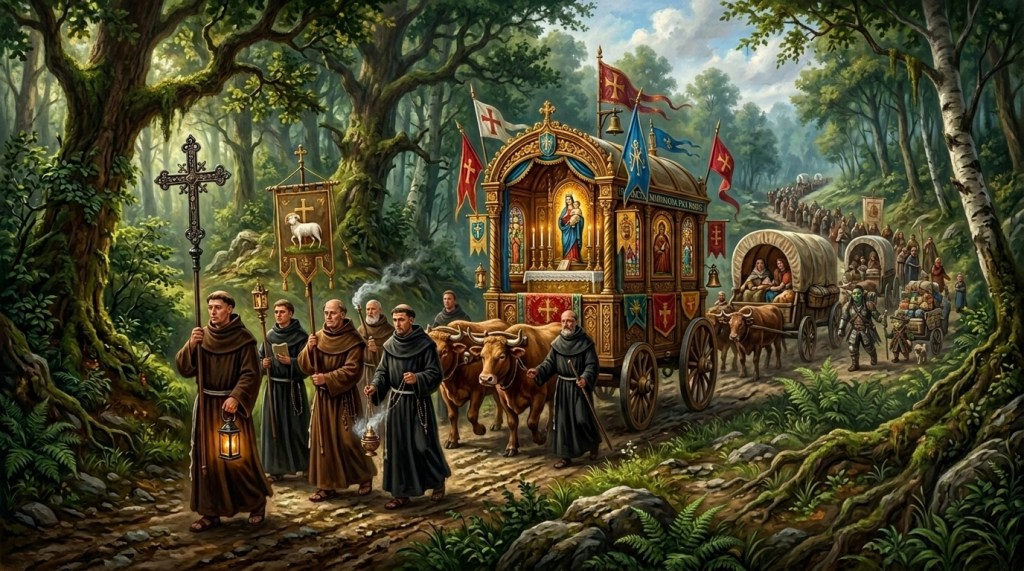
In March, I generally listen to a lot of folk music, mostly from Ireland, for obvious reasons. A common archetype in these songs is the rambler, a person who cannot or will not stay in one place for long. The Feengrenze’s sole world, Domhannua, is a place where rambling is a foreign concept. It is a smattering of mostly inward-looking enclaves and successor states separated by leagues of untamed wilderness. It is a world where most folk cling to their home and hearth, and the next town over might as well be on the moon. But there are always a few that take to the road, some chasing profit, some in search of a homeland, and those whose faith and conscience demand it. These are the folk of the roads.
Flimflamers
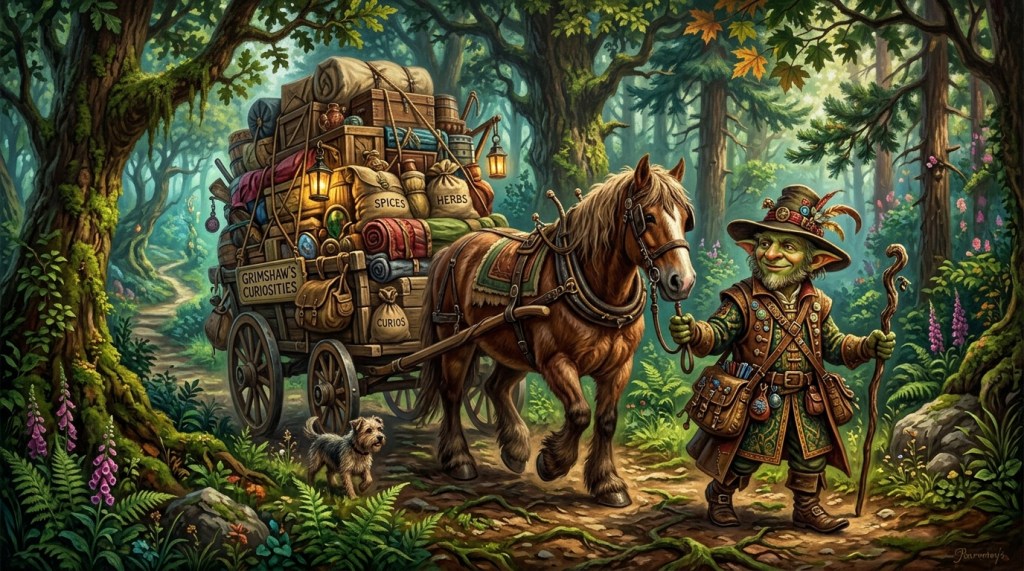
Goblins only really care about two things: having a horde of gold coins and causing mischief. Since time immemorial, there has been one sure-fire way to achieve both at the same time: flimflamming. Out from the Faerie roads, goblins in what could be called presentable clothes, in loose terms, would wander into mortal towns with backpacks filled with Faerie fruit and other magical doodads to trade with mortals for gold coins. They would then retreat to whatever vantage point they could find, watch the mortals make a fool of themselves with their new powers, and be satisfied that they did not lie about their words; they just did not tell the whole truth.
This tradition of the traveling goblin flimflamer continues unabated on Domhannua, but with one tiny difference: the mortals have long since gotten wise to the nature of the goods they sell, so the flimflamers had to adapt. Instead of looking to cause mayhem by selling rubes things that they cannot control, they now focus on moving products to get rich, preferably with very little effort. Goblins have always been the get-rich-quick sort, and there’s plenty of money to be made from selling the latest and greatest fad or magical doodad in Sliberberg, Slanach town, Vineta, and Qualdria to yokles out in the sticks, provided you have the gift of gab and fleet feet.
The typical flimflamer works on a seasonal basis. The so-called hunting season on Tir Na Calite runs from late Thawmoon, when the roads become passable, to Samhain, when the weather quickly starts to turn foul in much of the Lyonesse Marches, Moon Mounts, and the Silver Highlands. During this period, it is fairly common to find goblin and non-goblin flimflamers traveling the roads all over Tir Na Calite with overstuffed backpacks, carts, and wagons of various sizes, and even the occasional 3-axled 6-wheeled sleeper wagon with a built-in shop and a team of oxen looking for the next sale. When the season ends, flimflamers descend on the coastal cities to stash their earnings. During this wintering season, a good flimflammer will be on the lookout for anything novel enough to sell at a significant markup, preferring intermediate manufactured goods (like cloft), cheap magical trinkets, and anything that seems fancier than it really is or has potential to start a fad. Of course, in a pinch, things like Faerie Fruit preserves, gigglewine, potions, and novelty toys are always good sellers, and many can be procured in the field.
Goblins tend to have mixed feelings about their flimflamming brethren. While it is true that flimflammers tend to be among the richest of all goblins, second only to slum lords and owners of breweries, alchemical works, firework and novelty toy factories, the consensus is that professional flimflamers are less goblin than others. Most goblins take pride in their thick layer of grime, dirty clothes, and awful smell. Flimflamers, due to the nature of their profession, need to be at least presentable to mortals, which means presentable clothes and regular bathing, with only a strong, usually homemade cologne as a token attempt to be disgusting.
Ironically, they are the only goblins widely accepted among what the goblins call yarks, aka rubes, since, as well as being cleaner than the average goblin, they also tend to be much more restrained in their mischief, restricting themselves to gags with novelty toys or promoting the mild form of stupidity associated with drunkenness. After all, raw, unbridled chaos is bad for business in the long term. But the occasional spooked herd of cows, a well that runs green for a fortnight, or an embarrassed country squire can be very good for business, provided one happens to be selling the appropriate remedy.
So when the snow melts, and the roads become passable once more, the flimflamers emerge with packed backpacks, carts, and wagons creaking under their wares. The hunt begins anew, and there is no shortage of gold waiting patiently in the forests and hills for someone persuasive enough to coax it loose.
Orcs
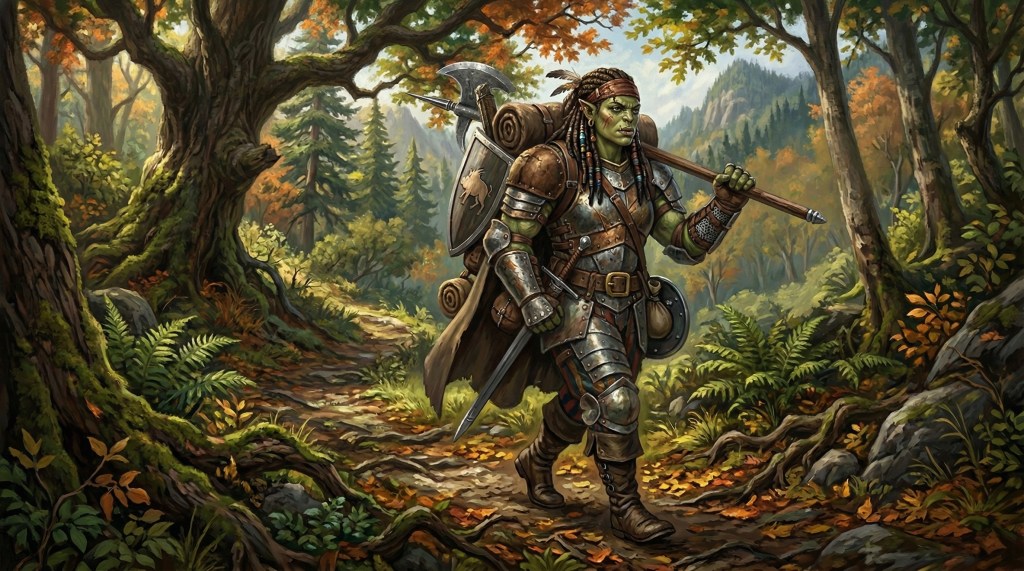
Of all the mortal races, the orcs are most pitied and feared. They are pitied as a species without a homeland forced to wander hither and thither, and feared as they are always traveling towards one thing and one thing alone, battle.
Yes, the image most people have of the orc is the wandering sellsword and adventurer in piecemeal armor, using their polearm or greatsword as a bindlestick as they hobo from town to town, alone or in small groups, looking for battles to fight and monsters to slay in exchange for a few nights with a full belly. To the average peasant folk of the enclaves, orcs passing through are a bad omen, an omen of violence too close to comfort, be it in the form of war, a rampaging beast, or a desperate, hungry mercenary.
The orc homeland is long since gone; what it was like or where it went is a matter of contention. The descriptions of the orcs’ homelands, roughly how long ago they were lost, and how they were lost, as given by the orcs themselves, vary so widely that it is believed there is no single orc homeland. Various smallish groups of orcs, with temperaments ranging from almost civilized to raging barbarians, arrived in the Feengrenze over multiple centuries from different worlds, sometime between 300 and 1200 years ago.
The orcs have never had a chance to recover from whatever catastrophes doomed their homelands. They mostly arrived in small bands and tribal groups in the territory of more established civilizations or deep in the wyrdlands. Naturally, the tribes and bands that were less inclined to coexist with their new neighbors were culled quickly. However, those same bands gave the orcs as a whole a pretty bad reputation with the enclaves and the successor states, and any orc who was at least inclined to honest work was driven out into the wilds.
Orcs mostly live in small nomadic bands out on the edge of civilization. They subsist on small herds of hardy livestock and what they can catch, forage, and hunt. There are no idle hands in an orc band; old or young, men or women, all work to gather enough to survive another day.
This is doubly true for the one or two sons or daughters from each band who sell themselves as mercenaries and adventurers. All orcs know how to fight with a poleaxe, javelin, and greatsword. When an orc comes of age, they go out to find the sort of work that requires such skills, either traveling alone or joining mercenary companies. This serves three purposes: the young orc is to bring back the sort of goods that can only be acquired in civilized lands with gold, second, it eases pressure on the band’s limited resources, and third, they are expected to bring back a mate.
Among mercenaries and adventurers, orcs tend to be surprisingly well-behaved. When every penny counts for your folks and siblings back home, carousing becomes something you cannot afford. In battle, orcs tend towards the most dangerous and therefore best-paying work. They serve as shock troops, using their impressive strength to smash through pike squares or to be the first over the wall in a siege.
If the roaming scion does manage to return to the band after a few years of mercenary work, they usually are leading a newly purchased drafthorse laden with cloth, blades, metal tools, needles, and other manufactured goods, their new spouse at their shoulder, and often a new addition to the tribe in the womb.
It is often joked that war is courtship among orcs and that they cannot roll in the hay until they have fought their partner to submission. There is more than a kernel of truth to the joke; roughly half of all orc couples meet for the first time while fighting for opposite sides of a battle, the rest while fighting for the same side. The traditional opening move of traditional orc courting is to spar with your would-be mate on or off the battlefield while flirting. If one yields or falls before the other, it is clear they are not meant to be together, and regardless of the circumstances, they both part ways; if they both yield at the same time, further courting may commence.
Those non-orcs who get to know orcs or their tribes well report that orcs are not the warmest of species. Their whole species seems infected with a melancholy at their lack of a homeland that neither ale nor good company can disperse. Even their Beltane and Samheim festivals, the two times a year when multiple orc bands gather in one place, are dour affairs marked by commiseration and comparing notes as to which kingdoms and enclaves grow hostile and which places remain safe enough to linger. One might even hear speak of Orkkholmn at these gatherings; depending on whom you ask, the mythical homeland of the orcs is either long lost or yet to be found.
However, all orcs agree on one thing: the first monarch of the orcs will be the man or woman who finds Orkkholm.
So out the young and restless of the orc bands go out into the world looking for a place where the orc bands can gather beyond the reach of the successor states and their well-organized armies, dreaming that they will be the hero who becomes the ruler of Orkkholm. Until then, however, the orcs live on the edge of a knife; the memories of the other species are long, and they all remember the time when the orcs razed and pillaged all.
The Orders of the Road
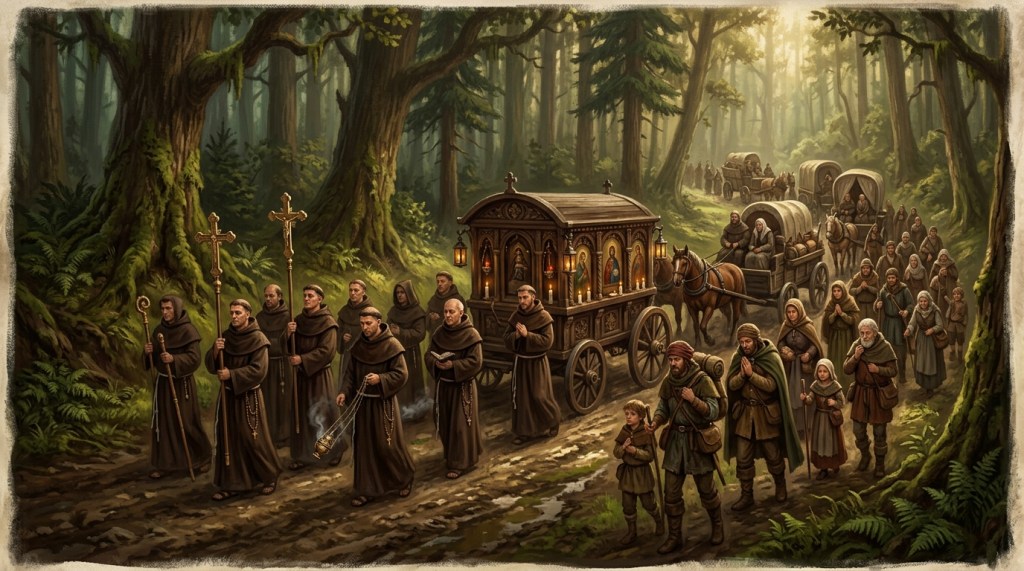
Healing magic is rare in the outlands. Beyond the occasional druid, Silver Moon Sister, or wandering cleric with a vestigial spark, the average country bumpkin only has access to herbal remedies and expensive potions bought from flimflammers. This usually suffices for most aches and illnesses associated with simple country life. However, when serious illnesses or injuries rear their ugly heads, there is usually no hope except to take the ill person far away to the larger churches and monasteries where the saints’ relics lie. However, for most in the enclaves, this is impossible; the distances are great, the expense even greater, the wilds perilous, and there is no guarantee that the one in need of healing will even survive long enough to reach a healer. Some among the Christian clergy, more faithful in their devotion to the word of God and the teachings of Jesus, have noticed this need and have abandoned their monasteries and churches to take their relics where they are needed most, as orders of the road.
Order of the Road is a general term used by laypeople to refer to any Christian monastic group that forgoes a traditional monastery in favor of being completely or almost completely itinerant. Most members of a given order of the road usually travel in a handful of convoys comprising the order’s brothers, their pack animals, pilgrims traveling with them, general travelers seeking the protection a convoy can provide, and at least one mobile reliquary built into a large wagon or cart. The convoy travels from settlement to settlement along a route set by the deacon leading it, setting up their mobile monastery outside enclaves and trading religious and magical healing services for food and fodder for a few days before traveling to the next settlement, never stopping for anything, even in inclement weather.
Strangely, this idea is popular across all sects of Christianity, from Catholicism to Orthodoxy. Most of the orders of the road were sedentary orders before they, usually under their own initiative, abandoned their monasteries for a life on the road. The higher echelons of Christianity have never been particularly thrilled by the prospects of sacred relics and their resident vestigial sparks wandering the countryside. The bishops, archbishops, and abbots fear that the orders of the road cut into the pilgrim traffic and the resulting revenue, which might be true. The Patriarch of Kitzeh and the Cardinal Supreme fear for the safety of the relics, which is certainly true, for who knows what lurks in those woods, and no number of paladins and clerics hospitaliers can assage those worries.
But it is because of those dangers — the beasts, the brigands, the robber barons, and the Wyrd — that the Orders of the Road do what they do. The vestigial sparks are compelled to the work of their deities, as once they were compelled as angels. If the ill and injured cannot reach the relics, then the relics must be carried to them.
So the Orders travel onward, wagons festooned with painted saints and chiming bells. In every village they approach, simple folk gather in hopeful lines to receive even a pittance of divine grace. For the brothers of the Order, from the lowest novice to the paladins and abbots, it is not merely an obligation. It is an honor.
 The feengrenze historia
Leave a comment