

It’s not often that I post twice in a single week, but this one couldn’t wait. I’ve been wrestling with Sliberberg’s visual identity — its look, its vibe, the feeling it should evoke the moment you imagine it. On Saturday the 13th, everything finally clicked.
With the right inspirations in mind, the city suddenly snapped into focus, and I realized I’d stumbled onto something I’d been circling for a long while. I had planned to coast into the new year after finishing this month’s posts last week, but since this question has been front and center in the last two entries, it felt wrong not to show the finished result.
So, come take a look — and taste — the visual identity I finally managed to cook up.
The ingredients: My inspiration
Any good dish requires ingredients, even when the dish is a tortured metaphor for a work of the mind. Here are the ingredients that I put into my pot:
The Terrain
I might not have mentioned this before, but Sliberberg’s general environs are based on real geography in the northeastern United States. The Sliberberg is based on Mount Cadillac on Mount Desert Island and shares its height, footprint, and general shape. On the other side of the harbor is Marytrs Hill, which is loosely inspired by Great Blue Hill in Milton, Massachusetts. Between the two is SLiber Gorge, which is loosely based on real river gorges in the white Mountains, Flume Gorge in particular. The city is smeared across the sharp angle between these features, which squishes it and forces it upward along the SLiberberg.
A Muppet’s Christmas Carol
I am not one for Christmas movies, except for A Muppet’s Christmas Carol. The sets of the film have this lovely old-Victorian-city vibe that is instantly recognizable yet feels somewhat timeless, like they shot it on site somewhere in a real city, not a studio backlot (yes, they did film it on a backlot, I checked).
As I was rewatching some of the scenes for study, I also realized that the pooka were pretty much the animal muppets from the movie, just made with flesh and a little bit taller. Also, the costume work for the film for both muppet and human alike nails the look of the setting.
Grimm’s Fairytales and their modern adaptations.
Kind of obvious inclusion for a world where everybody operates on fairytale logic. I established early that SLiberberg is a green city, and New Mountainheart is the forest from the first half hour of Sleeping Beauty. So I decided to superimpose a fairy forest over the town and sprinkle it liberally with various fairy-tale tropes.
Jim Henson’s The Labrynth
A necessary inclusion for general weirdness, surrealness, and whimsy. Also, I borrowed the goblin designs. Jim Henson Studios’ goblin designs are second to none.
Irish mythology
And finally, some select tropes from Irish mythology about the fae. Sliberberg is a city devoid of iron, with brass and bronze serving in its place.
SLiberberg’s visual identity, vibe, and style
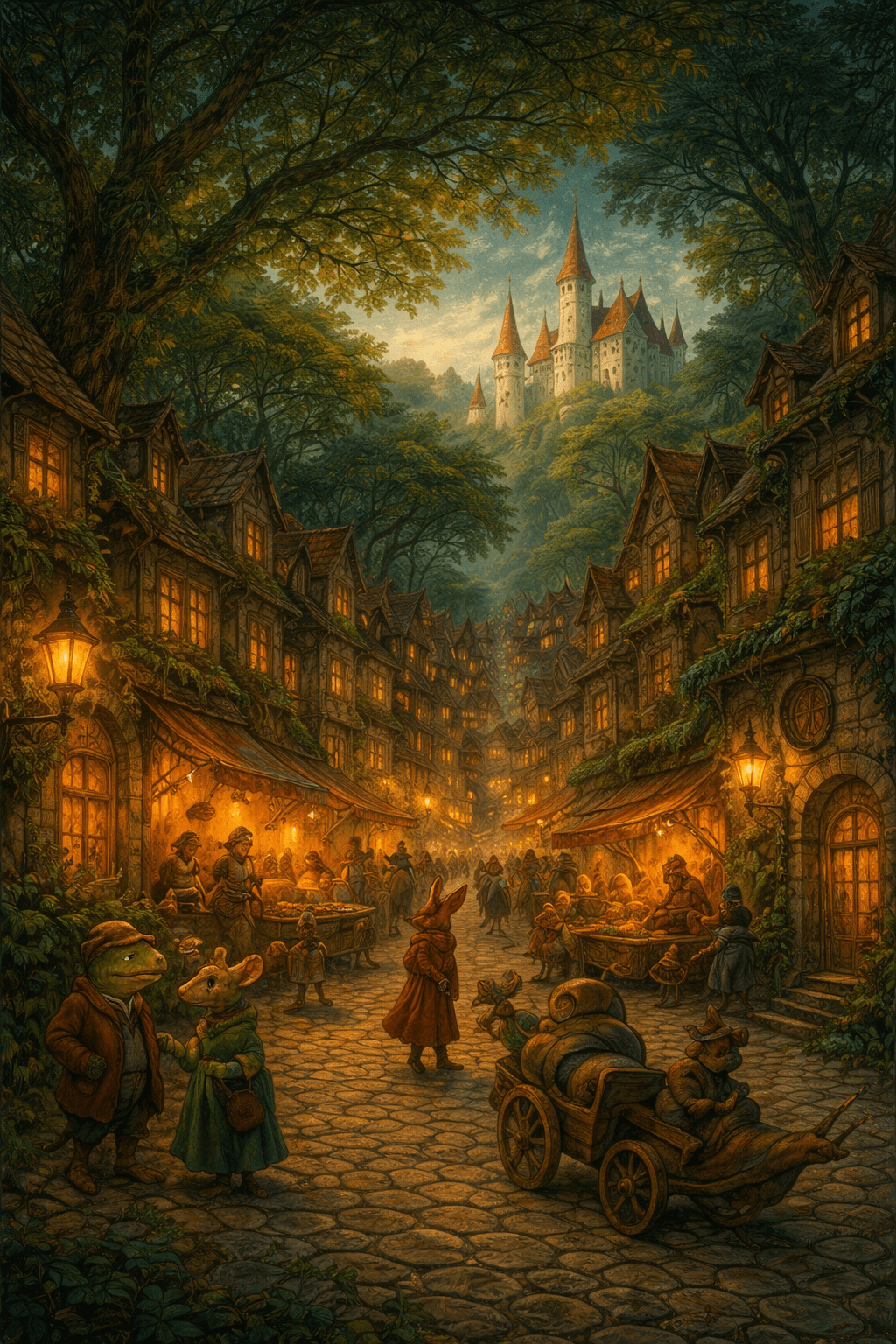
Sliberberg exists in a soft, perpetual twilight, created by two ever-present forces: the shade cast by the towering forest canopy above and the continuous, gentle glow of street lighting below. The result of these elements combining is not so much a city as an old-growth faerie forest that decided to experiment with urbanism, hired a bunch of drunk fairies with an infinite budget to handle the lighting, and then invited every creature that could talk and count to at least two to take up residence.
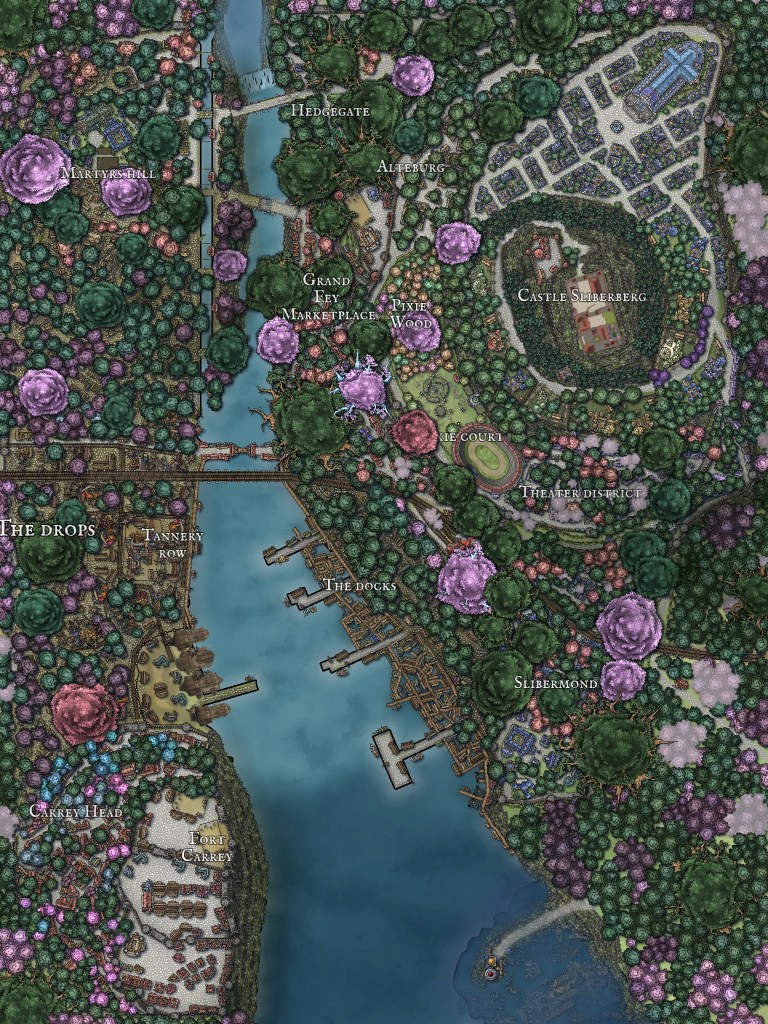
Trees are the defining element of Sliberberg’s skyline. The city is built beneath and around several dozen titanic ancient faerie trees nearly as old as the city itself, with thousands more filling the spaces between. Together, they form a continuous canopy that remains green year-round and creates the twilight world below. From a distance, it is difficult to tell where the fairy forests of the countryside end and the city begins.
This is not to say there are no borders at all. There are walls — old, imposing things of stone with battlements — surrounding the city and its various wards, but they are largely hidden beneath foliage, terraces, and towering piles of buildings pressed against them. They serve more to delineate the edge of the city than to defend it, for once one passes through the brass-barred gates, one enters an otherworld within the already tertiary otherworld of New Mountainheart, itself suspended in the in-between place of the Feengrenze.
The city is a maze of winding, well-maintained streets that snake up and down the mountain’s slopes, curve around giant trees, and meet at odd angles. Lining them are an eclectic mix of wood-and-brick buildings more at home in the historic districts of old European cities like Edinburgh, Jena, or Bern. They lean intimately over the streets, stack against one another in massive piles climbing the slopes, and cling to the bases of the titanic trees throughout the city. Buildings are constructed around these living giants, using them as pillars or carved directly into their trunks. As well as the green of the trees above the buildings themselves, it is dappled with green. Moss, ivy, and other vines creep across everything; windows sprout garden boxes wherever there is light, and where one would expect iron and steel like fences or fittings, instead, brass and bronze glimmer in the dim.
Faerie magic saturates the city. Beneath the canopy, the air is thick with it, carrying a faintly dense, tingling sensation. The entire valley is awash in magic; however, it seems to possess a higher concentration here than anywhere else in the valley. Street signs hold conversations with one another, cul-de-sacs unfold into small mazes with exits scattered across the city, shops change their wares on a whim, and streets occasionally change their minds about where they go. The folk do not mind this. It is simply how the city works.
And then there are the people. Nowhere else in the Manyfold will one find a more eclectic mix of species. In the Grand Fey Marketplace, one might observe the native pooka — short folk resembling the meeker species of mammal, dressed in Regency-era human clothes and given unmistakably muppet-like proportions — alongside humans, dwarves, elves, goblinoids, fairyfolk, and awakened animals. Even beings one would not normally expect to be law-abiding citizens, such as hags, devils, and brutish formorians, mingle freely among the crowd. A young dragon might even be spotted ducking into a shop to eagerly spend its horde on trinkets or baubles. Above the streets, the air throngs with awakened birds, magical creatures, and magical folk riding brooms, flying carpets, and stranger conveyances. On the high street, carriages and wagons share the road with the ubiquitous giant snails, their shells fitted with wagon bodies. The city is like this at all hours. Sliberberg rarely sleeps and is almost never silent.
Above it all, at the end of a long road lined with palaces and lesser castles that curls around the forested slopes of the mountain, rises Castle Sliberberg, the seat of the von Mountainheart family — a crown of red-topped white spires reaching skyward. It stands as a promise cast in white stone: that here, dreams can come true.
New Maps
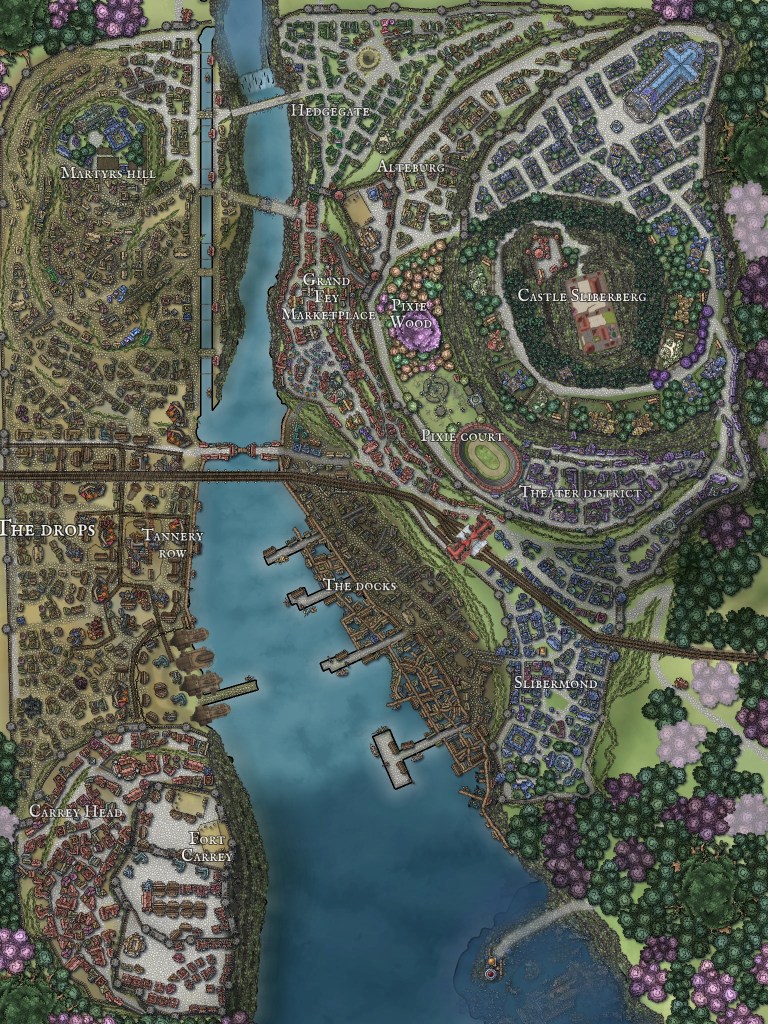
It also just so happens that I was reworking the map of Sliberberg to fix some… issues caused by changes to the kingdom and region maps and to generally make the maps look better, using the new assets from Inkarnate 2.0 to get the protofactories of Tannery row looking right. I think the results speak for themselves. The SLiberberg looks like a real mountain now with hips and ridgelines. Martyrs Hill now resembles its inspiration more closely, and its street layout more closely resembles the maze I had in my mind.
The new map of the city
With Most of the Trees Within the City Removed
 The feengrenze historia
Leave a comment