

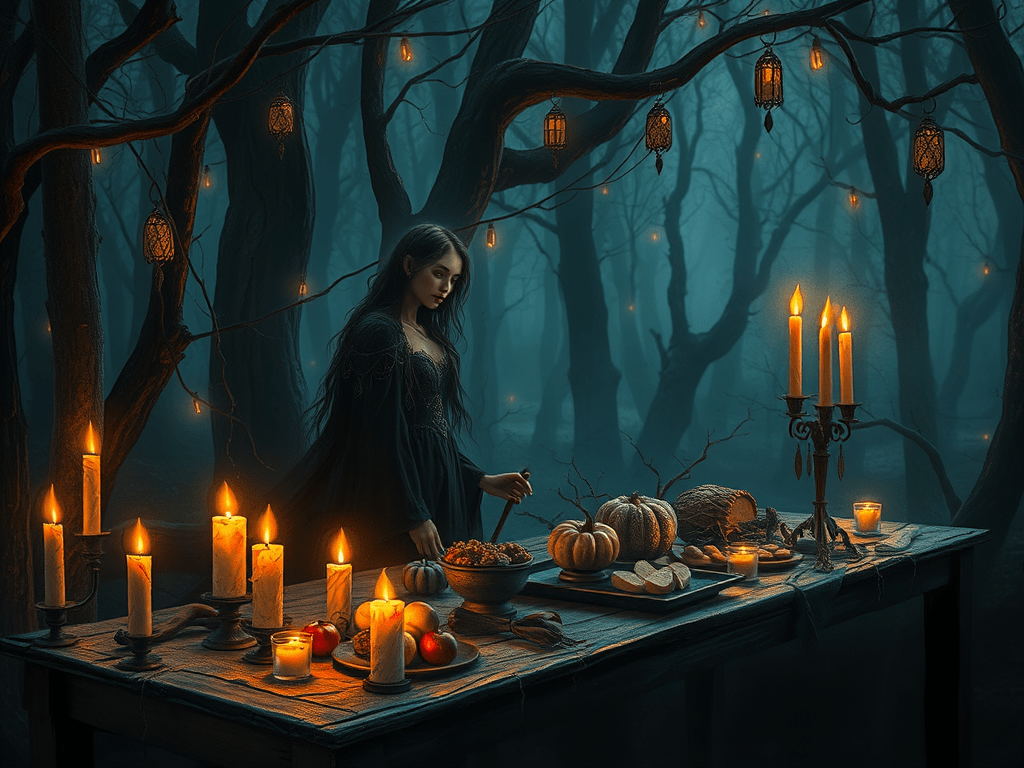
It’s that time of year again — when the veil thins, candles burn low, and Samhain returns to the Feengrenze. I missed the last few holidays of the year’s wheel—that’s on me for forgetting—but I am back and plan to get them next time. But for now, let’s discuss the Old Fey Pagan festival of the dead.
Half Fey: An individual of a fey species born outside Faerie or a mortal being who emigrates into Faerie and stays at least 8 months and three days within the Metauniverse. Half Fey have some of the powers of full Fey but lack the timelessness and immortality that Full Fey possess.
Origins
Like every turn of the wheel, Samhain in the Feengrenze carries myth and mystery. Its roots stretch deep into the soil of Old Fey Paganism. According to the myth and lore of Old Fey paganism, on the last day of the 10th month of the Feengrenze’s year, the Lady, in her aspect as the crone, slew the lord in his aspect as the withered tyrant, ending the cycle of the year. In truth, Samhain is the day Niamh sealed her husband, Faolan the mad, in his cell deep beneath the Feengrenze, and she herself died.
Since the beginning, it has been seen as a day for venerating and appeasing the dead; it is believed that Samhain is the time when the Metauniverse of Oblivion, where the dead supposedly reside, is closest to the Feengrenze. This is complete nonsense. Oblivion is not the realm of the dead but the Metauniverse of decay. The true dead do not reside there. Still, the Half-Fey believed that on this night, the dead — and the hungry spirits of Oblivion — could cross into the living world to visit loved ones… or to cause mayhem.
The truth is actually more terrifying. On Samhain night, Faolan the Mad doubles his efforts to break free. Each struggle sends wyrd magic surging through the world, widening the crack in his prison walls. This same surge of magic is the source of much of the mischief and mayhem blamed on the undead — especially in settlements near the Wyrdlands, where the walls of Faolan’s cell are thinnest.
Celebrations
Traditional
Historically, Samhain has been a night for horrors, strange noises, and staying indoors among those who practice the fey pagan ways.
The undead and the spirits of death and decay were believed to stalk the night and carry the unwary away, never to be seen again. It was also the one night of the year that the spirits of the dead would return to their families’ residences to be with them. Traditionally, fey families would leave a candle lit in the window to lead dead loved ones back home, provide a place for the deceased at their tables, and hang protective talismans wherever they could outside their dwelling place to ward away the bad spirits. Communities would leave out offerings of fruit and baked goods for those spirits with no family left, and as an offering for the restless spirits of Oblivion. It was believed that if the spirits of the dead were not appeased, then they would cause mayhem around town, breaking things and rattling windows.
If a person needed to travel or be out on this most magical and dangerous of nights, they would dress themselves in white with grotesque masks in hopes of blending in with the angry, restless dead. Often, they would carry a gourd or a turnip carved into the likeness of a will o’ wisp and place a single coal inside to hide their need for light from the undead. It was also customary for a few brave souls from each community to serve as watchmen this night, traveling about the town to scare off the undead.
It is also said that divination is easier on Samhain night, and it is true. Faolan’s struggle causes wyrd magic to flood the world, which decays into raw fey magic when it reaches the stable lands. Divination magic, all sorts of magic in fact, is stronger in this hyper-saturated atmosphere. Of course, this same magic is also the source of the “mischief and mayhem attributed to the undead and spirits of this night that would rock the settlements closer to the wyrdlands every Samhain night.
Contemporary
Four pagan holidays have been adopted by the mortal folk: Yule, Beltane, Midsommer, and Samhain. This is likely because they align well with existing holidays and festivals in the mortal folk’s culture. The fact that Samhain falls on the same day as the feast of All Hallows on the Christian calendar has likely contributed to its widespread appeal.
However, most communities do not follow the traditions of the Half Fey and use the holiday as an excuse to hold a harvest festival. Samhain has always coincided with the final harvest of the year and the butchering of the non-awakened farm animals, which many cultures from our world already celebrate. Communities in the Feengrenze celebrate the end of the harvest with music, dancing, games, and bonfires well into the night. Over the centuries, mortal folk have adopted some of the fey pagan symbols of the holiday, including costumes, the spooky talismans, and jack o’ lanterns, and the whole holiday has taken on a sort of undead theme in places like Sliberberg. The Half-Fey are not fond of what mortals have done with their oldest festival. Of all the holy days, Samhain remains the one they approach with the most fear, not joy. For them, it is a night to endure, not to celebrate.
Of course, the royals celebrate this holiday, too. Against the wishes of their half-fey vassals, the royal couple of New Mountainheart are preparing an elaborate costume ball. Strangely, Samhain and Halloween are banned in Loch Slanach. It is widely believed that Fionnuala the Fair’s birthday falls upon that night; her court is undoubtedly filled with dignitaries and godchildren bearing gifts when the holiday comes around. Yet those who know the true history whisper that, despite her age, Fionnuala is still a mother’s daughter — and that the last night of the tenth month opens old wounds and hearts once broken.
 The feengrenze historia
Leave a comment