

Something has been gnawing at me for a few months since I published Introducing the Manyfold. In establishing that the Feengrenze is at the dead center of the multiverse, where the six fundamental metaphysical forces should cancel out, and proving that every single divinity is a manifestation of the Allsource, which leaves me with a plot hole, how does divine magic work in the Feengrenze? After thinking about this for a few months, I have come up with a suitable, flavorful, and slightly terrifying answer to why divine magic works in the Feengrenze
What are Gods anyway?
In the Manyfold, gods—as mortals understand them—only half exist. There are hypernatural beings, the inhabitants of the metauniverses, who are called gods by mortals, and the metrarchs, the manifestations and often rulers of the forces of each metauniverse, who definitely have the powers of gods. Still, you will not find a being identifying as Zeus, Odin, Yahweh, or any other deity, although these three exist as different guises of the archetype Skyfather.
The substance of religion is belief, and all belief flows from the Metauniverse called the Allsource. There dwells the hypernatural beings known as the Archetypes, beings of pure belief the mortals call gods. Each Archetype is a collection of beliefs, motifs, and symbols that have coalesced into a form and personality befitting their self-appointed role in the Allsource’s cosmic drama. Witnessing an archetype’s proper form is impossible, nor can mortals hear them speak in their native celestial. By its very nature, the mortal mind plasters a familiar mask onto the form of an archetype. Thus, Skyfather becomes Ra, Odin, Zeus, and countless other deties from across the multiverse.
The Blind Spot of the Gods
The Feengrenze is a flawed attempt at a perfect prison for Faolan the mad. Located at the exact spot where the influence of all the Metauniverses cancel out, making it, in theory, perfectly unchanging. Furthermore, the world is hidden at the bottom of the most enormous, densest black hole in the Manyfold, a black hole so powerful that not even magic or hypernatural beings can escape, except for the fey folk who can use the umbilical linking Faolan the Faerie to come and go as they please. To (most of) the hypernatural beings that populate the metauniverses, the Feengrenze is a terra incognita, a realm of myth and speculation from which no explorer has returned.
This situation is particularly frustrating to the archetypes. By their very nature, the archetypes are the closest of all hypernatural beings to the mortals. They know that they have followers within the Feengrenze; they have witnessed each time the Feengrenze grabbed a civilization on death’s door to patch a hole in Faolan’s cell. They know via ambassadors from Fairie that those dead civilizations still survive after a fashion in shambling abominations of their predistaster forms.
The Archetypes are hyper-opinionated beings; they have strong feelings about almost everything, especially concerning their particular domain. When they get even the slightest evidence of their followers or anyone else doing things “wrong,” they will pop down either by messenger or in person and give the offending mortals not-so-subtle hints about their displeasure until they start doing things right. That’s why the Feengrenze situation is so unbearable to them, they cannot see what is going on in the Feengrenze, they know they have followers there that are not merely just in the wrong but screwing things up big time, and they cannot go to fix it. For eons, they tried to find a solution to this issue, but they did not want to rely on promising thousands of favors to the twin queens of the fey; the only solution that worked was borderline cruel.
A Crude Solution
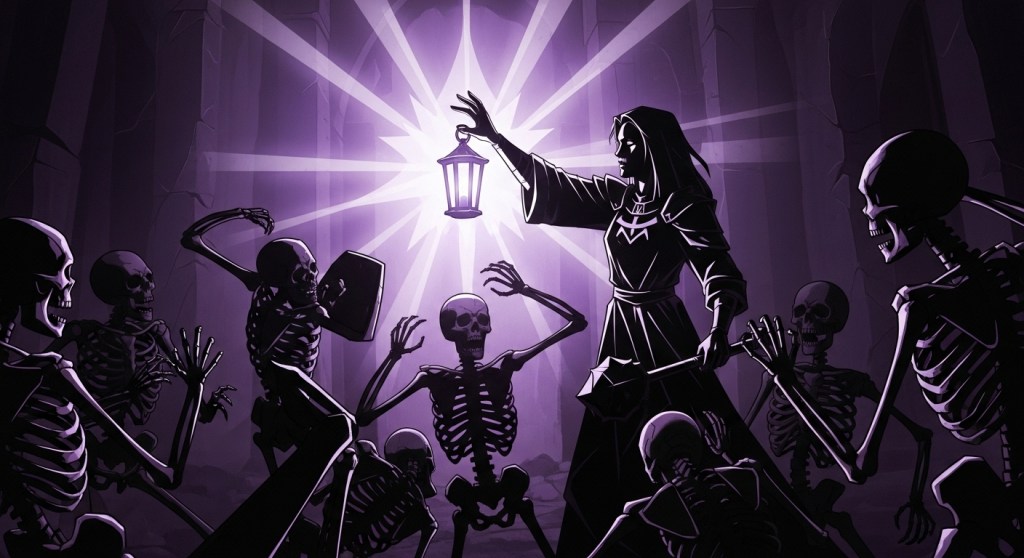
When an Archetype decides that some mortal in the Feengrenze needs a divine correction, they summon a powerful angel or archon volunteer, usually a solar or planetar, and empower them to enact their will in the Feengrenze as their deputy. As Deputy, they have full power to speak in their name, make decisions, and pass judgment on their behalf. These brave angels know that these missions are suicide runs and are fully resigned to their eventual fate.
When a resident of the Allsource loses their connection to the belief flowing from the Metauniverse of origin, be they angel or Archetype, they start to waste away. Eventually, they will fade into a vestigial spark, a tiny glowing orb of residual divine power and lingering will. In this state, they only have a pittance of power and fractured memories of their previous life, seldom more than their name and bits and pieces about the archetype they once served. The rate of decline is directly proportional to how often the celestial uses their divine powers. Deputies of the Archetypes burn out quickly; their duties demand that they flex their powers frequently. Yet even in this state, they will try to fulfill their purpose, using their dwindling powers to do anything they can to achieve their master’s goals, which only hastens their almost inevitable destruction.
However, it is often in vain that they work; there is always too much to do and fix, and the Successor States and enclaves are fixed in their ways. The deputized angels burn themselves out only to be replaced with another, and then another, and another. The archetypes have an infinite supply of celestials to send, and they will keep sending them until they finally get the messages across or doomsday comes.
Birth of A Cleric
Most vestigial sparks fade into nothingness in forlorn corners of the world, unseen by all but the most devout. All celestials are cursed to know when their end is near, and vestigial sparks are no exception; they fear their ignominious ends in a way that most celestials do not. They lament and plead for the universe to spare them as they fade, usually to no avail.
However, there are rare occasions when a passing mortal hears the sparks’ death laments and encounters the Spark in its fading moments. The spark will beg the mortal to save them, believe, and help them finish what they were sent to do. More often than not, this individual agrees. The spark will then instruct their savior on creating a suitable container for them. The vessel usually takes the form of a lantern, a humble reliquary, or a portable shrine. There are notable exceptions to the container being a shrine or lantern; holy avenger swords almost always contain a withered, starving spark within their blade.
Even in such a diminished state, the spark will have a driving need to complete its mission. The belief of a single soul is scarcely enough to sustain a vestigial spark, let alone fuel a world-changing spell. The enshrined spark will usually urge its keeper to gather belief, preach its archetype’s gospel, as provided by the spark, and work the will that the Archetype entrusted initially to the former angel.
As both reward and a means to that end, the spark offers what power it possesses to power the cleric’s divine magic. Most nascent clerics, often members of devout enclaves or low-level clergy, agree to this contract; thus, a cleric is born.
While a relationship between a cleric and their enshrined spark may seem transactional, even a little mercenary, it typically is not. Most clerics treat their sparks like their closest friend and confidante. Once they recover some of their lost power and mental capacity, most sparks grow fond of their keepers, even growing deeply melancholic once their keeper passes on from this world.
Life Support Centers for Ailing Angels
Most clerics end their lives facedown in a ditch or entombed in some forgotten dungeon, their sparks left to cool into lifeless metal. A rare few burn so brightly that even death cannot snuff them out. Their relics — bones, blades, and broken icons — still hum with the faint pulse of the spark within, the lingering fragment of the All-Source that once answered their prayers. These relics become the heart of cathedrals, monasteries, and shrines. Pilgrims kneel before them, whispering petitions to what they believe is a god, unaware that they are really feeding a starving ember of what was once an angel.
Each spark’s power, memory, and sanity depend entirely on belief. The more prayers it drinks, the more lucid and potent it becomes. Most are content to linger in their relics, murmuring in the guise of divine will — a steady, predictable drip of miracles and doctrine. To their worshipers, they are the voices of heaven. To those who know better, they are patients on divine life support.
Every great temple hides such wards of the dying divine: reliquaries sealed with incense and hymns, their relics glowing faintly like heart monitors. A single well-fed spark can empower a whole order of priests, granting visions and miracles of the highest order. Yet few celestials visit them. The healthy call the enshrined “quitters,” but their scorn is thin armor. To walk among these reliquaries is to confront one’s own inevitable fading — the slow suffocation of purpose, sustained only by the prayers of mortals. To a celestial, a cathedral is less a house of god than a hospice of heaven.
The curious case of Feengrenze Archetypes
It is a vanishing rarity, but sometimes an Archetype will willingly choose to enter the Feengrenze of their own volition. Young archetypes tend to be brash and proud and can easily test their elders’ patience. When a godling has pushed too far, they will typically head down to a mortal universe for a few centuries and set themselves up as a cult leader to pass the time until whoever they offended has forgiven or forgotten their transgression. However, in rare cases, a godling that has gone way too far will have no choice but to flee into the Feengrenze, the one place that their elder kin can not extract them from.
Unfortunately for most archetypes, the Feengrenze is infertile soil for those founding new and avant-garde religions. Many of the faiths that venerate their elders are well established here, and the priests and scholars of those religions do not take kindly to those seeking to form a cult. Most archetypes who avoid the inquisitors of their elders’ churches seldom find any believers. The archetypes who arrive in the Feengrenze are often representations of particular beliefs that are either too antisocial or ill-fit for the premodern world of the Feengrenze.
The lucky ones survive on the razor’s edge, sustained by a half-hidden mystery cult or a lonely settlement of devotees to worship them that could be wiped out by a passing gang of adventurers. Many perish outright rather than accept the humiliation of becoming a mere spark in a relic. However, a few rare Archetypes have the right domain to find forms of belief beyond the divine—the barkeep who gives you excellent advice and makes the perfect cosmopolitan might be a god of Barkeeping. The most sought-after masseuse at the bathhouse could be a goddess of relaxation. For such gods, belief is no longer measured in hymns or sacrifice, but in the simple conviction that no one does it better. And for some, that is enough.
 The feengrenze historia
Leave a comment