

What is a game without its players? Just a bunch of pieces and a board, that’s what. The Feengrenze is home to 16 successor states, the so-called players of the great game. Each one is a political tragedy writ large, doomed to repeat the errors that doomed their parent civilization ad nauseam without any chance to reform or learn from past mistakes. A few are visibly floundering, a few are quickly heading for a fall, none of them are capable of escaping their doom loop on their own.
Each one of the successor states is stated out for Godbound’s faction system and features at least two tags from Worlds Without Number.
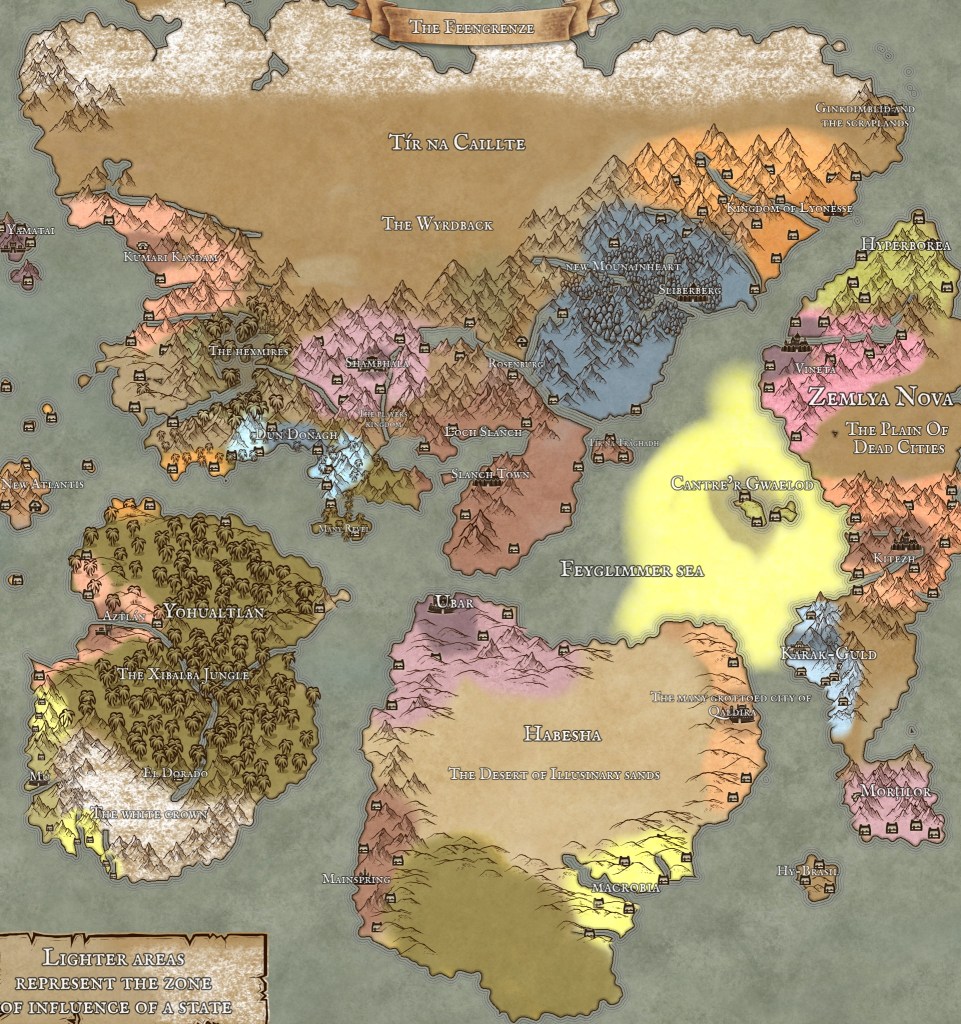
New Map of the Feengrenze
Aztlán
- Tags: Restive Lessers, Forbidden Romance
- Capital/Main Settlement: The city of Aztlán
- Power: 4
- Action Die: d12
- Cohesion: 4
- Trouble Score: 2
- Dominion: 4
- Features
- Aztlán holds a monopoly on chocolate production.
- The state maintains a network of tributaries through violence.
- Two cults of elite warriors are wholly dedicated to the chieftain.
- The city of Aztlán is a spiritual hub and pilgrimage site, with the chieftain revered as a demigod.
- Problems
- Prince Humac is engaged in a forbidden affair with a foreign princess.
- There is growing resentment among tributary states due to the brutal tactics of the Aztlán state.
- Interest
- Vineta (2 Interest): Long and profitable relationship with Aztlán.
- Intihuaca (6 Interest): Intihuaca is Aztlán’s primary rival in the great game, and the kingdom has multiple agents in the city-state
- The Jungle Tributary Enclaves (4 Interest): Aztlán keeps the enclaves in its sphere of influence on a short leash with threats and
History. Aztlán is the youngest successor state, having been snatched from an alternative Earth in 1550 CE. The City State was deposited mostly intact on the banks of the river Kan amid one of the New Atlanteans’ cyclical conquests of the world. They arrived during a New Atlanteans’ expedition of conquest into the Jungles of Yohualtlan. They proved instrumental in driving back the Atlanteans, thus cementing the city’s status as the de facto leader of the Mesoamerican enclaves of the Xibalba rainforest. It was also from those prisoners that the Aztlán learned the secret of metalworking, ensuring that the Atlanteans would not have an easy time in the conquests of Yohualtlan.
Description. Aztlán society closely mirrors its pre-Columbian forebears, notably differing only in the widespread use of iron and bronze, even for farmers’ tools. The old gods are revered with human sacrifices, and the city of Aztlán boasts numerous Aztec-style temples.
Leader. The current Chief of Aztlán is Tepiltzin the Great, a 40-year-old and the 18th ruler since the city’s arrival in the Feengrenze. He is a large, muscular man, marked by numerous scars, thinning hair, and blindness in one eye. A former jaguar warrior, he still wields his Atlantean spear (his baton of office) with deadly ability. Like his forebears, Tepiltzin is committed to a slow-burn growth strategy: dominating chocolate production via tributaries, trading it for foreign knowledge and luxuries, using these to enhance Aztlán’s untouchable status, and raiding enclaves for slaves and sacrifices.
Drowned Cantre’r Gwaelod
- Capital/Main Settlement: Caer Wyddno
- Tags: Inept Ruler, Overextended Grasp, Decadent Court
- Power: 3
- Action Die: d10
- Cohesion: 3
- Agenda: Dominate the eastern Feyglimmer Sea and extract tribute from all who sail its waters
- Features
- Abundant marine farms for fish, kelp, and pearls
- Control over key Feyglimmer Sea trade routes
- Amphibious merfolk forces are difficult for land-based powers to challenge militarily.
- Problems
- King Gwynfor’s hedonism and obsession with self-glory led to neglect of governance.
- Naval forces are stretched thin enforcing tolls and asserting sea control
- Pirate fleets exploit Cantre’r Gwaelod’s arrogance and lack of discipline
- A culture of decadence and self-indulgence has hollowed out civic duty and martial vigilance.
- Trouble Score: 4
Interest
- New Mountainheart (3 Interest): Duchess Muirín Uisceanna is a sister in law of the current King Gwynfor
- Coastal enclaves in the FeyGlimmer Sea(4 points): All the enclaves in the FeyGlimmer Sea regularly pay tribute to the kingdom
History: Once, Cantre’r Gwaelod was a prosperous kingdom built on land reclaimed from Cardigan Bay in Wales. However, it was flooded after a drunken Prince Seithenyn failed to close the sluice gates that kept out high tide. As the kingdom flooded, it was snatched away by the Feengrenze to plug a vast, weird magic leak in the middle of the FeyGlimmer Sea, a leak that produced one of the largest whimwhirls ever seen in the Feengrenze. The remains of the kingdom handily plugged the leak created by whimwhirl, but the whimwhirl forever changed the people of the kingdom into merfolk. Remarkably, Prince Seithenyn, the sole survivor of the royal family, claimed the entire sea as his domain.
Description: Built on the ruins of the old Cantre’r Gwaelod, its merfolk inhabitants utilize the remaining structures and sea caves as residences. They subsist on seaweed, fish, and shellfish from vast marine farms, but their primary wealth comes from extorting trade ships and island communities. Merfolk warriors prowl the Feyglimmer Sea, demanding tribute from surface dwellers—tribute invariably squandered on lavish parties and imported spirits, fueling their culture of decadence.
Leadership: King Gwynfor, a twenty-year-old merfolk and the current ruler of the House of Seithenyn, embodies the moral decay of his house, preferring hedonistic revelry to governance. His misguided ambition to dominate the Feyglimmer Sea has dangerously overextended his forces, leaving their territory vulnerable.
Dún Donagh
- Capital/Main Settlement: Sealbh Dhomhnaigh
- Tags: Iron Law, Diplomatic Demands
- Power: 4
- Action Die: d12
- Cohesion: 4
- Dominion: 4
- Agenda: Establish Dún Donagh as the undisputed mercenary power, leveraging this influence to maintain internal stability and exert proxy control over the Feengrenze.
- Features:
- The kingdom commands a vast, rigidly disciplined army of hobgoblin legions and fey skirmishers.
- The kingdom has a well-organized goblin spy network
- The kingdom is blessed with ample lumber and a thriving lumber industry
- The kingdom has alliances with Loch Slanach and the Hexmires
- Problems:
- The nobility, steeped in martial tradition, chafes under the magical prohibition against wars of conquest, fostering internal ambition and resentment.
- Trouble Score: 1
- Interest:
- Everyone (1d6 Interest): Despite being forbidden to wage war, the Dún Donagh exerts influence by providing mercenaries to everybody in the Feengrenze and spying on them for profit.
Description: Dún Donagh, the Feengrenze’s sole native-born and pure fey successor state, stands as a paradox of rigid order and enduring stability. This highly regimented nation is dominated by hobgoblins, with a minority of unseelie-aligned fey and militant mortals. A rigid caste system, modeled after military ranks, geometrically precise fortress towns of stone and wood, and massive, neatly rowed tree plantations define its order. Crime is nonexistent, and rebellion unthinkable; every citizen, from the lowest goblin alchemist to the highest-ranking scout, knows their place.
History: Long ago, the first king of Dún Donagh, Donagh MacGannon, made treaties with both of the great fey realms that bordered his, The Hexmires and Loch Slanach, only to be tricked. He hoped to secure the magical assistance of the archfey Ailénach An Draíocht and Fionnuala the fair for his conquests of the Feengrenze. What he received was binding contracts that forbade him and any of his successors from being conquerors in perpetuity, in exchange for securing his family’s eternal rule over their lands until the end of time.
Leadership: Calvin MacGannon, tall and muscular with light brownish skin, black hair, and a surprisingly handsome face, inherited his family’s striking appearance and their frustration with the magical prohibition. Like his forebears, he sought glory through adventuring in his youth, gaining renown as a skilled, if morally ambiguous, mercenary captain. Since assuming the crown, however, he finds himself unable to wield a sword, watching enviously as his citizenry pursues mercenary work, feeling personally imprisoned by his royal duties within the palace walls.
Intihuaca (El Dorado)
- Tags: Blandished Leadership, Fatal Extravagance
- Capital/Main Settlement: Qirupampa
- Power: 4
- Action Die: d12
- Cohesion: 4
- Agenda: Use their gold mines to purchase allies and luxuries from the world outside Yohualtlan.
- Features:
- Some of the richest gold mines in the world.
- Has the coin to hire frost giant mercenaries from the White Crown.
- Rangers are the best jungle fighters in the world.
- The people are fiercely devoted to their sun king.
- Problems:
- No direct connection to the outside world.
- The court has come under the sway of a young green dragon who is slowly corrupting it.
- Long-simmering tensions between several species of residents are starting to boil over.
- Trouble Score: 3
- Interest:
- Aztlán (3 point): Intihuaca’s primary rival in the big game, whom Intihuaca is constantly seeking to eliminate.
- Vineta(1 point): Intihuaca has an active trade mission in Vineta seeking to open formal trade relations
- The White Crown (3 point): Maintains the flow of gold in exchange for mercenaries.
- Dominion: 4
History: While often referred to as El Dorado by outsiders, Intihuaca is unique among Successor States, being a blend of several Mesoamerican and Earth civilizations. Scholars have identified at least eight distinct immigrant groups—including kobolds, lizardfolk, dragonborn, and yuan-ti—each preserving unique accounts of their former civilization’s demise. Qirupampa is a mishmash of pre-Columbian Mesoamerican and South American architectural styles.
Description: Intihuaca possesses some of the Feengrenze’s richest gold mines, with kobolds tirelessly extracting their wealth for trade. While frosty relations with Aztlán prevent the use of the River Kan, all commerce is conducted overland via heavily guarded dinosaur caravans through the Wyrdland known as the Xibalba Rainforest. Despite these impractical trade routes, Intihuaca stands as the wealthiest Successor State, its opulence evident in the gilded city of Qirupampa—a true wonder of the Feengrenze. Qirupampa, a true wonder of the Feengrenze, is dramatically situated atop and alongside a stunning mountain waterfall. Its mountainside features terraced ridges from which an eclectic array of Mesoamerican architectural buildings emerge. These structures grow larger as one ascends, culminating in the nobility’s opulent palaces. Crowning the city is the Palace of the Sun, a golden step pyramid bedecked with gardens and fountains.
Leadership: The current Sun King, Atz’amil Inti, is a corpulent lizardman in his mid-50s, embodying Intihuaca’s cultural decline through his notorious womanizing and extravagant weekly parties. Real power has shifted to Cōātlhuitl, a young female green dragon and one of the few chromatic dragons born in the Feengrenze to reach her ‘teenage years’. Like most dragons in the Feengrenze, the curse of stagnation has warped her mind towards small-minded and utterly self-centered pursuits. In her case, she has become a party girl, reveling in debauchery and court gossip. She arrived three years ago in the guise of a beautiful lizardfolk girl, instantly captivating Atz’amil. She has since been accelerating the court’s decline, aiming to replace Atz’amil with a court of sycophants soon.
Hyperborea
- Capital/Main Settlement: No single capital; multiple holds, each with its ruler.
- Tags: Recent Brutality, Rival Dreams
- Power: 3
- Action Die: d10
- Cohesion: 3
- Agenda: Internal survival and sectarian dominance.
- Features:
- They are literal giants, possessing immense strength.
- The Hyperboreans are renowned for their expertise in stone working and are sought after as skilled builders.
- Each sect or cult maintains an impressive, often isolated, fortress, monastic community, or fortified settlement.
- Problems:
- Lack of unity, fragmented by multiple independent lordships.
- Violence between sects is common.
- The land is inhospitable, mountainous highlands in the far north of the continent of Zemlya Nova.
- Trouble Score: 5
- Interest
- Dominion: 4
History: Hyperborea is one of several giant and giantkin empires from across the multiverse, originally hailing from a version of Earth. They have never recovered from the cataclysm that doomed their parent civilization, leading to centuries of cyclical violence.
Description: Hyperborean civilization is dominated by cults of mystics and druids, each with its isolated monastic community, compound, or hill fort village in the northern lands of Zemlya Nova. Violence between the sects is common; their last major war concluded only a few years ago. Currently the three largest sects are:
- The Stoneborn of Anaktorion. The soul is imprisoned in the body, which is itself a prison of flesh. Only through ascetic isolation, stone-carving meditation, and the denial of comfort can one “sculpt away” the mortal shell and achieve transcendence.
- The Flame-Eaters of Pyrgos. Fire is the divine element, and the cosmos will only be purified through its total consumption. Followers ritually burn offerings, texts, and sometimes captives to “feed the Great Becoming.”
- The Circle of the Great Measure. Harmony is the highest good, and all things should conform to mathematical proportion and cosmic balance. The gods are geometry given life, and life must be reshaped to fit their divine ratios.
The giants are also masterful builders, having long ago perfected the secrets of stoneworking, evident in their imposing fortress towns, impressive bridges, and towering dams. Most Hyperboreans earn their living by quarrying and finishing granite, slate, and marble, which they trade for food from other, more prosperous lands. Others tend herds of hardy giant mountain sheep, which they use for wool and meat.
Karak-Guld
- Capital/Main Settlement: No single capital.
- Tags: Waning Wealth, False Prize
- Power: 3
- Action Die: d10
- Cohesion: 3
- Agenda: Find a new source of ore or metal to replace depleted mines and regain their place as the metalworking capital of the Feengrenze.
- Features:
- The towns of the nation are located in fortified mines.
- Numerous foundries employ the most talented metalworkers in the Feengrenze.
- They have amicable relations with most other Successor States.
- Problems:
- The kingdom’s mines are mined out.
- The cadet branches of the ruling family control most of the bureaucracy and are notoriously fractious.
- Trouble Score: 2
- Interests
- Hyperborea (1 point): Potential market for their quarried stone.
- New Mountainheart (SLiberberg) (1 point): Source for high-quality metal goods and potentially skilled artisans.
- Other Successor States (1 point): Seek their renowned arms and armor.
- Dominion: 4
- History: Karak-Guld is among the oldest of the Successor States, its origins shrouded in the mists of antiquity.
Description: Karak-Guld is widely recognized for its pervasive internal squabbles, which frequently impede progress due to incessant disputes over responsibility and credit. Nevertheless, the nation maintains its reputation as the Feengrenze’s foremost producer of metalwork, with Karak arms and armor highly coveted by all countries of the Feengrenze. The many holds of Karak-Guld are dug into the side of the volcanoes of the Burning Range, where the dwarves harness the internal heat to power their forges. This legacy, however, is threatened as the kingdom’s mines are once again depleted, leading to renewed disputes among the ruling families over the path forward and who will lead the effort.
Leader: King Fallond Rakankrak of the Burning Ranges, the oldest monarch among the Successor Kingdoms at approximately 370 years old, is at his wits’ end. His beard, mustache, and hair are graying, but he is still solidly built even for a dwarf. He is utterly fed up with the fractious noble houses of Karak-Guld, all cadet branches of his own House of Rakankrak. These families, each controlling a vital aspect of the nation’s infrastructure or bureaucracy, are perpetually at odds with one another. Managing his fractious extended family consumes most of his efforts, leaving little capacity to address the kingdom’s crisis.
Grand Principality of New Vladimir-Suzdal
- Capital/Main Settlement: New Vladimir-Suzdal
- Tags: Awesome Legitimacy, Inept Ruler
- Power: 4
- Action Die: d12
- Cohesion: 4
- Agenda: Convert the Infidels of the Feengrenze or purge them by sword.
Features:
- The city serves as the seat of Orthodox Christianity and has converted most of the surrounding enclaves.
- The city is located in a natural fortress manned by paladins.
- It has beaten most of its neighbors into meek subservience.
- The state religion, Orthodox Christianity, fully supports the ruling princes.
- Problems:
- There is an increasing backlash against Orthodox Christian missionaries among New Vladimir-Suzdal’s neighbors.
- The ruling princess is woefully inexperienced as a ruler.
- A pending power struggle between the princess and the patriarch of the church is about to boil over.
- Raiders supported by foreign powers are nipping at the edges of their sphere of influence.
- It is becoming increasingly hard to maintain its constant crusades due to overreach.
- Trouble Score: 5
- Interest:
- Morților (5 point): New Vladimir-Suzdal senses the unholy kingdom’s vulnerability and is preparing for war against it, including sending missionaries to incite rebellion among the people
- Karak-Guld (3 points): New Vladimir-Suzdal is in active negotiations with Karak-Guld regarding the trade of metal ore for access to the holds by missionaries.
- Vineta(2 points): New Vladimir-Suzdal is one of two kingdoms trying to rile up the lowborn of the realm of New Vladimir-Suzdal.
- Dominion: 4
History: When Kitezh, the capital of the Grand Principality of Vladimir-Suzdal, sank beneath Lake Svetloyar in the late 1230s, it miraculously re-emerged in the Feengrenze’s wilderness of Zemlya Nova, largely untouched and isolated from its former threat of the Mongol horde. Recognizing the surrounding populace as infidels, the prince, nobles, and church swiftly resolved to convert the surrounding enclaves by any means necessary.
Description: The Modern Kitezh is a sight to behold—a medieval Russian city perched atop a mountain cleft, flanked by mighty rivers. Uniquely among the Successor States, New Vladimir-Suzdal exerts absolute control over its vassals, most of whom were forcibly converted and subjugated by its holy warriors centuries ago. Immense wealth flows into the coffers of both New Vladimir-Suzdal and its church from these vassal enclaves and its ongoing crusades.
Leadership: The current ruler of New Vladimir-Suzdal is Princess Svetlana. At only 17 years old, she is the Feengrenze’s youngest and most woefully unprepared ruler. Her unexpected ascension follows the tragic deaths of her father and older brother in a recent failed crusade into the Plains of Dead Cities. Compounding her challenges, a fierce power struggle simmers between the young princess and Patriarch Bogdan Innokentievich Ugolnikov, the de facto power behind the New Vladimir-Suzdal throne. The royal family has largely been reduced to mere puppets in his hands, and Patriarch Ugolnikov, a fat, balding middle-aged man with the face of a bulldog, eagerly awaits the chance to formalize his control.
Kumari Kandam
- Capital/Main Settlement: Chandrapuram
- Tags: Ministerial Capture, Outside Debts
- Power: 4
- Action Die: d12
- Cohesion: 4
- Agenda: Achieve diplomatic superiority by exporting cultural and educational achievements, influencing other Successor States’ styles and literature.
- Features:
- The citizens of Kumari Kandam are peaceful and solve problems rationally.
- The country boasts numerous universities, and its citizens are well-educated.
- The country is home to multiple well-trained poets and artists who export exquisite art and works of literature.
- They have a protective pact with Loch Slanach.
- Problems:
- The universities of Kumari Kandam are rigidly dedicated to teaching only sacrosanct, existing knowledge.
- The nation is ruled by an inflexible group of academics who exclusively focus on the humanities to the detriment of all other fields and sciences.
- The nation is currently up to its ears in debt to Vineta.
- Trouble Score: 3
- Interest
- Loch Slanach (4 points): A key ally due to their protective pact and patron of the arts
- New Mountainheart(4 point): A patron of their art and literature.
- Intihuaca(3 points) Intihuaca nobles often patronized the Sangam’s artists and poets.
- Many Grottoed Qualdria(3 points): Zahak is another major patron of the arts
- Dominion: 4
History: When Kumari Kandam sank beneath the sea on Earth’s south 60, a single university city, home to the second Tamil Sangam, was miraculously transported to the Feengrenze. The frightened populace naturally turned to the Sangam scholars for leadership, who swiftly assumed leadership and have governed the nation ever since.
Description: Modern Kumari Kandam revolves entirely around education and scholarly pursuits. Its citizens are largely literate, with many becoming highly educated poets, authors, and artists trained at the prestigious Sangam. These skilled individuals produce Kumari Kandam’s primary export: exquisite art, including plays, poems, tapestries, and paintings, which are highly coveted by nobles across the Feengrenze. Chandrapuram, their sole major settlement and capital, is a sprawling university city of white marble and domes primarily dedicated to the arts and humanities.
Rulers: The nation’s governance reflects its academic focus. Kumari Kandam is governed by a meritocratic oligarchy, comprising a council of 30 esteemed scholars. Kirubangan, a renowned half-elf bard in his late 80s and a masterful poet, serves as the current headmaster. He is an inflexible traditionalist who actively discourages studies outside the humanities, such as natural sciences or magecraft. This rigid stance is shared by the entire council, composed of aged humanities and arts experts who openly disdain other fields of study. Only civil engineering and architecture are tolerated—(civil engineering, viewed as a necessary evil, and architecture, considered an acceptable art form). This narrow focus on the arts over practical statecraft has led the nation to accrue significant debts to external lenders.
Lyonesse
- Capital/Main Settlement: Lyonesse
- Tags: Rival Dreams, Regency council
- Power: 4
- Action Die: d12
- Cohesion: 3
- Agenda: Navigating internal divisions to establish a unified future for the kingdom.
- Features:
- The city of Lyonesse is the seat of the Catholic church.
- The kingdom has a strong core of paladins in the Arthurian tradition.
- The kingdom has historically had a strong base of moral authority.
- The kingdom has a large amount of territory.
- Problems:
- The king has died relatively recently, leaving the throne in the hands of a regency council.
- Factions are forming within the regency council with irreconcilable visions for the young prince’s future.
- Foreign powers, including Vineta, are starting to circle the floundering kingdom.
- The fey enclaves displaced by Lyonesse’s growth are using the pending civil war to avenge their lands’ loss.
- The paladin corps and the knights are split evenly between the three camps, leaving no one faction with any real authority to implement their vision unimpeded.
- Trouble Score: 5
- Interest
- Morților(1 point): Lyonesse has routinely sent paladins to Morților to keep an eye on the situation
- New Vladimir-Suzdal(2 points): As a rival religious power, catholic missionaries are frequently sent to New Vladimir-Suzdal’s sphere of influence.
- Vineta(4 points): Lyonesse has dispatched a large force of clerics and paladins on a missionary mission to undermine the church of Mammon and end their control over Vineta
- Macrobia(6 points): The catholic mission in Macrobia has been by far their most successful missionary effort
- Dominion: 4
History: Lyonesse, an Arthurian kingdom from a version of Earth (Order, Life, and Beliefward of Zero Prime), was whisked away to Tir Na Calite. There, its people successfully rebuilt their kingdom in the style of King Arthur’s court, a strategy rooted in virtue. Slowly but surely, their territory expanded as new enclaves integrated, although this growth came at the cost of displaced fey enclaves.
Description: Lyonesse boasts the largest core territory among the successor states, a vast expanse of rolling green hills crisscrossed by rivers and dotted with quaint villages. Its growth was fueled by a policy of moral authority rather than force, willingly attracting many enclaves into its sphere of influence. At its heart stands the fabled Cathedral of the Lion, a stunning Gothic castle-cathedral that miraculously survived the calamity that fell upon old Lyonesse. From this Cathedral, the Lyonesse paladin orders ride forth to protect the land. Renowned for their wisdom as mediators and steadfastness as protectors of mortal enclaves, these paladins, dressed in instantly recognizable white tunics over gleaming silver armor, strive to embody the virtues espoused by King Arthur and his legendary court. However, their intolerance of fey is equally well-known; they historically drove fey from the kingdom’s lands and surrounding enclaves. To this day, it is rumored their swords are forged of cold iron, specifically to combat fey creatures.
Leadership: King Norman’s recent poisoning, widely suspected to be the work of a fey assassin, has left his six-year-old son, John, as the sole heir. The regency council, led by Queen Emmeline, currently holds the throne but is fracturing into three factions, each with irreconcilable visions for John’s future and the kingdom. Unfortunately for all three factions, the paladin corps and the knights are split evenly between the three camps, leaving no one faction with any real authority to implement their vision unimpeded.
- The Lions, led by Marshal Henry, want to fast-track John’s military education and knight training to recapture the military glory of the kingdom’s Camelotian origin by starting a crusade against the other successor states.
- The Doves, led by Archbishop Raymond, want to raise John to be a devout Catholic and turn Lyonesse into a new Rome, funneling wealth into a massive church building program and various other vanity projects.
- The Stags, led by Queen Emmeline, want to avoid any major change in policy and focus on solving the kingdom’s increasing number of problems.
Macrobia
- Capital/Main Settlement: The palace of Asmakar
- Power: 3
- Action Die: d10
- Cohesion: 3
- Agenda: The various factions are attempting to reunite the Macrobians under a single religion.
- Features:
- The goliaths of Macrobia are talented warriors and especially potent archers and javeliners.
- The lands of Macrobia are rich in copper and other semi-precious metals.
- The Macrobians are known for easy acceptance of outsiders, provided they harbor no ill intent.
- Problems:
- Four competing religions vie for dominance of the nation.
- Multiple noble houses are under the sway of various religious leaders from each faith.
- The mounting sectarian crisis has eroded the king’s authority.
- Trouble Score: 3
- Interest:
- Dominion: 3
History: The Goliath kingdom of Macrobia, originally from classical-era Ethiopia on Earth, was transported to the Feengrenze. Historically, it has remained a quiet backwater, acting as neutral ground rather than seeking to impose its will on other kingdoms or enclaves.
Description: Macrobia is a land of rolling scrubby hills, sparse forests, and swift rivers. The goliaths build their villages and towns in sheltered dells and nooks in these hills to protect them from the whimwhirls from the Sea of Illusionary Sands. These towns tend to be modest affairs filled with simple dwellings of stone and mud brick with thatch roofs. The Macrobians are humble folk; most are farmers or herders, and few work in mines in the hills. They are also notoriously accepting when it comes to foreigners. To your average goliath, so long as a non-goliath does not steal, assault someone, or do anything else to show that they are untrustworthy, they can be welcomed in their community. Macrobia has a reasonably large population of expatriate foreigners who work as prospectors, healers, trading post operators, and experts in fields such as engineering and irrigation. However, Macrobia’s accepting nature has proven a double-edged sword: missionaries from other Successor States—including Catholic, Islamic, and Mu mystery cults—have aggressively vied for influence among the tribes. This has led to growing sectarian tensions, with some pushing for holy war against rival faiths.
Leadership: King Tamrat Zere Tessema, a middle-aged, tactful stone goliath, ardently seeks to restore Macrobia’s traditional ways, free from missionary influence. His strong ally, his athletic eldest son Prince Basliel, aids him in feverishly trying to defuse the spiraling sectarian crisis. While they have averted several near battles, the long-term success of their efforts remains uncertain.
Morților
- Capital/Main Settlement: Castle Moldoveanu
- Tags: Waning Wealth, False Prize
- Power: 4
- Action Die: d10
- Cohesion: 4
- Agenda: Find a new source of blood to feed the increasingly starving population.
- Features:
- The ruling nobility consists entirely of vampires.
- Maintains a vast army of skeletons and zombies for manual labor and combat.
- Vampire nobility is enthralled by the House of Radacanu, demonstrating unwavering loyalty.
- The House of Radacanu has several alliances with notable demon princes.
- Problems:
- The supply of blood for the vampire nobility is rapidly diminishing.
- Morților is almost universally reviled by other nations in the Feengrenze.
- Several nations, notably Lyonesse and New Vladimir-Suzdal, actively seek to destroy the kingdom.
- Trouble Score: 3
- Interests
- Ubar (2 points): Natalia has dispatched agents to Ubar to seek out the mysterious prize her demonic contacts informed her of.
- Vineta (2 points): The only nation that tolerates the vampiric kingdom in form and the only source of outside contact the kingdom has.
- Dominion: 4
History: Morților is a Successor State that originated as the last bastion of a vampire nation on Mount Moldoveanu, transported to the Feengrenze just as it faced overrun by crusading knights. After reestablishing itself, it was nearly destroyed by Lyonesse’s paladins. This cycle of decimation and desperate search for new blood sources, often leading to conflict with other Successor States, has been a recurring plight for the kingdom.
Description: Morților is a grim and brooding land of foreboding mountains, dark moors, and sparse, rocky farmlands, dotted with gothic castles and bleak, undecorated villages. Its dreary townsfolk, seemingly devoid of joy, inhabit stout stone houses with heavy shutters and doors. The primary industry is subsistence agriculture and fishing, as the populace sees no point in anything more, given that no other nation, not even the greedy Vinetans, will trade with them.
Ruler: Natalia Radacanu, a vampire who appears to be 19 but possesses two centuries of experience, is the current ruler. She is a reasonably competent ruler, having learned from the mistakes of her predecessors. She cleverly uses human thralls to keep her mortal ‘cattle’ content, levies blood taxes rather than allowing random snatching, and maintains a small, manageable vampire nobility. Despite her careful management, a sudden plague has decimated her mortal population, igniting growing dissent and hunger among her nobility. She has resorted to her demonic contracts to find a solution that will prevent her family’s recurring destruction, leading her to scope out Iram of the Pillars for a prize whose true nature remains a mystery.
MU
- Capital/Main Settlement: Mu City
- Tags: Rival power, Poisoned cliques
- Power: 4
- Action Die: d12
- Cohesion: 4
- Agenda: To establish Mu as the preeminent civilization via spreading a sorcerer-based mystery cult and aggressive political maneuvering to protect said cults.
- Features:
- Mu is home to a vast number of sorcerers.
- Mu is home to the best university of the magic arts in the Feengrenze.
- Mu possesses an enormous number of technological marvels from before the collapse.
- A lineage of magically gifted artisans is there.
- Problems:
- The sorcerer king’s power is diluted by the rise of cliques among the sorcerer nobility.
- Rampant inbreeding is diluting the blood of many of the most potent sorcerer-noble families.
- The kingdom is paying off a crippling foreign debt.
- The military is locked in constant low-level policing.
- Trouble Score: 4
- Interest:
- Macrobia(6 points): Mu has set up a branch of their mystery cult in Macrobia and is inflaming their followers to war.
- Other successor states(2 points): Small branches of the Mu cult can be found in most towns in the successor states
- Enclaves(2 points): Small branches of the Mu cult can be found in many enclaves
- Dominion: 4
History: Like Shambhala and Hyperborea, the continent of Mu and its hyperadvanced civilization are recurring constants across the Manyfold’s many universes. Mu’s original Earth instance (Earth 25 south) was destroyed when an elven sorcerer’s cataclysmic spell, intended for Lemuria, backfired. The Feengrenze subsequently seized fragments of Mu, including its capital, from this destruction.
Description: Modern Mu is uniquely advanced for a world of the Feengrenze. The people of Mu possessed advanced magic technology, which enabled the construction of structures such as skyscrapers, airships, artificial servants, and self-propelled carriages, featuring a pseudo-Mayan aesthetic. However, none of the factories that produced these wonders survived the journey to the Feengrenze. Consequently, the citizens of Mu are fighting a losing battle to maintain their once-gleaming metropolis.
Leadership: Mu is ruled by the Coyopa family, a lineage of powerful sorcerer kings dating back to their time on Earth. The current scion of the family is Caprakan, an ugly, short man with a gargoyle-like face and a perpetual scowl. However, Caprakan is a notably weak sorcerer. Rumors of inbreeding diluting the sorcerous blood of the Coyopa and other noble houses have led to the formation of cliques around cadet branches, further eroding Caprakan’s authority.
New Atlantis
- Tags: Rival Power and Disputed Inheritance
- Capital/Main Settlement: Elassos
- Power: 4
- Action Die: d12
- Cohesion: 4
- Agenda: Conquer and convert lesser peoples, expanding their empire through naval might and demanding tribute.
- Features:
- A large, well-trained navy
- They have a stockpile of ancient magi-tech, including weaponry
- Home to some of the world’s most revered classical universities.
- A vast treasury of stolen wealth
- Problems:
- The ruling oligarchy consistently repeats ancestral mistakes, overextending their navy to inevitable defeat.
- A growing schism is emerging within the Navy regarding its expansion strategy. The main faction wants to press on as is, while the rivals want to consolidate their gains before pushing on.
- The nation is facing increasing difficulties in converting its newly acquired territory to its culture. Local resistance groups are emerging.
- Trouble Score: 3
- Interest:
- Aztlán( 5 points): The kingdom of New Atlantis is especially keen on conquering Aztlán. It was at the hands of the Chieftain of Aztlán that the last high king’s campaign of conquest came crashing down 200 years ago. It has multiple agents deployed to sow discontent among the chiefdom’s tributaries.
- Hexmires(2 points): The current oligarchy is considering expanding into the sphere of influence of the hexmires. It has deployed agents in the region to prepare the way.
- Kumari Kandam(2 points): Atlantean agents have been deployed to try to circumvent the Sangam to their ends
- Coastal Enclaves(4 points): New Atlantis’ vast fleet is prowling the western ocean, looking for settlements to raid
- Dominion: 4
History: When the gods sank Atlantis and its ten kingdoms 10,000 years ago, only a fragment survived: the capital of Elassos. Bits of its territory were plucked from the maelstrom and deposited on the western edge of the known world. When the maelstrom abated, the House of Eumelus found itself alive, albeit with its empire in ruins. The survivors set about recreating their lost glory.
For several millennia, New Atlantean history has been trapped in a predictable, self-destructive cycle. A high king unites the squabbling noble houses, dispatches the great Atlantean fleet on campaigns of conquest and conversion, inevitably overextends, and suffers catastrophic defeat, losing all gained territory. This leads to internal succession crises among the Eumelus-descended noble houses, restarting the cycle with the emergence of a new high king.
Description: Little has changed since New Atlantis arrived in the Feengrenze. They maintain the pseudo-classical Greek culture described in Plato’s dialogues, their small, rocky island dotted with Greek-style towns and temples. New Atlantis serves as a stark example of history repeating itself in tragic, almost farcical ways within the Feengrenze. The Atlanteans are famously hubristic; despite possessing some of the finest classical universities, they stubbornly fail to recognize the Feengrenze’s inherent resistance to their lasting conquest. Only their island’s abundant wood and iron resources allow them to perpetuate these ancestral errors for millennia without being conquered.
Leadership: The current High King of New Atlantis, Cycnus Elasian, approximately 19 years old, is the second-youngest ruler in the Successor Kingdoms. He possesses a distinctive, somewhat unattractive appearance, characterized by a square, blocky face, sandy hair, and a pale, almost sickly complexion. Having been sickly as a child, Cycnus is determined to prove himself a capable ruler and expand Atlantean power. However, he faces an uphill battle against an oligarchy composed of cousins and distant relations of similar age, many of whom previously vied for the throne. Factions are already forming regarding the kingdom’s expansion strategy. The houses of Thraso, Alektoios, Hektorios, Aristeides, and Eudoxia advocate for traditional rapid expansion, relying on overwhelming might. Conversely, the rival houses of Thessalios, Callistratus, and Melantha propose a slower, more deliberate approach, prioritizing integration of newly conquered territories and fleet consolidation.
Shambhala
- Tags: Ministerial Capture, Rampant Corruption
- Capital/Main Settlement: The great monastery of Shambhala
- Power: 4
- Action Die: d12
- Cohesion: 4
- Features:
- The core territory of Shambhala is located in an easily defensible mountainous region
- Shambhala has a force of elite warrior monks with extensive training in various disciplines of wushu
- Shambhala is an important religious center for the Feengrenze’s Zen community
- Vast amounts of religious tribute flow into the nation from pilgrims and tributaries
- Problems:
- The ruler, despite good intentions and a desire for reform, is largely a figurehead.
- The state bureaucracy is hopelessly corrupt.
- Trouble Score: 4
- Interest:
- The enclaves of Tir Na Calite(4 points): Shambhala monks are far-traveled and well-liked. In most enclaves, the words of a Zen monk can be much more influential than any amount of gold.
- Dún Donagh(3 points): Dún Donagh is Shambhala’s longtime nemesis, and the monks have been working to undermine Dún Donagh’s control of the enclaves in its zone of influence
- Loch Slanach(2 points): Shambhalan monks are tolerated in Loch Slanach, which has allowed Zen to make some inroads in the realm.
- Dominion: 4
History: Shambhala, or Shangri-La, is a civilization unique in its multiversal presence, existing across countless versions of Earth. The iteration transported to the Feengrenze originated from a universe adjacent to our own, vanishing one night to reappear in this new realm. Remarkably, the residents and monks of Shambhala continued their routines with an almost serene indifference, as if their world had merely shifted.
Description: Shambhala occupies one of the smallest core territories among the successor states—a single mountain valley with Tibetan villages surrounding a large Zen monastery—yet it stands as a formidable religious powerhouse. The monks of Shambhala have had centuries to spread their faith throughout the lands of Tír na Caillte. Shambhala has by far the most vassal enclaves of any of the Successor states, and benefits from a constant influx of wealth from pilgrims and aspirant monks.
In recent centuries, the Great Lamias have ceded much of their power to an ever-growing, increasingly corrupt bureaucracy. Under the current Great Lamia Yangtso, this bureaucracy is plagued by rampant favoritism, bribery, and cronyism. While the nation is not yet jeopardized, all signs point towards a perilous future.
Leadership: The Great Lamia Yangtso is the image of what a Buddhist monk should strive to be. He is a human man in his early 40s who dresses in the typical style of Buddhist monks, down to the shaven head and orange robes. He is a good-natured man and a master of his kingdom’s religious and martial arts. However, his efforts are largely undermined by the rampant bureaucratic corruption and the figurehead role he has been reduced to.
Ūbār
- Tags: Threatened Violence, Daring Ambition
- Capital/Main Settlement: Iram of the Pillars
- Power: 4
- Action Die: d12
- Cohesion: 4
- Agenda: To construct an earthly Eden within the Feengrenze, maintaining the illusion of paradise at any cost.
- Features:
- Renowned for architects and artisans of sublime skill
- Enslaved genies provide magical assistance for grand state projects and defense
- Possesses magically lush lands
- The kingdom controls a vital strait into the FeyGlimmer Sea
- Problems:
- A brutal dictatorship that ruthlessly suppresses civil liberties to maintain its illusory perfect society, inadvertently fueling a growing underground resistance.
- Several nations find Ubar’s heavy-handed policing of the Strait of Ubar infuriating and are actively plotting against the country
- The massive construction projects have been eating away at the national treasury
- Trouble Score: 3
- Interest:
- Macrobia(6 points): The sultanate has multiple agents among the missionaries sent to the realm who are intent on converting the land of Macrobia to Islam
- Many Grotoed Qualdaria(4 points): The sultanate has long been in the good graces of Zahak.
- Dominion: 4
History: Ubar and its capital, Iram of the Pillars, were dramatically transported to the Feengrenze from the alternative earth Beliefwise of Zero Prime in 700 AD. Swallowed by the Arabian Desert sands, they reappeared here largely unaltered. For centuries, Ūbār’s rulers have relentlessly pursued the creation of an earthly Eden, a grand ambition they have outwardly achieved.
Description: Iram, the capital of Ūbār, stands as one of the Feengrenze’s four true cities. Though perhaps the smallest, it is widely acclaimed as the most beautiful settlement—an Arabian dream of white walls, turquoise and golden domes, with gardens lining its well-made streets. The Sultans of Ūbār have long leveraged summoned djinni, effrets, marid, and dao for grand construction projects, magical workings, and the education of their renowned elementalists. This opulence is primarily funded by their control over the vital Strait of Ūbār, which connects the western ocean to the Feyglimmer Sea.
Beneath this shimmering facade, Ūbār operates as a brutal and insidious dictatorship. The sultans of Ubar have quietly outlawed suffering, rebellion, and unhappiness in all forms. Citizens are forced to wear perpetual false smiles, knowing that any deviation risks attracting the dreaded Censors of Joy, leading to their silent disappearance. Many resort to drugs and caffeine to keep up with the mandatory happiness. Literature is heavily censored to ensure that ideas that would introduce suffering into the world are not disseminated.
Leadership. The current ruler of Ubar is the handsome and charming 25-year-old half-djinni, Shah Kalim. He is the very model of the Ubaran shahs before him and is dedicated to the great project of his forebears. As part of the facade of his kingdom, he likes to host grand events for foreign leaders in his massive palace at the center of Ubar, where he shows off the wonders of Iram.
Vineta
Tags: Hidden blight, Sublime skill
Capital/Main Settlement: Vineta
- Power: 4
- Action Die: d12
- Cohesion: 4
- Agenda: To amass wealth through any means possible, including trade monopolies, war profiteering, piracy, and raiding.
- Features:
- The banking houses of Vineta count many members of the nobility of the successor states among their debtors.
- The merchant houses of Vineta have a vast trading fleet.
- The ruling council has in its employ a highly skilled warlock’s agents
- They have a common fund among the merchant houses to hire mercenaries
- Problems:
- Escalating poverty among the masses leads to rampant unsanitary conditions and widespread illness.
- A new generation of merchant princes is jockeying for control of the council.
- Missionaries are riling up the masses against their devil-worshipping betters
- The ruling merchant class is consumed by pervasive greed, fostering widespread corruption.
- Trouble Score: 4
- Interest:
- Kumari Kandam (5 points): Kumari Kandam is heavily indebted to Vinetanese bankers
- Mu (4 points): Mu is heavily indebted to Vinetanese bankers
- Lyonesse (3 points): Vineta is positioning itself to take advantage of the pending civil war in Lyonesse.
- Aztlán (4 points): Vineta and Aztlán are longtime trading partners
- Hyperborea(4 points): Vinetanese merchants are the primary trading partners of the hyperborean giants
- New Mountainheart (5 points): As the new breakout star of the game, Vineta is trying to position themselves as a potential partner of the legendary wealthy kingdom
- Yamatai (3 points): Vineta is Yamatai’s only trading partner.
- Cantre’r Gwaelod(2 points): A long-term project of Vineta is the collapse of the drowned kingdom of Cantre’r Gwaelod to free up shipping routes.
- Karak-Guld(4 points): Vineta is hoping to take advantage of the metal shortage to influence politics in Karak-Guld
- Dominion: 4
History: Legend claims Vineta was submerged by divine wrath due to its wickedness, a half-truth. While the city was indeed steeped in moral decay, with powerful merchant princes openly worshipping Mammon, it was the Feengrenze that transported it from an alternate Earth. Upon arrival, the elites interpreted this as a miracle from their dark lord, swiftly establishing open Mammon worship in a realm seemingly devoid of opposing religious authority.
Description: The city of Vineta is two-faced, much like its ruling class. The seaward quarter is a sight to behold, filled with the glittering compounds of the great merchant families and the opulent casino temples of Mammon. However, beyond this quarter, hidden by giant walls, lie the stinking, polluted slums known as Helltown. Here, life is short and miserable, offering few pleasures beyond hard liquor, the gambling halls of Mammon, and the brothels’ devilish delights. Disease and crime are rampant, exacerbated by hopelessly corrupt authorities. Helltown also has an above-average population of tieflings, leading to the belief that Vineta is the source of tieflings in the Feengrenze.
Leadership: The city and its network of enclaves are governed by the Council of Six Great Merchant Houses, whose current members are:
- Matriarch Julita Borowiecka: The matriarch of House Borowiecka, trading in spices, wine, silks, and chocolate. At over 80, Isolde is the council’s oldest member, yet remains surprisingly sharp and a deft poisoner. She is a devoted member of the cult of Mammon.
- Patriarch Sebastian Adamski: An ugly, portly slob in his fifties, he leads House Adamski, a prominent trader in mundane and arcane weaponry. He maintains extensive contacts among the gnomes of Ginkdimblid and the sorcerous cabals of Mu.
- Cyprian Gadomski: A gaunt, shaved-headed man in his mid-60s, he serves as the head of the House of Gadomski bankers and hierophant of the Temple Casino of Mammon.
- Wacław Młynarczyk: A forty-year-old tiefling with a hunchback and a sinister raspy voice, he is the head of House Młynarczyk. House Młynarczyk deals in potions and drugs, both legal and illicit. He is a sorcerer of considerable renown.
- Kondrad Serafin: The youngest of the current batch of Patriarchs, who murdered his father for the position, Kondrad is cunning, duplicitous, and theatrical. House Serafin controls one of the largest forces of mercenaries and pirates in the Feengrenze, and Kondrad leans into the persona, dressing like a pirate.
- Katarzyna Miś: 50 years old and this homely and fat tiefling is the matriarch of House Miś, which has a vast trade fleet that hauls everything from cotton to iron. However, the actual trade of House Miś is information, as the sailors of the house’s enormous trading fleet are adept at collecting rumors.
Yamatai
- Tags: Proxy Speaker, Inadequate Tools
- Capital/Main Settlement: Yamato-kyo
- Power: 4
- Action Die: d12
- Cohesion: 4
- Agenda: Maintain pseudo-isolation from the other successor states at all costs
- Features:
- The priestess empress is one of a small handful of level 18 clerics in the Feengrenze.
- The priesthood is a talented diviner.
- The land of Yamatai has an elite force of Bushi trained in the ways of mounted longbowmanship
- The land of Yamatai is one of the most productive tea and silk producers in the world
- Problems:
- The Priestess Empress wields very little actual power.
- The priestly bureaucracy’s increasingly rigid and inept interpretations of divine signs, coupled with high-profile setbacks, have eroded its moral and temporal authority.
- The bushi are getting increasingly restless and openly question the priestly bureaucracy that supposedly relays the will of the Priestess Empress.
- A recent, unseasonable failure in the tea crop has severely undermined the priestly bureaucracy’s spiritual standing.
- Trouble Score: 4
- Interest:
- Dominion: 4
History: Legend states Yamatai vanished from Earth 0 in the 3rd century AD, spirited away by the original Priestess Empress Himiko. A long line of priestess empresses have since presided over this relatively prosperous and peaceful small nation. However, the last few centuries have seen a concerted shift towards isolationist principles, a period that coincides with the steady accumulation of power by the priestly bureaucracy.
Description: The islands of Yamatai remain remarkably preserved, mirroring their ancient Kofun-period Japanese origins despite 17 centuries removed from their original Earth. Its mountainous terrain is dotted with villages resembling those of the, where the citizenry makes their homes. Rice paddies and tea plantations abound on the island. These villages are ruled by Shinto priests who claim to relay the divine commandment of the Priestess Empress and use their powers of divination to judge simple problems. In reality, the priesthood has long ago reduced the Priestess Empress to a mere figurehead. Leveraging their divinatory powers, the priesthood has effectively steered the ship of state without her direct involvement.
In recent years, however, the power of the priestly bureaucracy has been declining. The younger priests’ declining talent in interpreting visions and their general lack of finesse in governance have led to several high-profile blunders, severely eroding the priesthood’s moral, temporal, and spiritual authority. Losing an entire year’s tea crop, one of the kingdom’s most important exports, to a typhoon has severely damaged their standing. A growing movement among the bushi to restore Masako to full power is threatening to erupt into an open crisis.
Leadership. The current Priestess Empress Masako is little more than a figurehead ruler. She is 22 years old, possessing a delicate beauty and a gentle, naive demeanor. Cloistered in the temple palace with her adoptive mother since age 7, she remains entirely ignorant of the outside world. True power rests in the hands of the royal proxy High Priest Sheigo, a 70-year-old man with a stooped back, forcing him to walk with a cane, wrinkled features, and a balding head. He has outlived two such empresses in his time as priest and has become quite adept at ruling as the empresses’ proxy.
 The feengrenze historia
Leave a comment