

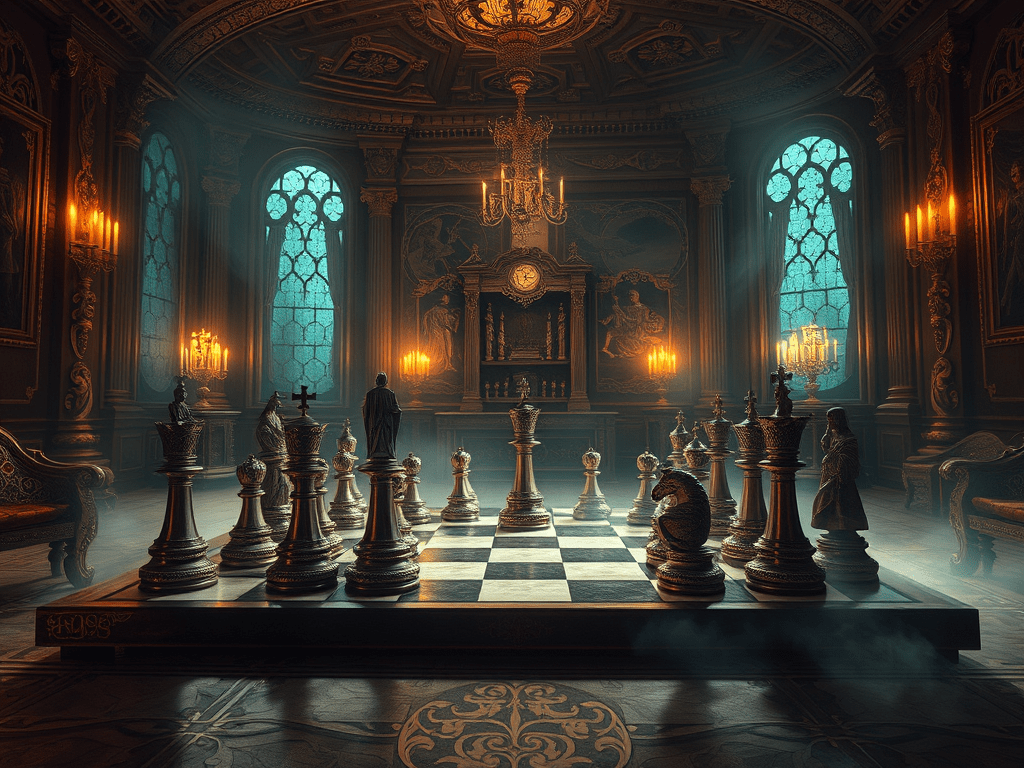
The Great Game is everything; it amounts to nothing. If you participate in the Great Game, you are relevant; if you do not play, you are irrelevant. Glory comes to those who play the Great Game well, yet no lasting glory comes from playing the Great Game. These paradoxes define the political landscape of the Feengrenze. The Great Game is one of the primary driving forces of life in the Feengrenze and an infinite source of stories, drama, and plot hooks. This is the first in a series of articles introducing the Great Game and its players. Next week, I will be digging into my own homebrew system for running players’ realms and starting our introduction to the players in the great game.
What is the Great Game?
The Great Game refers to the constant social maneuvering, political grandstanding, trade wars, vanity projects, and saber-rattling in which the successor states of the Feengrenze engage. These states expend most of their energy on these fruitless displays of power. Their rulers are painfully aware of their kingdoms’ decline. Evidence of their fall is everywhere: their lands are littered with grand, half-demolished ruins, decaying arcane devices, and the faded art and legends of their people. The past mocks them with proof of lost greatness, driving these rulers to reclaim a sense of that glory however they can.
Ultimately, however, the Great Game is in vain. Whenever a successor state appears poised to reclaim its lost empire, unforeseen misfortunes—plagues, succession crises, rival advancements—conspire to snatch away success, driving them back into the mud. Most participants understand this inherent futility, pouring resources into merely appearing grand and mighty, rather than actually being so. In the Feengrenze, true greatness for the powerful is impossible; thus, the Great Game is reduced to rulers endlessly shuffling their decks and pretending they are winning.
States of the Feengrenze
There are three primary types of states in the Feengrenze: Enclaves, Successor States, and Fey Domains.
Enclaves
On the smaller end of the scale are the Enclaves. These small, semi-isolated communities of mortals and fey dot the landscape. Their population generally hovers around 1,200 souls, though some communities are significantly larger or smaller. Typically, these states are ruled by a chief or petty lord, but minor archfey are known to govern a few enclaves.
These picturesque communities are often at the mercy of the Feengrenze and their larger neighbors. Successor states frequently bully nearby enclaves, demanding tribute under threat of military force. A fortunate few, like Rosenberg, secure protection as vassals to the scattered Fey Dominions.
Fey Domains
On the other end of the scale are the Fey Domains. Throughout the Stable Lands and the Weirdlands are fey domains of all sizes, ranging from a small goblin hamlet to entire kingdoms of pixies ruled by a minor archfey. Successor states generally avoid shaking down Fey Domains in their spheres of influence, lest they unleash fey mischief on their lands. In fact, most successor states leave the minor Fey Domains alone unless they are trying to recruit some form of advantage in the Great Game. The Fey prefer it that way; they understand the futility of trying to change anything in the Feengrenze.
However, there are five Fey Domains that every player of the Great Game respects, fears, and desperately desires to emulate: New Mountainheart, Loch Slanach, the Sultanate of Qualdira, the Hexmires, and the city-state of Mainspring. These domains hold vast territories and populations, dwarfing any other state in the world. Their involvement in the Great Game aligns with their unique interests, such as Sultan Zahak’s pursuit of lavish luxuries, or Fredrick and Aoibheann’s reluctant prominence as shifting allies or rivals.
Successor States
Smack in the middle are the Successor States. They get their name because they are direct successors of legendary lost civilizations and cities like Atlantis and Mu. They generally have populations of 13,000 to 22,000 souls and are led by direct descendants of their predecessor states’ pre-collapse rulers. The Successor States form the core of the players in the Great Game. Their rulers are surrounded by reminders of their kingdom’s lost glory—ruins, ancient magical devices, and the historical records and artifacts of their forebears.
Faced with the evidence that they are no longer relevant in the world at large, especially in comparison to the Fey Domains, they act out. They bully the enclaves within their reach, spend fortunes on elaborate balls and tournaments, commission megaprojects that are more vanity symbols than practical, hyperfocus on rituals whose original purpose they no longer understand, and rattle their sabers at each other. However, all this chest-beating and showboating amounts to nothing; the Successor States are doomed to be stuck in the same place by forces beyond their control.
Playing the Great Game
There are two ways to be part of the Great Game: as players or pieces.
Players as Pieces
For those seeking to engage in the Great Game, up-and-coming adventurers serve as valuable assets. By level 5, D&D campaigns typically elevate players from local sellswords to figures capable of confronting realm-wide threats and navigating political intrigues. Naturally, this attracts the attention of players in the Great Game, who are always in need of people to do their dirty work.
In this type of game, when players hit level 5, they find themselves the target of unwanted attention from various Great Game players. These patrons will send agents to tempt or coerce the players into working for them, doing everything imaginable, including bribes, gifts of titles, blackmail, and threats. Be creative with your attempted coercion. Once the players are in the game, the campaign becomes a high-intensity story of assassinations, sabotage, and spying, with occasional forays to find magic or weapons to turn the tide in their patron’s favor. The group patron rules from Tasha’s Cauldron of Everything will prove useful in developing the dynamic between the players and the sovereign, allowing them to move as pieces in the game. Ultimately, depending on how the players were dragged into the Great Game, the party’s goal will either be to rise through the ranks to acquire actual titles or power, or find a way to take down their patron and free themselves from their control.
Players as Rulers (Domain-Level Play)
Players reaching level 5 may find themselves ruling a small domain. They might be gifted a fief by a local lord in exchange for their services or completing a quest, elected mayor of a settlement, or, in rare cases, inherit their family lands. Once this happens, the game shifts into domain-level, and they are now not just another adventurer but players in the great game, whether they want to or not.
In such a campaign, the focus shifts to protecting their realm, expanding their interests, and dealing with the humdrum problems of being a ruler. This style of play, known as domain-level play, is not commonly seen in modern D&D and lacks official rules in contemporary editions.
However, when official rules fall short, other creators and systems provide solutions. I have based much of the Great Game’s mechanics on Kevin Crawford’s robust faction rules used in his OSR RPGs, specifically the variant found in Godbound and Worlds Without Number (an excellent, free resource for DMs available on DriveThroughRPG). While not required, other resources like MCDM’s Strongholds and Followers and Kingdoms and Warfare, and several conversions for Pathfinder Kingmaker, are also excellent for running these political games. Choose a set of rules that best suits your campaign.
DM Advice for the Great Game
- Limit active factions to four (or six, as Worlds Without Number suggests) to avoid overwhelming yourself and your players.
- : Leverage third-party resources for domain-level play and faction management, as D&D’s core rules are limited in these areas.
- C Ensure player characters have personal stakes. This is vital for engagement. Involve their friends or family, or give them a kingdom to protect from circling vultures.
The Great Game is an ongoing tragicomedy writ large about the afterlife of empires and the myths they create. It is global politics in the form of a munchkin march, where everybody is trying to climb over each other and recreate a glorious past that is always just out of reach. Emphasize the tragic futility of their ambition, the absurdity of their attempts to recreate the past, and the performative nature of their power struggles.
Campaign Pacing and Content
Modern D&D editions often feature breakneck pacing, with many official modules assuming campaigns conclude within a few months. A player-ruled realm provides a natural justification to slow down the campaign, necessitating downtime for kingdom management to prevent its collapse.
This naturally slower pace also alleviates the pressure on you, the DM, to constantly generate new epic quests. When players return to their stronghold to manage their domain, it creates organic opportunities for ‘filler’ adventures that require minimal contrivance. It doesn’t need to be fancy; a one-shot featuring a 5-room dungeon or a few roleplaying scenes is all it takes. Have them make peace between feuding vassal families, have a traveling fair come to town with mini-games, have a foreign ambassador from a land with strange customs visit, or have the players deal with a haunting. The sky is the limit for these slower-paced adventures.
 The feengrenze historia
Leave a comment