

I’m back in the saddle again, wayfarers. After stumbling through a Greenleaf(April) full of writer’s block and false starts, I finally got my act together enough to get not one but four new pieces out the door on the eve of Beltane. This is the first of four total pieces that will be dropping this week. The others are my return to long form adventure writing so keep an eye out for them.
Of all the festivals of the Wheel Of The Year, Beltane is by far the most loved, with only Yule being able to compete for the affection of the masses. It is not hard to imagine why Beltane is a holiday characterized by fairs, games, music, dancing, secret rendezvous, and marriages.
The old fey Pagan roots
Like most of the holidays of the Wheel Of The Year, Beltane originated in Old Fey Paganism. It was traditionally a fertility festival and was usually considered the first day of summer. In the lore of the old Fey pagans, Beltane is when the Lord and the Lady are both in their teenage aspects. During the festival, it was believed that the two would come together in marriage and consecrate their union. It is from this act that the year’s crop of grain would ripen.
Beltane was one of two times, the other being Samhain, where the domain of the Lord and the Lady, a mythicized version of the feywild, was supposedly closest to the Feengrenze. It is said that during the festival, the Young Lord and Lady and their fey couriers would travel through the Feengrenze and invite themselves into the celebrations there. From this old belief, one of the most enduring traditions of Beltane celebrations came into being. It is considered taboo to turn away a stranger from a community’s Beltane celebrations; strangers might be The Lord, The Lady, or one of their courtiers in disguise, and to turn them away would invite the wrath of the court of The Lord and The Lady.
Contemporary Celebrations
While the ancient roots of Beltane still resonate, contemporary celebrations across the Feengrenze showcase a vibrant tapestry of traditions. Beltane is the most widely celebrated holiday of the Wheel Of The Year. As such, one would expect that celebrations varied wildly from community to community, and you would be right. However, Beltane celebrations do share one thing in common: They are community events that tend to be loud, boisterous, and very public affairs where all are welcomed. While it would be impossible to list all the variations in the celebration, here are a few common themes that can be found along the Feyglimmer coast from Loch Slanach to New Mountainheart.
Greenleaf Poles
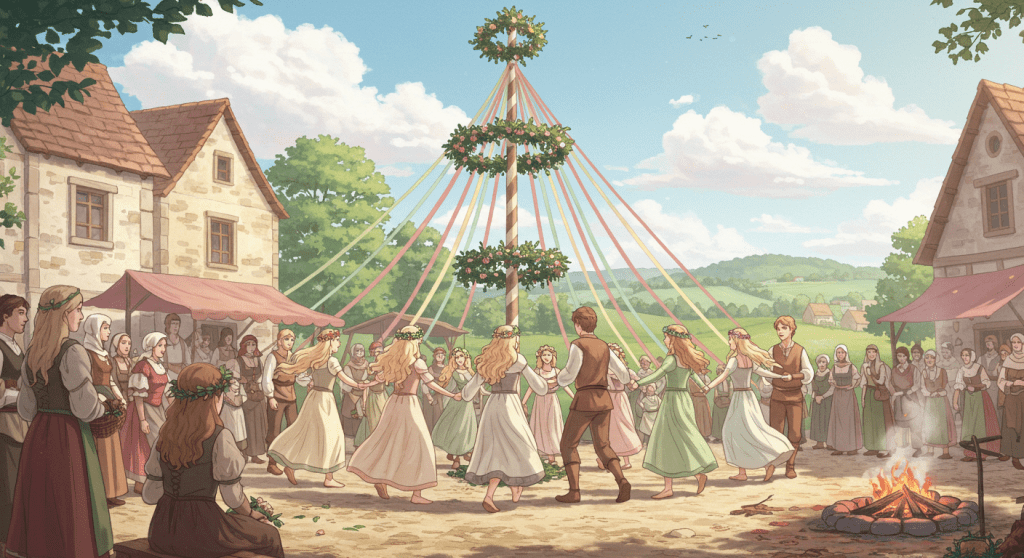
Perhaps the most iconic image of the holiday is the Greenleaf Pole. Greenleaf poles are generally between 9 and 18 feet tall and bedecked with flowers and greenery. Long, colorful ribbons, often silk or satin, anywhere from 10 to 25 feet long, flutter down from the top of the pole, catching the sunlight and creating a mesmerizing spectacle.
Closely associated with Greenleaf Poles is the intricate dance performed around them. While the dance has many variations, they generally follow a common formula. Two circles of dancers, typically boys and girls, each hold a ribbon. As lively folk music fills the air, they skip and weave, each dancer stepping into the opposite circle on alternating beats. The ribbons create a beautiful, braided pattern as they wind around the pole.
Historically, the Greenleaf Poles Dance was a significant part of the Old Fey Pagan rites surrounding Beltane. The dance, specifically how the ribbons wind together, supposedly symbolizes the union of the Lord and the Lady. Some scholars believe that the dance originates in various dancing traditions practiced by the Fey, especially pixie dances.
Beltane Queen
Many communities choose a Beltane Queen, a teenage girl honored to lead the Beltane Parade or Procession, often on foot or horseback. As the embodiment of the Lady’s youthful aspect, she carries the hopes for a bountiful harvest. She performs a speech or ritual, often an ancient ode to fertility and growth, to bless the festivities. She is traditionally adorned in a white gown, a floral crown woven with the first blossoms of the season, and an abundance of flowers, each bloom carefully chosen for its symbolic meaning.
The selection process for the Beltane Queen varies from community to community. Some communities do the selection by lottery. Others will hold elections by the young men of the community. In other places, the selection is done by the town elders, who select whoever meets some arbitrary criteria, most often the girl who best embodies the maiden aspect of The Lady. In Sliberberg, the Beltane Queen for this year, Sally McDouglas, the daughter of a family of halfling brewers, was picked by Queen Aoibheann herself.
It is also traditional in some communities for the Beltane Queen to have a court. Most commonly, this takes the form of a consort in the form of Jack in the Green, a representation of The Lord as a young man, played by the community’s teenage boys. Sometimes the Beltane Queen will have a group of, usually younger, girls who serve as ladies in waiting to the Beltane Queen.
Flower Crowns
Flower crowns are a common and beloved adornment during the Beltane celebrations. These crowns have been part of the celebration from its earliest days, when the symbolic flowers woven into the crown were believed to impart a minor blessing onto the wearer. Most depictions of the Lady in her Maiden aspect have her wearing a flower crown and various floral wreaths.
Traditionally, the flowers used to make flower crowns bloom in late spring, with hawthorn, bluebell, and primrose being the most common. The association of these three particular flowers with the holiday goes well beyond the simple making of flower crowns. Hawthorn, also known in our world as mayflower, was once believed to mark the entrance to the otherworld of the Feywild, and it was considered a bringer of ill luck to cut a Hawthorn bush at any time except the week of Beltane. Primroses are said to represent youth and new beginnings. Bluebells have long been associated with the feywild. Of course, other flowers are often used in crowns, but these three are the most traditional and common.
Parades and Processions
It is almost a universal truth that Beltane means a community will have a parade or procession through the town. Processions have been part of the holiday since the beginning, when the druids would march through towns in solemn procession, chanting ancient hymns. Nowadays, while the religious undertones may have faded, the spectacle has only grown. At the bare minimum, a Beltane parade takes the form of the Beltane Queen leading the community members to the fairground, a joyous procession filled with music and laughter. However, large communities will make the parade a much more elaborate affair, a dazzling display of community pride. Imagine flower-decked floats carrying local dignitaries, troupes of dancers in vibrant costumes, whole bands playing lively folk tunes, and whatever else the community can dream up. Sliberberg’s annual Beltane parade that kicks off the Beltane fair is by far the largest in the Feengrenze, a sight to behold with dozens of floats and hundreds of dancers, magicians, acrobats, and musicians, transforming the city streets into a river of color and sound.
Fairs
It is common for communities to host lively games and tournaments alongside the Greenleaf Poles Dance. These range from simple races and tests of strength to more elaborate contests of wrestling and archery. In larger communities, these evolve into full-fledged fairs, a riot of color and sound. Traders hawk their wares, a midway buzzes with carnival games, and the aroma of delicious food wafts from the tents. Horse or boat racing adds to the excitement at larger town fairs.
Several towns are well known for their Beltane fairs. Sliberberg’s Beltane fair covers the entire city. It features such events as The Sliberberg Regata, several horse races, a legendary baking competition hosted by the Silver Moon Coven, and ends with a fireworks show. In Loch Slanach Fionnuala the Fair, aka THE Fairy Godmother, holds open court in the middle of the fairgrounds, drawing thousands to Slanch Town in hopes of petitioning the most powerful archfey in the Feengrenze, turning the picturesque market city into a massive tent city for one week. In Qaldira, Beltane marks the start of the Golden Fete, a week-long fair where the city shows off its massive wealth.
Bonfires
As the sun sets, the focus shifts from the bustling fairs to the warmth and light of the bonfires. Bonfires are traditionally part of any Beltane festival. In this context, fire is associated with passion and the return of summer. Most Beltane celebrations will end with community bonfires. It is a somewhat common tradition to burn effigies of winter in a community bonfire, winter coats, skis, etc. In some larger communities, the bonfires will be accompanied by fireworks displays.
Romantic Rendezvous and Weddings
The ancient ties of Beltane to fertility remain strong, perhaps even stronger than in the days of Old Fey Paganism. It’s a time-honored, whispered tradition for young couples to seek secluded, picturesque spots to celebrate the season’s passions, whether bound by marriage or not. The tradition is believed to have started as a rite of passage in days of yore, when a maiden had reached their majority at Beltane, they would lose their virginity, thus becoming a women. Nowadays, it is not an official part of the celebration for young men and women to lose their virginity. But teenage paramours sneaking off into the woods for a roll in the hay with only the animals and the fey as witnesses is so common that it might as well be. Strangely, it is well-documented that wolves and other dangerous animals will not attack or fear bother young couples making love on Beltane Day.
Beyond the secret rendezvous in the woods, Beltane is one of the preferred times of the year for young couples to get married. It is believed that any couple who gets married and consecrates their union will be blessed with boundless fertility and a large family. Beltane Weddings are wild affairs and often held at the local Beltane fair.
The Social Season
Beltane heralds the start of the social season in kingdoms like Loch Slanach and New Mountainheart. The peerage emerges from their estates, eager to participate in the capital’s festivities. This influx of nobles contributes to the extravagance of Beltane celebrations in these cities, with lavish balls, elaborate feasts, and displays of wealth and status that last for weeks.
 The feengrenze historia
Leave a comment