


I have something interesting for you today. Ever since I put to the canon of the lore of the feyrealm that Faolon the Mad was defeated using the deck of many things, I knew had to find a way to integrate tarot into dnd. After some experimentation, I developed several different useful spreads for the tarot to create adventures, npcs, and encounters.
Before we dive into it, a disclaimer. I know that Wizards of the Coast released the Book of Many Things in November of last year and included in the box set there is an expanded deck of many things with instructions on how to create dungeons using what it calls the dungeon spread. I have yet to read the book or any other content of the box set that was published alongside it. From what I have been able to piece together, you could use the cards of the expanded deck of many things with any of the systems I will describe. However, I think tarot has some advantages all its own. First, the standard deck is 78 cards to the expanded deck of many more things’ 66 cards, more cards mean more options, second the box set for the Book of Many Things that contains the deck of many more things and the reference book needed for the dungeon spread costs 90 dollars whereas my rider tarot deck costs less than 20. Finally, tarot is iconic, the deck of many things riffs off rider tarot deck for a reason after all.
Tarot in the mortal and fey realms
Since the High Queen Niamh’s fateful decision to scatter the original Deck of Many Things to the winds, tales of its legendary power have captivated the imaginations of beings across the realms. As the cards were dispersed, so too were the seeds of fascination and speculation sown among the inhabitants of the world. Many sought to recreate the deck, hoping to harness its mystical properties, yet their efforts proved futile.
In the absence of the original deck, a new tradition emerged – one steeped in mystery and intrigue. It was whispered among scholars and seers that decks fashioned in the likeness of the Deck of Many Things held the potential to divine the future. Thus, Tarot was born.
Among the fey, particularly the low fey such as goblins and pucas, Tarot became a favored pastime. To most, these intricately adorned cards served merely as tools for games of chance and amusement. However, in the deft hands of fey fortune-tellers, the Tarot took on a life of its own. With a mere shuffle and draw, these skilled practitioners unlocked the hidden potential within the cards, peering into the threads of fate itself.
To the untrained eye, Tarot remained little more than an elaborate game, but to those attuned to the arcane currents of the world, its true power was undeniable. And for those rare few who possessed a card from the original Deck of Many Things, the Tarot held an even greater significance. With each draw, they wielded a limited yet potent ability to shape the course of destiny itself, forever altering the tapestry of fate with each twist of the cards.
Adventure Spread:
The Adventure Spread offers a versatile tool for Dungeon Masters to unravel the mysteries of their campaigns, guided by the ancient wisdom of the tarot. Unlike the Dungeon Spread, which focuses solely on dungeon creation, the Adventure Spread is a flexible system designed to craft a wide range of adventures, from epic quests to thrilling escapades in any setting imaginable.
The Adventure Spread consists of seven key components, each represented by a draw from a standard tarot deck. These components form the foundation of the adventure, guiding the Dungeon Master in shaping the narrative, encounters, and rewards for their players.
Components of the Spread:
- Inciting Incident: The first card drawn sets the stage for the adventure, presenting a catalyst that propels the party into action.
- NPC(s): Draw one or more cards to introduce key non-player characters who will shape the narrative and interact with the party.
- Location: A single card designates the primary setting or pivotal location where the adventure unfolds, imbuing it with its own mystical significance.
- Encounters: Multiple cards represent the challenges, obstacles, and encounters the party will face on their journey.
- Final Encounter or Boss: The climactic showdown or ultimate challenge awaits, revealed by a single card drawn from the deck.
- Reward: The final card determines the rewards, treasures, or consequences that await the adventurers at journey’s end.
For example take this example spread I drew when creating this article
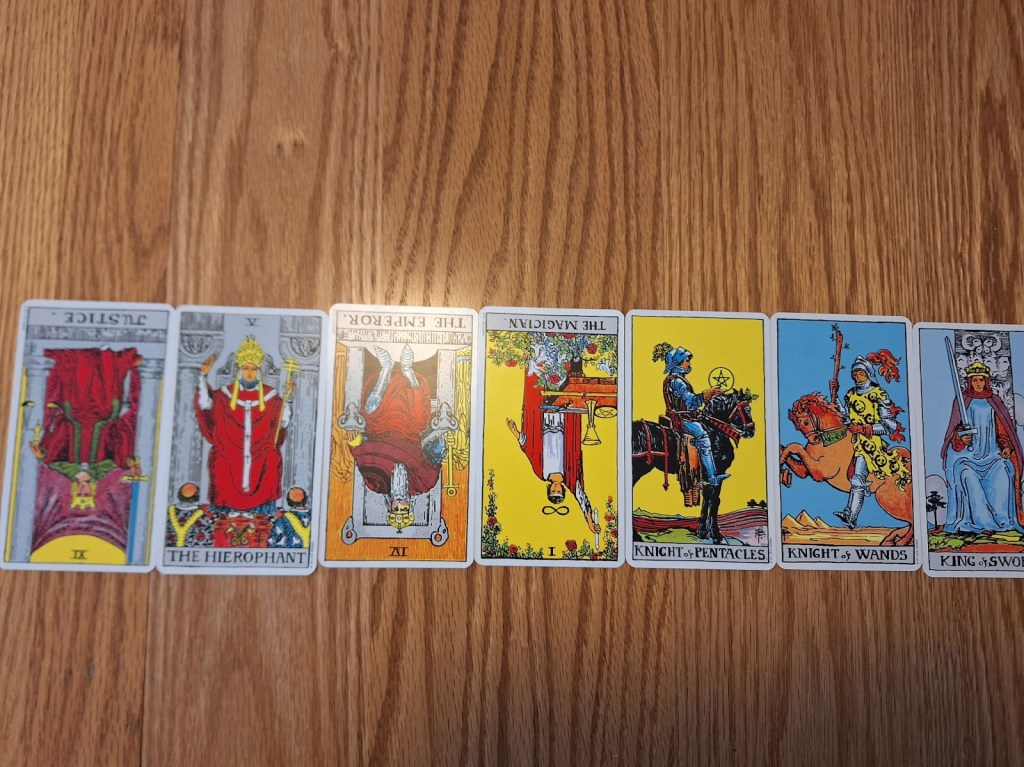
- Inciting Incident (Justice Reverse):
- This suggests an imbalance, unfairness, or injustice has occurred.
- NPC (Hierophant):
- The Hierophant represents tradition, authority, and wisdom.
- Location (Emperor):
- The Emperor symbolizes authority, power, and structure.
- Encounter 1 (Magician Reversed):
- The reversed Magician suggests manipulation, trickery, or misuse of power.
- Encounter 2 (Knight of Pentacles):
- The Knight of Pentacles represents diligence, hard work, and stability.
- Boss (Knight of Wands):
- The Knight of Wands is impulsive, reckless, and prone to sudden action.
- Reward (King of Swords):
- The King of Swords embodies intellect, logic, and clarity of thought.
I created the following adventure
Title: “Innocence Lost”
Synopsis:
The party finds themselves wrongfully accused of a crime and thrown into the depths of a fortress prison ruled by a corrupt sheriff. With the help of a wise sage imprisoned for speaking out against the sheriff’s tyranny, they must prove their innocence, escape the prison, and confront the deputy in a climactic showdown.
Adventure Outline:
1. Inciting Incident:
- The party is falsely accused of a crime they didn’t commit by the corrupt sheriff and thrown into the fortress prison.
2. Encounter 1: Retrieving Evidence
- Objective: Sneak into the sheriff’s office to retrieve evidence of his misdeeds and reclaim confiscated weapons.
- Challenges: Stealth checks to avoid detection by guards, investigation checks to find the evidence, and a potential combat encounter if detected.
3. Encounter 2: Digging the Escape Route
- Objective: Work together to dig an escape route through the fortress’s underground passages while fending off attacks from guards.
- Challenges: Skill checks (Athletics, Dexterity) to dig quickly and quietly, combat encounters with waves of guards, and environmental hazards (collapsing tunnels, traps).
4. Encounter 3: Confronting the Deputy
- Objective: Face off against the sheriff’s blindly devoted deputy in a climactic showdown.
- Challenges: Combat encounter with the deputy and his minions, who fight fiercely to protect the sheriff’s interests.
5. Reward:
- Clearing Their Names: Present the evidence of the sheriff’s corruption to the King, clearing the party’s names and restoring their honor.
- Celebration: The party is hailed as heroes, their deeds celebrated throughout the realm, and they receive rewards and recognition for their bravery.
Additional Details:
- Setting: The adventure takes place in a grim fortress prison filled with dark corridors, guarded cells, and hidden passages.
- NPC Allies: The wise sage serves as the party’s guide and mentor, providing assistance and advice throughout the adventure. He has been imprisoned for quite a long time and has tried to escape many times. He knows the ins and outs of the prison like nobody else.
- Villains: The corrupt sheriff and his blindly devoted deputy serve as the primary antagonists, representing the oppressive forces of tyranny and injustice.
- Roleplaying Opportunities: Encourage roleplaying interactions with NPCs, allowing the party to gather information, form alliances, and uncover secrets within the prison.
- Pacing: Keep the pace of the adventure brisk, with each encounter building upon the last towards the climactic showdown with the deputy.
The villain spread
The Villain Spread is a variant of the Adventure Spread tailored specifically to create adventures focused on the conflict between the players and a compelling villain. By drawing upon the symbolism and storytelling traditions of the tarot, Dungeon Masters can weave intricate narratives that challenge their players and immerse them in a world of villainy and heroism.
- Villain: The first card drawn represents the central antagonist of the adventure, embodying their personality, motives, and/or overarching goals. From cunning masterminds to malevolent sorcerers, each villain sets the stage for an epic clash of wills between darkness and light.
- Motivation (Placed Across Villain): Positioned across from the Villain card, the Motivation card reveals the driving force behind the antagonist’s actions. Whether driven by greed, revenge, or a thirst for power, this card illuminates the depths of the villain’s ambitions and the lengths to which they will go to achieve them.
- Location of First (Indirect) Contact: This card unveils the setting where the players first encounter the subtle machinations of the villain. From shadowy back alleys to opulent ballrooms, this location sets the stage for intrigue, deception, and the unfolding of the villain’s grand design.
- Nature of Contact: Determine the manner in which the players first become aware of the villain’s influence indirectly. Whether through a cryptic message, a sinister plot unfolding before their eyes, or the discovery of a dark secret, this card sets the tone for the players’ initial confrontation with evil.
- Villain’s Lair: This card signifies the location of the villain’s stronghold or base of operations, a place steeped in darkness and teeming with danger. From forbidding castles to hidden sanctuaries, this lair serves as the heart of the villain’s power and the ultimate destination for the players’ quest for justice.
- Encounters (2-7 Cards): Draw multiple cards to represent the challenges, obstacles, and confrontations the players face as they pursue the villain. From encounters with the villain’s minions to puzzles, traps, and moral dilemmas, each card unveils a new chapter in the unfolding saga of heroism and betrayal.
- Final Encounter or Showdown: This card represents the climactic confrontation between the players and the villain, the ultimate test of strength, wit, and resolve. Whether facing off against a cunning strategist or a malevolent sorcerer, this showdown will determine the fate of the world and the heroes’ place in history.
- Reward: The final card drawn signifies the rewards, consequences, or revelations that await the players upon defeating the villain. From treasures and artifacts to newfound knowledge and the resolution of key plot threads, this card marks the culmination of the heroes’ journey and the dawn of a new era.
Consider for example this spread

- Villain – Queen of Wands: The Queen of Wands represents a charismatic and influential figure, likely a powerful sorceress or charismatic leader. This villain possesses a fiery determination and magnetic personality, using their charm and ambition to pursue their goals with unwavering confidence.
- Motivation (Placed Across Villain) – The Tower Reversed: Across from the Queen of Wands, the Tower Reversed suggests that the villain’s motivations stem from a fear of change or a desire to maintain control at any cost. They may be clinging to outdated beliefs or structures, resisting the inevitable upheaval that threatens their position of power.
- Location of First (Indirect) Contact – The Moon Reversed: The Moon Reversed indicates that the players first encounter the villain’s influence in a place shrouded in deception and illusion. Perhaps it’s a shadowy forest where the boundaries between reality and nightmare blur, or a dimly lit tavern where secrets are whispered in hushed tones.
- Nature of Contact – Page of Swords Reversed: The Page of Swords Reversed suggests that the players’ initial contact with the villain is marked by misinformation, confusion, or betrayal. They may receive a cryptic message that leads them astray, encounter a false ally posing as a friend, or stumble upon a trap set by the villain to test their resolve.
- Villain’s Lair – King of Cups Reversed: The King of Cups Reversed signifies that the villain’s lair is a place of emotional turmoil and instability. It could be a decrepit castle haunted by past traumas, a hidden sanctuary ruled by dark emotions, or a corrupted temple where power is wielded without mercy.
- Encounters (2-7 Cards):
- Judgement: This card represents a pivotal moment of reckoning, where the players must confront the consequences of their actions and make difficult choices that will shape the course of their journey.
- Knight of Swords: The Knight of Swords embodies swift and decisive action, signaling a confrontation with the villain’s most loyal enforcer or a daring raid on their stronghold.
- Strength: Strength reflects the inner fortitude and resilience needed to overcome the challenges ahead. Whether facing physical threats or psychological manipulation, the players must rely on their courage and determination to emerge victorious.
- Final Encounter or Showdown – Ace of Cups: The Ace of Cups heralds a moment of emotional renewal and spiritual awakening, suggesting that the final showdown with the villain will be a test of the players’ compassion, empathy, and ability to forge meaningful connections with others.
- Reward – Two of Pentacles Reversed: The Two of Pentacles Reversed indicates that the players’ reward may come at a cost or require them to make sacrifices in order to achieve it. Despite the challenges they face, they will emerge stronger and wiser, ready to embrace the next chapter of their journey with renewed purpose and determination.
From these 8 plot points I created the following adventure.
Adventure: “The Sorcerer Queen’s Stasis”
Introduction:
In the kingdom of Eldoria, ruled by the charismatic Sorcerer Queen Valeria, time stands still under the weight of her powerful magic. The once vibrant land now lies frozen in an eternal state of stagnation, its people trapped in a perpetual cycle of sameness and routine. But beneath the surface, whispers of rebellion stir, as a small band of rebels seeks to defy the queen’s iron grip on the kingdom and restore freedom to its people.
Act 1: The Contract
Inciting Incident: The players, skilled adventurers seeking employment, are approached by a royal emissary with an offer from Queen Valeria herself. She tasks them with quelling the rebellion threatening her rule, promising rich rewards and royal favor in return for their service.
First Contact: In the bustling streets of Eldoria’s capital, the players encounter signs of dissent and rebellion, from graffiti denouncing the queen’s tyranny to hushed conversations among the populace.
Nature of Contact: The players are approached by a mysterious informant, offering information about the rebels and their hideout in exchange for a favor to be named later.
Act 2: Uncovering the Truth
Revealing the Motivation: The players learn of the rebels’ true leader, Prince Alaric, cursed by the queen’s magic to remain eternally youthful and powerless to overthrow her.
Exploring the Kingdom: The players journey across Eldoria, gathering allies and information to aid them in their quest to confront the queen and break her hold over the kingdom.
Discovering the Artifact: Through their investigations, the players uncover the existence of an ancient artifact, hidden deep within the queen’s palace, that grants her control over time and stasis.
Act 3: Confronting the Queen
Lair of the Sorcerer Queen: The players infiltrate the queen’s palace, navigating its labyrinthine halls and arcane defenses to reach the chamber where the artifact lies hidden.
Overcoming the Knights: The players face off against the queen’s elite knights, skilled warriors sworn to protect her at all costs. They must use all their cunning and strength to defeat these formidable adversaries and reach the queen herself.
Final Showdown: In a climactic battle, the players confront Queen Valeria in her throne room, where she wields the artifact to bend time to her will. With courage and determination, they must overcome her powerful magic and destroy the artifact, breaking the spell of stasis and freeing the kingdom from her grasp.
Conclusion:
As the artifact shatters and time begins to flow once more, the people of Eldoria awaken from their slumber, blinking in the light of a new dawn. With the queen’s tyranny at an end, the kingdom is free to chart its own destiny once more, and the players are hailed as heroes, their names celebrated throughout the land. And though their adventure may be over, their legacy lives on, a beacon of hope in a world once lost to darkness
The NPC SpreadI
In the vast worlds of Dungeons & Dragons, NPCs (Non-Player Characters) serve as the lifeblood of storytelling, enriching the tapestry of adventures with their diverse personalities, motivations, and secrets. To aid Dungeon Masters in creating memorable and multi-dimensional NPCs, we introduce the NPC Spread. This specialized tarot spread provides a structured framework for generating NPCs, drawing upon the rich symbolism and narrative depth of tarot cards to breathe life into characters that captivate players’ imaginations and drive the story forward.
The NPC Spread consists of seven key elements, each represented by a tarot card drawn from a standard deck. These elements unveil different facets of the NPC’s character, including their identity, personality traits, motivations, conflicts, relationships, secrets, and role in the story.
- Identity Card (Appearance, Demeanor, Background): This card reveals the NPC’s basic identity, encompassing details about their appearance, demeanor, and background. From a mysterious wanderer with a shadowy past to a jovial innkeeper with a heart of gold, the Identity Card sets the stage for the NPC’s introduction to the players.
- Personality Trait: The Personality Trait card unveils one dominant personality trait or characteristic that defines the NPC’s behavior and interactions with others. Whether it be courage, cunning, kindness, or ambition, this trait shapes the NPC’s demeanor and guides their actions throughout the adventure.
- Motivation: The Motivation card indicates the driving force behind the NPC’s actions and decisions. From lofty aspirations to deeply-rooted fears, this card sheds light on what motivates the NPC to pursue their goals, providing insight into their desires, ambitions, and innermost thoughts.
- Conflict: The Conflict card highlights a personal struggle or conflict that the NPC faces, adding depth and complexity to their character. This conflict could be internal, such as grappling with moral dilemmas or past traumas, or external, such as facing off against adversaries or overcoming obstacles in their path.
- Relationships: The Relationships card describes the NPC’s connections with other characters in the story, including allies, enemies, and loved ones. Whether it be a loyal companion, a bitter rival, or a distant relative, these relationships shape the NPC’s interactions and influence their decisions.
- Secrets: The Secrets card uncovers a hidden secret or piece of information that the NPC keeps concealed from others. This secret may impact the plot or reveal hidden depths to the NPC’s character, adding intrigue and suspense to their interactions with the players.
- Role in the Story: The Role in the Story card determines the NPC’s significance to the overall narrative. Whether they serve as a quest-giver, a mentor, a villain, or a potential ally, this card illuminates the NPC’s role in shaping the players’ journey and advancing the plot of the adventure.
Consider for example the following spread
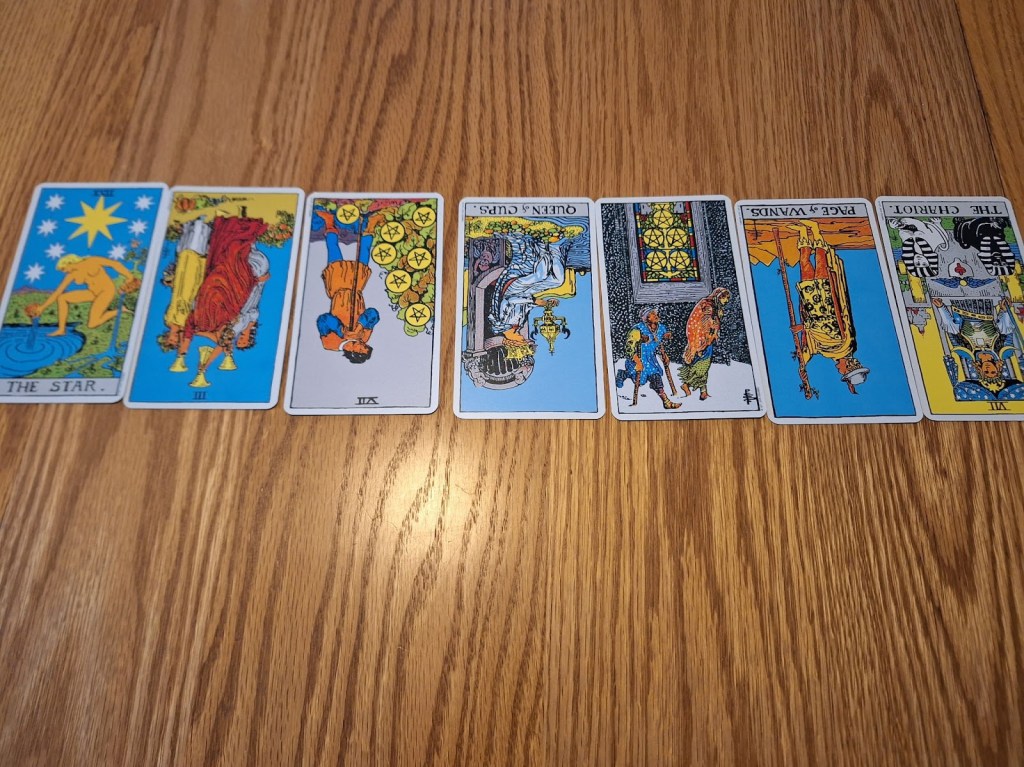
- Identity Card (The Star): The Star represents hope, inspiration, and guidance. This NPC is likely to be a beacon of optimism and idealism, possessing a bright and hopeful outlook on life. They may have a dreamer’s spirit, always striving for something greater and inspiring others to follow their lead.
- Personality Trait (Three of Cups Reversed): The Three of Cups reversed suggests a lack of celebration and harmony. This NPC may struggle with feelings of isolation or disconnection from others. They could be withdrawn or reserved, finding it difficult to connect with those around them or form deep, meaningful relationships.
- Motivation (Seven of Pentacles Reversed): The Seven of Pentacles reversed indicates frustration and impatience with progress. This NPC may be driven by a desire for quick results or instant gratification, leading them to take risks or make impulsive decisions in pursuit of their goals. They may also feel disillusioned or dissatisfied with their current circumstances, seeking change or a new direction in life.
- Conflict (Queen of Cups Reversed): The Queen of Cups reversed suggests emotional instability and inner turmoil. This NPC may grapple with deep-seated insecurities or unresolved emotional issues, leading to mood swings or unpredictable behavior. They may struggle to trust others or express their true feelings, creating tension and conflict in their relationships.
- Relationships (Five of Pentacles): The Five of Pentacles represents hardship and adversity, particularly in the realm of relationships. This NPC may have experienced loss or betrayal in their past, leading them to be guarded or closed off in their interactions with others. They may feel like an outsider or struggle to find their place within their social circle or community.
- Secrets (Page of Wands Reversed): The Page of Wands reversed suggests a lack of direction or purpose. This NPC may be hiding their true ambitions or desires, feeling uncertain or insecure about their future. They may also be holding onto a secret that could impact their relationships or influence their decisions.
- Role in the Story (The Chariot Reversed): The Chariot reversed represents a lack of control or direction. This NPC may find themselves at a crossroads in their life, unsure of which path to take or how to move forward. They may play a pivotal role in the story as a source of conflict or instability, challenging the players to confront their own limitations or uncertainties.
From these 7 character traits I created the following character
NPC: Princess Elara
Background: Princess Elara is the youngest daughter of King Edmund and Queen Isolde, rulers of the prosperous kingdom of Evercrest. From a young age, Elara was confined to the confines of the royal palace, her every move dictated by her overbearing mother, Queen Isolde.
Personality: On the surface, Elara presents herself as a dutiful and obedient princess, adhering to her mother’s strict expectations with a forced smile and polite demeanor. However, beneath her façade lies a deep well of pain and longing, as she yearns for freedom and autonomy beyond the gilded walls of her tower prison.
Motivation: Elara’s primary motivation is to break free from the oppressive constraints of her mother’s expectations and experience the world beyond the palace walls. She dreams of embarking on adventures, meeting new people, and discovering her own identity outside of her royal title.
Conflict: Elara struggles with the constant pressure to live up to her mother’s lofty standards, facing verbal and physical abuse whenever she falls short of expectations. This internal conflict fuels her desire to escape, but she lacks the courage and means to do so on her own.
Relationships: Elara’s relationship with her mother, Queen Isolde, is strained and fraught with tension. While Elara longs for her mother’s approval and affection, she also fears her wrath and resents the suffocating control she exerts over her life.
Secrets: Elara harbors a secret longing to escape from the palace and explore the world beyond. She has clandestinely collected maps, books, and trinkets from distant lands, hidden away in her chambers as a source of comfort and inspiration.
Role in the Story: Elara’s fate becomes intertwined with the players’ quest when they stumble upon her tower prison during their adventures. As they uncover the truth of her plight, they are faced with a moral dilemma: to aid Elara in her escape and risk the wrath of Queen Isolde, or to leave her to suffer in silence. The players’ actions will determine Elara’s destiny and have far-reaching consequences for the kingdom of Evercrest.
Encounter Creation Spread:
Within the vibrant tapestry of Dungeons & Dragons adventures, encounters serve as pivotal moments of conflict, challenge, and opportunity. Whether facing off against ferocious monsters, navigating treacherous traps, or engaging in tense negotiations with cunning adversaries, encounters propel the narrative forward and test the mettle of the players. Encounter Spread a concise yet powerful tarot spread designed to generate dynamic and immersive encounters for tabletop role-playing games. Drawing upon the symbolism and storytelling potential of tarot cards, this spread offers Dungeon Masters a structured framework for crafting compelling encounters that captivate players and drive the story to new heights.
Understanding the Encounter Spread:
The Encounter Spread is a concise three-card layout that guides Dungeon Masters in the creation of engaging and dynamic encounters. Each card represents a distinct aspect of the encounter, from the initial situation to the resolution of conflict and its ultimate outcome.
- Situation: The Situation card sets the stage for the encounter, presenting the players with a scenario or challenge that demands their attention and action. This card establishes the context and atmosphere of the encounter, whether it be a perilous dungeon delve, a diplomatic negotiation, or a sudden ambush by enemies.
- Conflict: The Conflict card reveals the primary source of conflict or challenge within the encounter. It could be a combat encounter against monstrous foes, a moral dilemma that tests the players’ principles, or a puzzle that demands clever solutions and quick thinking.
- Outcome: The Outcome card determines the resolution of the encounter and its impact on the players and the ongoing narrative. Whether it be victory or defeat, success or failure, this card shapes the consequences of the players’ actions and sets the stage for future adventures.
For example, consider this spread

- Challenge (Empress Reversed): The Empress reversed represents stagnation, neglect, or a lack of nurturing energy.
- Opposition (Two of Swords): The Two of Swords symbolizes indecision, stalemate, or a need to make difficult choices.
- Outcome (High Priestess Reversed): The High Priestess reversed suggests hidden truths, secrets, or deception.
Use the spread, I cooked up this encounter.
Encounter: Negotiating Peace in the Forest
Introduction:
As the players venture deeper into the heart of the forest, they come upon a clearing where two groups of druids stand locked in heated debate. One faction argues for drastic intervention to halt the forest’s decay, while the other advocates for a hands-off approach, believing that nature will heal itself if left undisturbed. Sensing the urgency of the situation, a graceful dryad steps forward from the shadows, her eyes pleading for assistance as she implores the players to intervene and broker a truce between the warring factions.
Scene Setting:
- Location: The clearing is bathed in dappled sunlight, the air thick with the scent of moss and pine. Ancient trees loom overhead, their gnarled branches whispering secrets of ages past. The two factions of druids stand on opposite sides of the clearing, their faces set in determined expressions as they argue their respective positions.
- Druid Factions: The first faction, known as the Guardians of the Grove, believes that the forest’s decay can only be halted through direct intervention, such as magical rituals or the planting of enchanted saplings. The second faction, known as the Keepers of Balance, advocates for a more passive approach, trusting in nature’s resilience to heal itself over time without interference.
- The Dryad’s Plea: The dryad, named Lyra, stands at the center of the clearing, her ethereal beauty contrasting sharply with the tension in the air. She beseeches the players to help unite the two factions and find a solution that will save the forest without upsetting its delicate balance.
Roleplaying Opportunities:
- Negotiation and Diplomacy: The players must use their diplomatic skills to navigate the delicate negotiations between the two factions, listening to their arguments and finding common ground to bridge the divide.
- Conflict Resolution: As tensions escalate, the players may need to defuse confrontations and mediate disputes between the druids, using persuasion and empathy to ease hostilities and build trust.
- Compromise and Collaboration: Ultimately, the players must convince the two factions to set aside their differences and work together to find a solution that honors both the forest’s need for intervention and its inherent balance and harmony.
Using the Tarot 5 Card Rectangle Spread as a means to create player backgrounds
In the realm of Dungeons & Dragons, character backstories serve as the foundation upon which epic adventures are built. They shape the motivations, goals, and personalities of the players’ characters, guiding their actions and decisions throughout the campaign.. By drawing upon the rich symbolism and narrative potential of tarot, players can uncover hidden truths, explore untold mysteries, and weave intricate tales of heroism and destiny that can be used as backstories.
To create character backstories using tarot, players can utilize the 5 Card Rectangle Spread. This spread, which is one of the many used in actual tarot readings, consists of five cards laid out in a rectangle, representing the present situation, influences, challenges, final outcome, and overarching theme of the character’s backstory.
- Present Situation: The first card drawn represents the character’s current circumstances and the events that have led them to this point in their journey. It provides insight into the character’s starting point and sets the stage for their future adventures.
- Influences: The second card reveals the external influences that have shaped the character’s life and decisions. It may represent mentors, family members, or significant events that have left a lasting impact on the character’s development.
- Challenges: The third card highlights the obstacles and challenges that the character has faced or will face on their journey. It may represent personal struggles, conflicts with adversaries, or moral dilemmas that test the character’s resolve and resilience.
- Final Outcome: The fourth card predicts the ultimate outcome or resolution of the character’s backstory. It offers a glimpse into the character’s destiny and the culmination of their journey, whether it be triumph, tragedy, or a combination of both.
- Theme: The fifth and final card represents the overarching theme or message of the character’s backstory. It may reveal the character’s central purpose, the lessons they must learn, or the larger forces at play in their destiny.
For example consider this spread.

- Present Situation – Three of Wands: The Three of Wands indicates that the character finds themselves at a point of anticipation and exploration. They are poised on the brink of a new journey or endeavor, filled with ambition and the desire for expansion. This suggests that the character is seeking opportunities beyond their current circumstances, eager to embark on a voyage of discovery and growth.
- Influences – Knight of Cups: The Knight of Cups represents a figure of romance, creativity, and emotional depth. This card suggests that the character has been influenced by a person or experience that embodies these qualities. Perhaps they have been inspired by a romantic partner, a mentor, or a work of art that has awakened their imagination and stirred their passions.
- Challenges – The World: The World card symbolizes completion, fulfillment, and the attainment of goals. However, when drawn as a challenge, it suggests that the character may struggle with feelings of stagnation or being trapped in a cycle of achievement without satisfaction. They may find themselves grappling with a sense of restlessness or a longing for new experiences and opportunities, despite their outward success.
- Final Outcome – The Magician: The Magician represents mastery, creativity, and the power of manifestation. As the final outcome, this card suggests that the character will ultimately harness their inner resources and talents to overcome their challenges and achieve their goals. They will tap into their innate abilities and intuition, wielding their personal power to manifest their desires and shape their own destiny.
- Theme – Temperance Reversed: Temperance reversed suggests imbalance, excess, and a lack of harmony. As the overarching theme of the character’s backstory, this card indicates that the character may struggle with moderation and self-control. They may be prone to extremes in their emotions or behaviors, leading to conflict and upheaval in their lives. This theme underscores the character’s journey towards finding balance and equilibrium within themselves, navigating the highs and lows of their experiences with grace and wisdom.
And the actual backstory
In the bustling port city of Lysandra, there lived a young sailor named Elara. Born into a family of seafarers, Elara’s childhood was steeped in tales of distant lands and daring adventures. From a young age, she felt drawn to the call of the sea, yearning to explore the vast unknown beyond the horizon.
Present Situation (Three of Wands): At the age of eighteen, Elara finds herself standing on the deck of her family’s ship, the Sea Serpent, gazing out at the open sea with a sense of anticipation and excitement. She longs to embark on her first solo voyage, to chart her own course and discover new lands beyond the familiar shores of Lysandra.
Influences (Knight of Cups): Elara’s journey is influenced by the memory of her late father, a charismatic and adventurous captain who instilled in her a love for the sea and a thirst for adventure. His tales of exotic ports and legendary treasures fuel her imagination and inspire her to follow in his footsteps.
Challenges (The World): Despite her dreams of exploration, Elara finds herself grappling with a sense of restlessness and dissatisfaction. She yearns for something more than the repetitive routine of life at sea, longing for a sense of purpose and fulfillment that has thus far eluded her grasp.
Final Outcome (The Magician): Determined to carve out her own destiny, Elara sets sail on a daring quest to uncover the lost treasures of the ancient seafarers who once roamed the waters of the Forgotten Isles. Armed with her wits, her courage, and the knowledge passed down from her father, she harnesses the power of her inner resources and talents to navigate the treacherous waters and overcome the obstacles that stand in her way.
Theme (Temperance Reversed): Along her journey, Elara must confront her own inner demons and struggles with moderation and self-control. Tempted by the allure of riches and glory, she must learn to balance her ambitions with humility and patience, lest she succumb to the pitfalls of greed and recklessness that threaten to derail her quest.
Enhancing Gameplay with Tarot readings
In the world of Dungeons & Dragons, the art of fortune-telling holds a mystique that can add depth and intrigue to gameplay. Tarot cards, with their rich symbolism and storytelling potential, offer players and Dungeon Masters alike a unique tool for shaping the narrative and influencing the course of their adventures. In this chapter, we explore ways to integrate tarot readings into the game and session, allowing players to uncover hidden truths, foreshadow future events, and shape the destiny of their characters.
Integrating Tarot Readings Before the Session
Players may choose to conduct a tarot reading before the start of the gaming session, either individually or as a group. The Dungeon Master can then use the insights gleaned from the reading to add encounters, change events, or introduce rewards into the adventure.
For example, if a player draws cards indicating a journey (such as the Six of Swords) and a sudden change or upheaval (such as the Tower), the Dungeon Master might incorporate a surprise voyage to a distant land, where the players must navigate treacherous waters and confront unexpected challenges along the way. Alternatively, if the reading suggests an abundance of wealth and prosperity (such as the Ten of Pentacles), the Dungeon Master could introduce a lucrative treasure hoard hidden deep within a forgotten dungeon, rewarding the players with valuable loot and artifacts.
Integrating Tarot Readings In-Game
Players’ characters could encounter fortune-tellers or wise mystics during their adventures, who offer to perform tarot readings to provide insights into their destinies. Alternatively, characters proficient in the art of divination may choose to conduct their own tarot readings as a means of seeking guidance or foresight.
The Dungeon Master can use these in-game tarot readings to foreshadow encounters or events, hint at hidden secrets or plot twists, or provide clues to solve ongoing mysteries. For example, if a character draws the Death card, the Dungeon Master might hint at the looming presence of a powerful undead adversary that the players will soon face. If a character draws the Ace of Cups, it could signify an upcoming encounter with a benevolent NPC who offers aid and support to the party.
Bonus npc
I have a small gift for you for your own game. This time around it is an example fortune teller npc for you to use in your games. Faela is a fairy fortune teller who with some slight retooling could be a sprite or pixie in other settings.
Meet Faela, the Mischievous Fey Fortune-Teller:
Name: Faela
Appearance: Faela is a 2.5-foot-tall fairy with delicate wings shimmering with iridescent hues of blue and green. Despite her diminutive size, she possesses an air of mystique and elegance, enhanced by her flowing attire reminiscent of a traditional gypsy fortune-teller. Her long, flowing robes are adorned with colorful scarves, beads, and trinkets, and she wears an array of bangles and bracelets that chime softly with her every movement.
Personality: Faela exudes a bubbly and cheerful demeanor, with an anime-girl-like personality that endears her to those around her. She is enthusiastic and optimistic, always eager to share her insights and offer guidance to those seeking her counsel. However, beneath her youthful exterior lies a deeper wisdom and intuition, honed by years of experience and a keen understanding of the mystical forces at play in the Märchenweltgrenze.
Despite her efforts to maintain a facade of maturity and gravitas when dealing with customers, Faela’s youthful exuberance often shines through, much to her chagrin. She strives to uphold the archetypal image of a mysterious and enigmatic fortune-teller, but her natural warmth and enthusiasm are difficult to conceal.
Abode: Faela’s traveling fortune-telling booth is a whimsical sight to behold, adorned with colorful tapestries, mystical symbols, and twinkling fairy lights. Her magical self-setting-up tent unfolds with a flourish wherever she goes, providing a cozy and enchanting space for her clients to seek her counsel.
Faela Whisperwing Small fey, neutral good
Armor Class 14 (natural armor)
Hit Points 45 (10d6 + 10)
Speed 30 ft., fly 30 ft.
STR 8 (-1)
DEX 16 (+3)
CON 12 (+1)
INT 14 (+2)
WIS 16 (+3)
CHA 18 (+4)
Skills Insight +6, Persuasion +7
Senses Darkvision 60 ft., passive Perception 13
Languages Common, Sylvan
Challenge 3 (700 XP)
Fey Ancestry. Faela has advantage on saving throws against being charmed, and magic can’t put her to sleep.
Innate Spellcasting. Faela’s innate spellcasting ability is Charisma (spell save DC 15). She can cast the following spells, requiring no material components:
- At will: Druidcraft, Prestidigitation
- 1/day each: Charm Person, Lesser Restoration
Tarot Magic. Once per long rest, Faela can shuffle a single card from the Deck of Many Things into her tarot deck during a tarot reading. This allows her to alter the future for one individual whose fate is revealed during the reading.
Actions
Tarot Reading. Faela can perform a tarot reading for a willing creature. This takes 10 minutes to complete and provides insights into the individual’s present situation, influences, challenges, final outcome, and overarching theme.
Fortune’s Blessing (Recharge 5-6). Faela can bless a creature she performs a tarot reading for, granting them advantage on their next saving throw or ability check.
 The feengrenze historia
Leave a comment